
Understanding the Meaning of Apaideutos in Greek
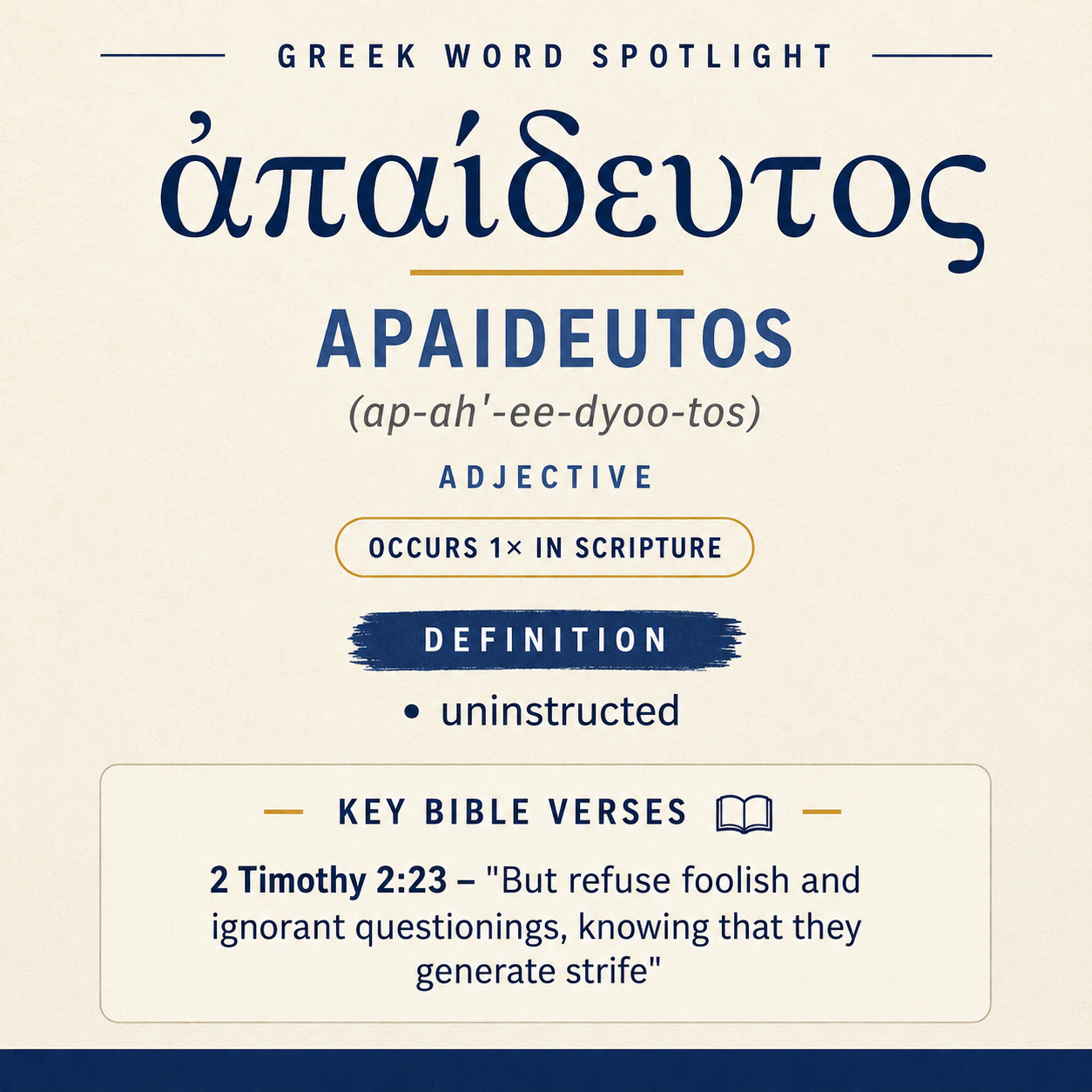
ἀπαίδευτος means “uninstructed” and appears once in Scripture, in 2 Timothy 2:23.
Biblical Occurrence
This adjective occurs 1 time in Scripture. It is found in 2 Timothy 2:23.
Learn More →Verse Context
In 2 Timothy 2:23, it describes “foolish and ignorant questionings” that generate strife.
Learn More →ἀπαίδευτος means “uninstructed” and appears in the instruction to refuse a certain kind of disputing talk in 2 Timothy 2:23. In that setting it characterizes questionings whose lack of instruction shows itself in the conflict they produce.
Root and Related Words
ἀπαίδευτος derives from paideuo (παιδεύω), “to instruct” (Strong’s G3811). The prefix a (α), “Alpha” (Strong’s G1), stands at the front of the word-form as the element Strong’s connects to its derivation.

Occurrences
“But refuse foolish and ignorant questionings, knowing that they generate strife.” (2 Timothy 2:23)
In this command, ἀπαίδευτος modifies “questionings,” placing them in the category of talk that lacks instruction. The verse frames two marks of such questionings: they are grouped with what is “foolish,” and they have a predictable social outcome—“they generate strife.” By labeling the questionings as uninstructed, the word signals more than the mere presence of questions; it points to questions handled in a way that has not been shaped by instruction, so that they tend toward contentiousness rather than understanding. The command “refuse” treats this kind of speech as something to be declined, not entertained, and the rationale (“knowing that…”) ties the refusal to the destructive momentum of strife that these questionings set in motion.
Sense and Usage
The single New Testament use of ἀπαίδευτος locates “uninstructed” within a practical judgment about discourse. The adjective does not describe an abstract state in isolation; it functions as a discerning label applied to a particular kind of “questionings.” In 2 Timothy 2:23, the word helps distinguish between inquiry that is informed by instruction and inquiry that is not. The surrounding phrasing treats the “uninstructed” quality as something observable in effect: the hearer is expected to “know” what these questionings generate, and that knowledge becomes the basis for refusal.
Because ἀπαίδευτος is attached to “questionings,” the “uninstructed” element is presented as a property of the questions as they are posed, pursued, or promoted in conversation. The verse does not present them as harmless curiosities; rather, their lack of instruction aligns them with “foolish” talk and links them to relational breakdown (“strife”). In this way, the word contributes to the verse’s moral and pastoral logic: not every question is worth the same attention, and the measure is not novelty but whether the questioning has been formed by instruction such that it does not spiral into conflict.
The use alongside “foolish” also places ἀπαίδευτος within a cluster of evaluative terms that guide speech practices. The adjective adds a distinct angle: a questioning can be rejected not only because it is “foolish” but because it is “uninstructed”—that is, because it is untutored in the sort of instruction that would restrain it from producing strife. The verse therefore treats “uninstructed” not as a neutral description of inexperience, but as a quality of discourse that has consequences for community peace.
Imagery
2 Timothy 2:23 attaches ἀπαίδευτος to the picture of conversations that ignite rather than clarify: “questionings” that “generate strife.” The adjective evokes the image of talk that has not passed through instruction’s shaping work and so becomes a spark for conflict, making refusal a protective act for the community addressed by the command.
Sources: Lexical data from Strong’s Exhaustive Concordance and the Translators Brief Lexicon of Extended Strongs for Greek (STEPBible, CC BY). Occurrence data from the Translators Amalgamated Greek New Testament (STEPBible, CC BY). Scripture quotations from the World English Bible (public domain).




