Understanding the Meaning of Apagchomai in Greek
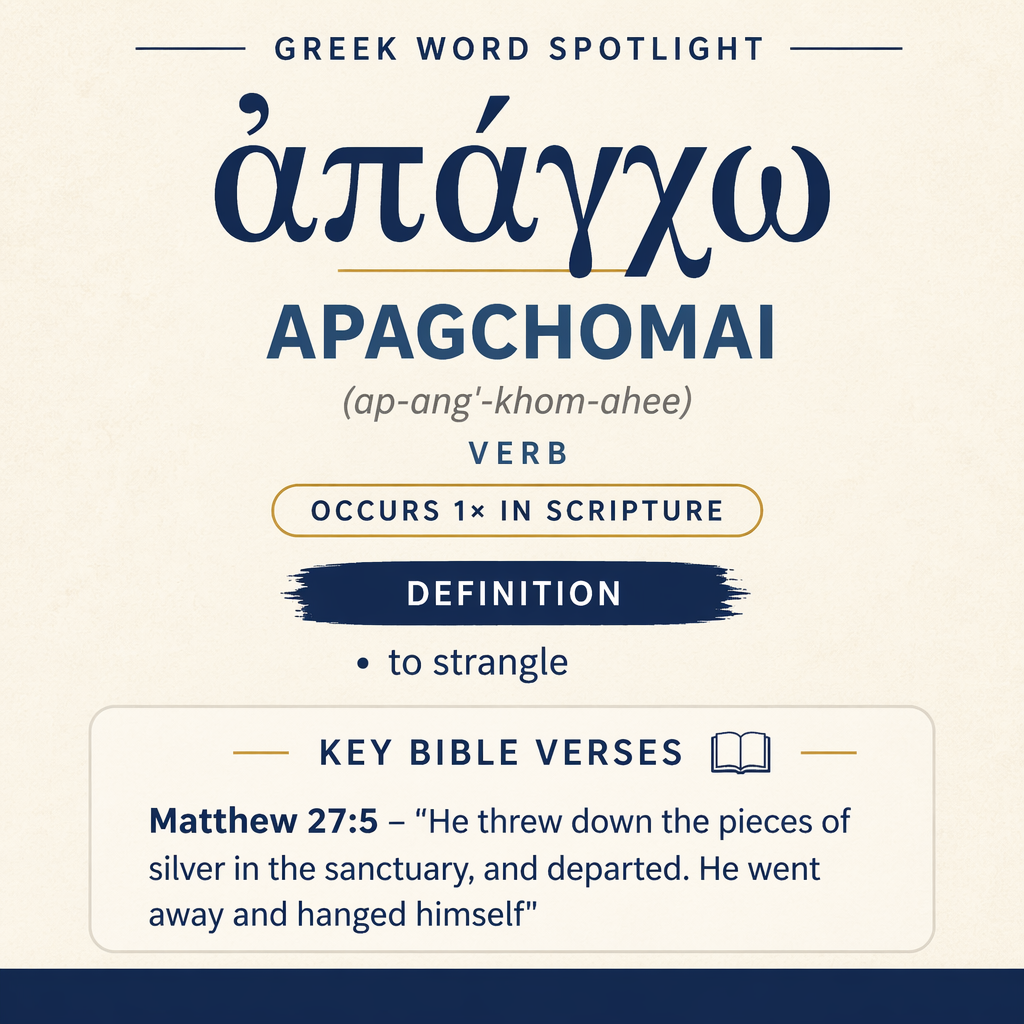
ἀπάγχω means “to strangle” and appears once in Scripture, in Matthew 27:5.
Scripture Occurrence
This word occurs 1 time in Scripture. Its single occurrence is in Matthew 27:5.
Learn More →Verse Context
In Matthew 27:5, the verse states that he “went away and hanged himself.”
Learn More →ἀπάγχω expresses the act of strangling, and it appears in a single New Testament narrative describing the end of Judas’s actions after returning the silver. In that scene it names the method by which he ends his life.
Root and Related Words
ἀπάγχω is connected with ἀπό (apo), “away from” (Strong’s G575), as a related element noted in traditional Strong’s-style derivation.

Occurrences
“He threw down the pieces of silver in the sanctuary, and departed. He went away and hanged himself.” (Matthew 27:5)
In Matthew’s terse sequence of actions, ἀπάγχω stands at the end of a chain of decisive verbs: Judas “threw down” the silver, “departed,” “went away,” and then performed this final act. The placement gives the verb a grim finality: it is not presented as a passing thought or an attempted self-harm, but as the culminating deed that follows physical movement away from the sanctuary and away from the transaction represented by “the pieces of silver.” The narrative does not linger on mechanics or description; the verb itself carries the weight of what occurred.
The immediate context also frames the act as occurring after a visible renunciation of the money—he “threw down the pieces of silver in the sanctuary.” The verb ἀπάγχω then names the mode of death in a way that contrasts sharply with the public setting of the sanctuary. Judas’s movement (“departed… went away”) sets the act in a separate, removed space, and ἀπάγχω identifies what he does there. In the rhythm of the sentence, the act is reported without elaboration, matching the narrative’s rapid, factual reporting style.
Sense and Usage
The given sense, “to strangle,” is applied in this passage to a self-inflicted death reported as “hanged himself.” Within the verse, the verb functions as a compact way to state the cause of death without adding interpretive comment. It names a lethal constriction of the body’s life-breath in a single stroke, fitting Matthew’s manner here: Judas’s interior motives are not unpacked in the verse; instead, the reader is shown concrete actions that move from the sanctuary to separation and then to death.
Because ἀπάγχω occurs here in a narrative that emphasizes departure—“departed” and “went away”—the verb is heard not merely as a physiological term but as the endpoint of withdrawal. The story’s syntax highlights motion away from a holy place and away from the silver, and then the final act is stated. In this setting, ἀπάγχω contributes a stark, unadorned naming of the manner of death, allowing the surrounding verbs to supply the scene’s momentum and the moral gravity to be carried by the sequence itself.
The reported act is also reflexive in sense in the English (“hanged himself”), which presents Judas as both agent and victim of the strangling. The verse gives no intermediary—no rescuer, no delay, no external force—only Judas’s own actions, culminating in ἀπάγχω. The verb thus functions as the narrative’s closing point for Judas within this immediate episode, sealing the progression from returning the money to irreversible self-destruction.
Imagery
Even in a single occurrence, the imagery is severe and concrete. Matthew 27:5 places the act after the clatter of “pieces of silver” discarded in the sanctuary and after the bodily motions of leaving and going away; ἀπάγχω then supplies the final, silent image of death by strangling. The verse’s restraint—stating the act in one line—lets the starkness of the verb stand without embellishment.
Sources: Lexical data from Strong’s Exhaustive Concordance and the Translators Brief Lexicon of Extended Strongs for Greek (STEPBible, CC BY). Occurrence data from the Translators Amalgamated Greek New Testament (STEPBible, CC BY). Scripture quotations from the World English Bible (public domain).