
Exploring the Meaning of Antanapleroo in Greek
ἀνταναπληρόω means “to fill again” and appears once in Scripture, in Colossians 1:24.
Biblical Occurrence
This word occurs 1 time in Scripture. It appears in Colossians 1:24.
Learn More →Verse Context
In Colossians 1:24, it is used in the phrase “fill up on my part that which is lacking of the afflictions of Christ.”
Learn More →ἀνταναπληρόω expresses the idea “to fill again.” It appears once in the New Testament, in Paul’s statement about rejoicing in sufferings and “fill[ing] up” what is “lacking” in connection with “the afflictions of Christ” for the sake of “his body,” identified as “the assembly.”

Root and Related Words
ἀνταναπληρόω is connected with the verb anapleroo (ἀναπληρόω), “to fulfil,” and with the preposition anti (ἀντί), “for.”

Occurrences
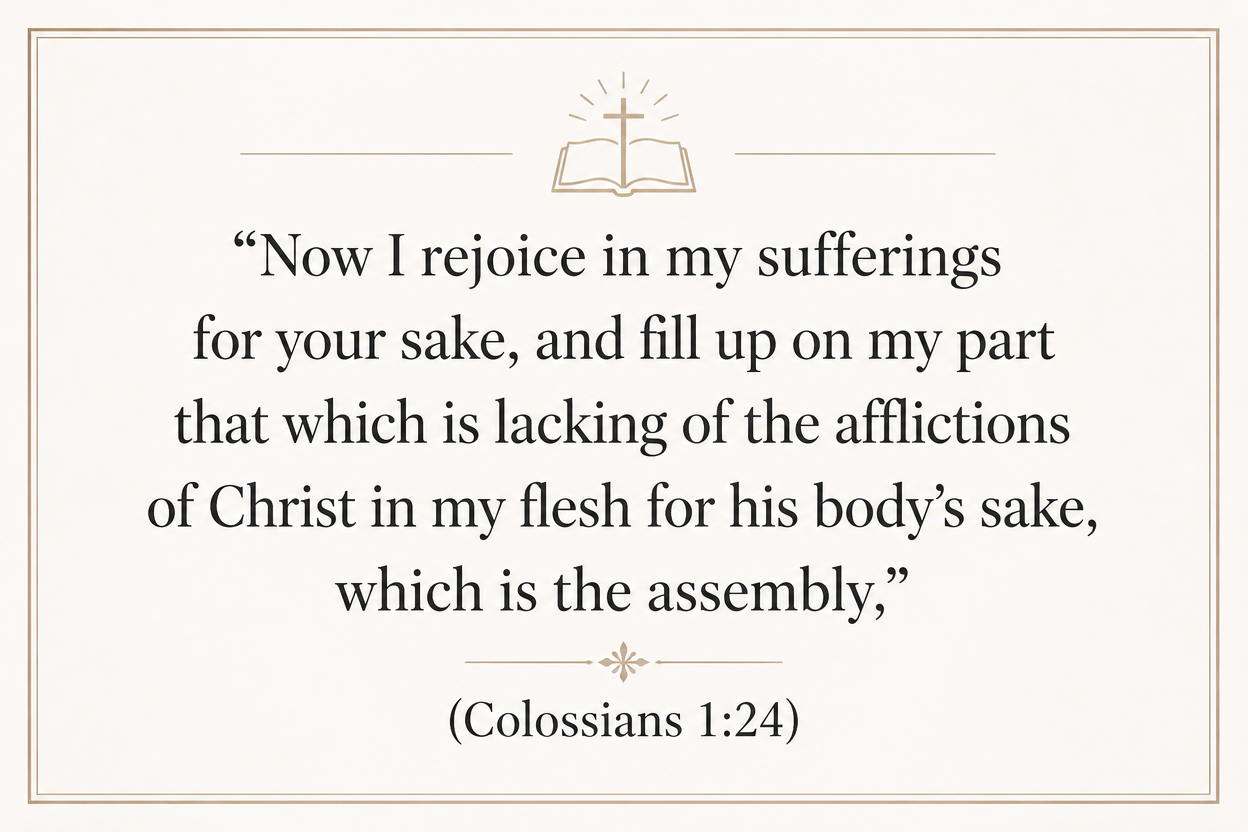
“Now I rejoice in my sufferings for your sake, and fill up on my part that which is lacking of the afflictions of Christ in my flesh for his body’s sake, which is the assembly,” (Colossians 1:24)
In this sentence, ἀνταναπληρόω stands at the hinge between Paul’s personal experience (“my sufferings,” “in my flesh”) and his stated aim (“for your sake,” “for his body’s sake”). The verb is framed by two features that sharpen its force in the line: first, the explicit personal limitation and contribution (“on my part”), and second, the language of deficiency (“that which is lacking”). Together, these give the filling action a concrete contour: it is not a vague sense of completion but a filling that is described as Paul’s particular share within a larger reality.
The immediate object of this filling is “that which is lacking of the afflictions of Christ.” The clause does not describe Paul as creating afflictions; rather, it casts his sufferings as an act of filling in relation to a lack, with “afflictions of Christ” marking the sphere within which that lack is named. The phrase “in my flesh” anchors the verb in bodily, lived hardship. In other words, the “fill[ing] up” is enacted not in abstraction or merely in thought, but in the tangible arena of suffering that Paul experiences and endures.
The purpose or beneficiary is also stated twice and in two directions. Paul’s rejoicing is “for your sake,” addressing the readers directly, and the filling is “for his body’s sake,” with that body identified as “the assembly.” This pairing shows how the verb functions within a relational web: what Paul undergoes and “fill[s] up” is not presented as private heroism but as something oriented toward others. The verb therefore contributes a communal, service-shaped angle to the suffering it describes: Paul locates his bodily afflictions within the welfare of Christ’s body, the assembly.
Sense and Usage
The sense “to fill again” is expressed in Colossians 1:24 through a vivid interplay of scarcity and supply. The verse establishes a “lack” and then presents Paul’s action as filling in response to that lack. The idea of filling again can be heard in the way the statement portrays an existing measure that, in some respect, stands incomplete (“that which is lacking”), and then a further filling that is carried out “on my part.” The verb does not appear in a setting of material containers or physical replenishing, yet the imagery naturally leans toward the language of measure and completion: something has not reached its intended fullness, and a further filling occurs.
Because the filling is explicitly tied to “my sufferings” and located “in my flesh,” the action is portrayed as costly and personal. “Fill again” here operates in the arena of afflictions rather than in an arena of goods or resources. This shapes the kind of “filling” implied: it is not a mere administrative making-up of what is short; it is an embodied participation in hardship that is described as adding to what is missing. The phrase “on my part” further underscores that the filling is a particular, allocated contribution—Paul is not claiming to be the whole supply, but he is naming his own portion as a real addition.
The line also ties the filling action to a communal end: “for his body’s sake, which is the assembly.” In this context, “fill again” is not presented as self-repair or self-completion, but as something performed with reference to a corporate body. The verse portrays the assembly as the setting in which the significance of Paul’s filling is realized. The filling, therefore, is framed as meaningful precisely because it is “for” others—both the immediate “your sake” and the broader “his body’s sake.”
Finally, the verse’s opening clause (“Now I rejoice in my sufferings for your sake”) sets an emotional and interpretive tone for the action of filling again. The filling is not narrated as reluctant resignation but as an action embedded in rejoicing. This does not change the concrete reality of “sufferings” and “afflictions,” yet it does show how the filling is evaluated within the sentence: as a purposeful, embraced role rather than an accidental deficit-management. In this single occurrence, ἀνταναπληρόω thus carries the imagery of replenishing what is short, but the “material” being added is personal suffering, and the goal is the good of the assembly.
Imagery
Colossians 1:24 uses the language of lack and filling to portray suffering in terms of measure: there is a shortfall (“that which is lacking”), and Paul speaks of his own embodied afflictions as a filling “on my part.” The image is not of a momentary top-up but of a costly, bodily contribution offered “for” others, tied to “his body,” “the assembly.”
Sources: Lexical data from Strong’s Exhaustive Concordance and the Translators Brief Lexicon of Extended Strongs for Greek (STEPBible, CC BY). Occurrence data from the Translators Amalgamated Greek New Testament (STEPBible, CC BY). Scripture quotations from the World English Bible (public domain).




