
Exploring the Meaning of Antapodidomi in Greek
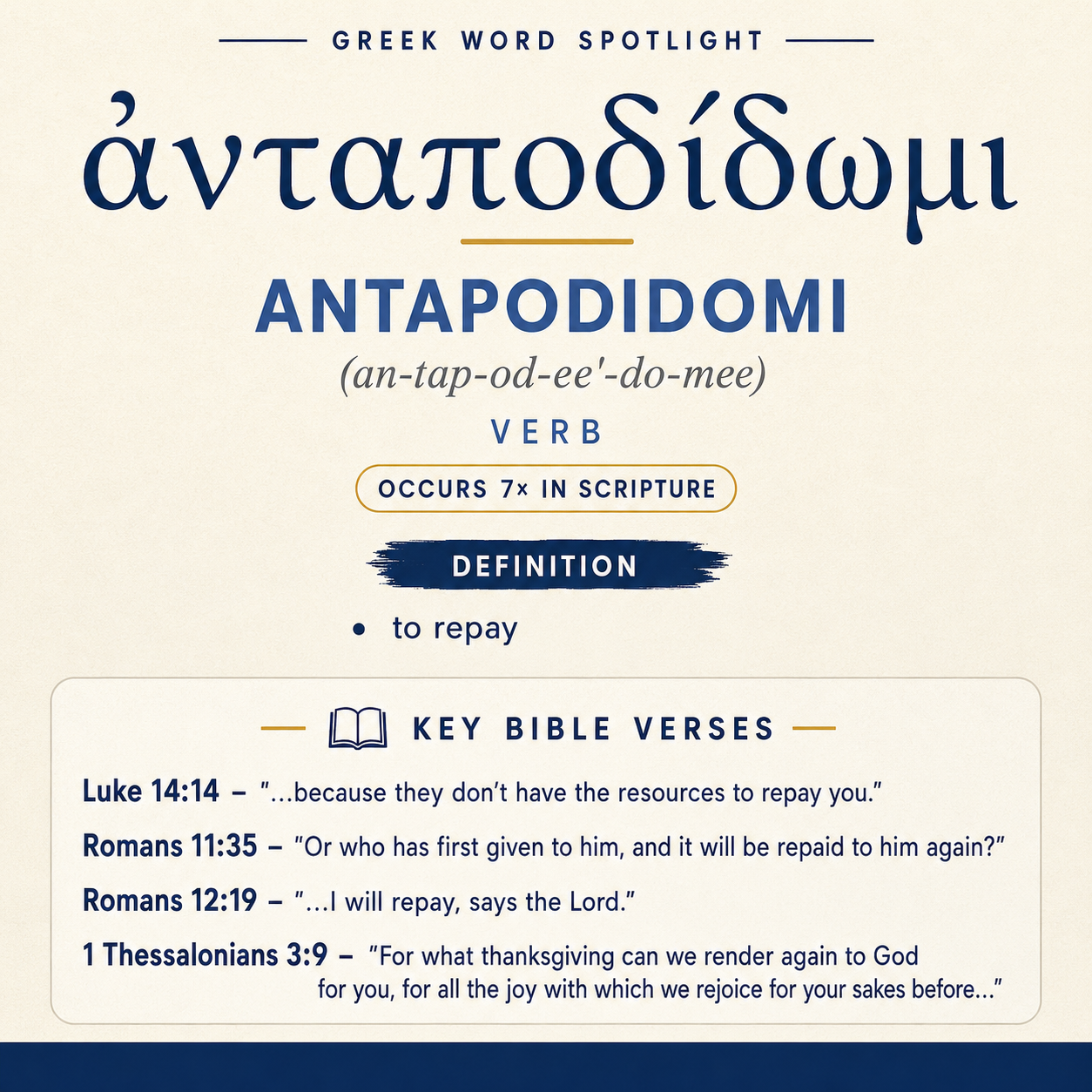
ἀνταποδίδωμι means “to repay” and occurs 7 times in Scripture, including Luke 14:14; Romans 11:35; Romans 12:19; 1 Thessalonians 3:9; 2 Thessalonians 1:6; Hebrews 10:30.
Core Meaning
ἀνταποδίδωμι means “to repay.” It is used for repayment given by people and repayment attributed to God.
Learn More →Key Passages
Luke 14:14 speaks of being repaid at the resurrection. Romans 11:35 asks who could give first so as to be repaid.
Learn More →Justice Themes
Romans 12:19 and Hebrews 10:30 connect repayment with God’s vengeance: “I will repay.” 2 Thessalonians 1:6 describes God repaying affliction to afflicters.
Learn More →ἀνταποδίδωμι expresses the act of repaying. In the passages where it appears, it frames repayment both in ordinary human exchange and in God’s just response.
Occurrences
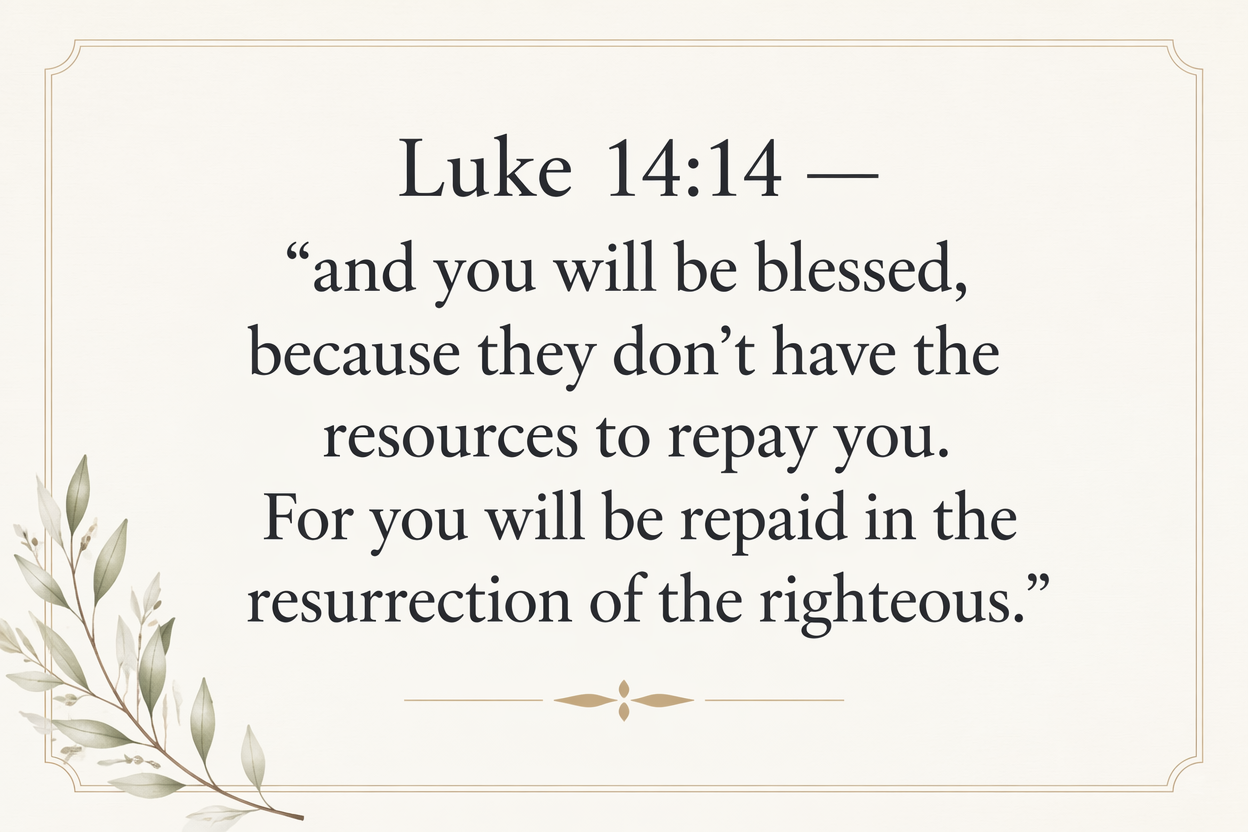
Luke 14:14 — “and you will be blessed, because they don’t have the resources to repay you. For you will be repaid in the resurrection of the righteous.”
Here repayment is set against a concrete social situation: some invited guests “don’t have the resources to repay you.” The verb marks the normal expectation of return for generosity, then redirects the axis of repayment beyond immediate reciprocity: “you will be repaid in the resurrection of the righteous.” Repayment is still real and future-facing, but not controlled by the giver or limited by the recipient’s capacity.
Romans 11:35 — ““Or who has first given to him, and it will be repaid to him again?””
This rhetorical question uses repayment to probe the logic of giving and return. The emphasis falls on priority (“first given”) and the imagined obligation that would follow (“repaid to him again”). Repayment here functions as a measure of whether anyone could place God in a position of debt; the question assumes that repayment would be the expected consequence if such a prior gift existed.
Romans 12:19 — “Don’t seek revenge yourselves, beloved, but give place to God’s wrath. For it is written, “Vengeance belongs to me; I will repay, says the Lord.””
In this exhortation, repayment is aligned with vengeance and explicitly reserved to God: “Vengeance belongs to me; I will repay.” The verb contributes the idea of an answer that matches a wrong, but the text’s main force is procedural and moral—believers are told not to “seek revenge” because repayment is claimed by the Lord. Repayment is thus presented as a divine act tied to wrath rather than a human act of settling scores.
1 Thessalonians 3:9 — “For what thanksgiving can we render again to God for you, for all the joy with which we rejoice for your sakes before our God,”
Repayment appears here in a different register: not retribution or settling accounts, but an attempt to answer joy with gratitude. “What thanksgiving can we render again to God” frames thanksgiving as a kind of return response—something offered back in light of what has been received. The context is relational and devotional: joy “for your sakes” overflows into a desire to repay, not with material goods, but with thanksgiving directed “to God.”
2 Thessalonians 1:6 — “Since it is a righteous thing with God to repay affliction to those who afflict you,”
This line uses repayment to state a principle of divine justice. The repayment is described as “a righteous thing with God,” and what is repaid is “affliction” to the ones who “afflict you.” The verb underlines strict correspondence: the same kind of suffering is returned to those who have inflicted it. Repayment is not portrayed as arbitrary; it is explicitly linked to righteousness and framed as God’s action.
Hebrews 10:30 — “For we know him who said, “Vengeance belongs to me;” says the Lord, “I will repay.” Again, “The Lord will judge his people.””
Repayment is again joined to vengeance and placed in the Lord’s mouth: “I will repay.” The surrounding statements—“we know him who said” and “The Lord will judge his people”—situate repayment within personal knowledge of God’s character and within judgment. The verb reinforces that judgment includes active recompense; it is not merely evaluation but a decisive responding act.

Sense and Usage
Across these contexts, “repay” operates as a single, stable idea that takes on different moral and temporal shapes depending on who repays and what is being repaid. Luke 14:14 starts with everyday reciprocity—repayment as the normal counterpart to a meal invitation or generous act—then relocates repayment to an eschatological horizon: “in the resurrection of the righteous.” The verb therefore supports a view of repayment that can be delayed yet certain, not dependent on human resources.
Romans 11:35 uses repayment to explore obligation: if someone could “first” give to God, repayment would follow “again.” The verb’s usefulness here is its clarity about the direction of obligation: repayment goes from the recipient of the initial gift back to the giver. By raising the question, the verse leverages the common moral intuition that a prior gift can create a claim to return.
In Romans 12:19 and Hebrews 10:30, repayment is explicitly the Lord’s prerogative and tied to vengeance and judgment. In both, the first-person promise “I will repay” is the point of restraint for human behavior: the community is addressed (“beloved”) and is told not to “seek revenge” but to leave space for God’s wrath. The verb therefore functions not only as a description of what God does but as a boundary-marker for what the audience is not to do. Repayment, when fused with vengeance, is treated as an aspect of divine governance rather than personal retaliation.
2 Thessalonians 1:6 adds a key ethical qualifier: repayment of affliction is “a righteous thing with God.” The verb’s sense remains repayment, but the sentence places that repayment inside the category of righteousness. It also specifies a matching object—“affliction”—which gives repayment a concrete, almost symmetrical quality: what is inflicted is returned. The implied logic is that God’s repayment answers oppression with proportionate response.
1 Thessalonians 3:9 shows that the same verb can describe repayment in a non-punitive setting. The language of “thanksgiving” and “joy” turns repayment into a response of gratitude. Here repayment is not a settling of harm, nor a balancing of social favors, but the attempt to answer a benefaction with worshipful acknowledgment—“render again to God.” The verb helps depict thanksgiving as responsive and relational: joy received evokes a desire to give back.
Read together, these uses show repayment as a flexible frame for moral accounting without changing its core. The agent of repayment alternates between humans (who might repay a host, or render thanks to God) and God (who repays in resurrection, repays affliction, and repays in vengeance). The objects of repayment range from social benefit (Luke 14:14) to obligation implied by giving (Romans 11:35), to affliction and vengeance (Romans 12:19; 2 Thessalonians 1:6; Hebrews 10:30), to thanksgiving (1 Thessalonians 3:9). The same verb thus binds together daily exchange, worshipful response, and divine judgment under one intelligible action: repayment as an answering return.
Imagery
The imagery carried by ἀνταποδίδωμι in these passages is that of return and settling: a gift answered, a wrong answered, a kindness eventually answered. Luke’s scene evokes the quiet imbalance of generosity offered to those who “don’t have the resources to repay you,” and then the promise of a later balancing “in the resurrection of the righteous.” Romans and Hebrews place repayment in the solemn register of “Vengeance” and “judge,” where the return is weighty and final. Thessalonians shows both edges at once: thanksgiving rendered back to God for joy, and affliction repaid to afflicters as a righteous act. Together these texts portray repayment as a real return that can be deferred, reassigned to God, or transformed into gratitude, but never treated as meaningless.
Sources: Lexical data from Strong’s Exhaustive Concordance and the Translators Brief Lexicon of Extended Strongs for Greek (STEPBible, CC BY). Occurrence data from the Translators Amalgamated Greek New Testament (STEPBible, CC BY). Scripture quotations from the World English Bible (public domain).




