
Exploring the Meaning of Antagonizomai in Greek
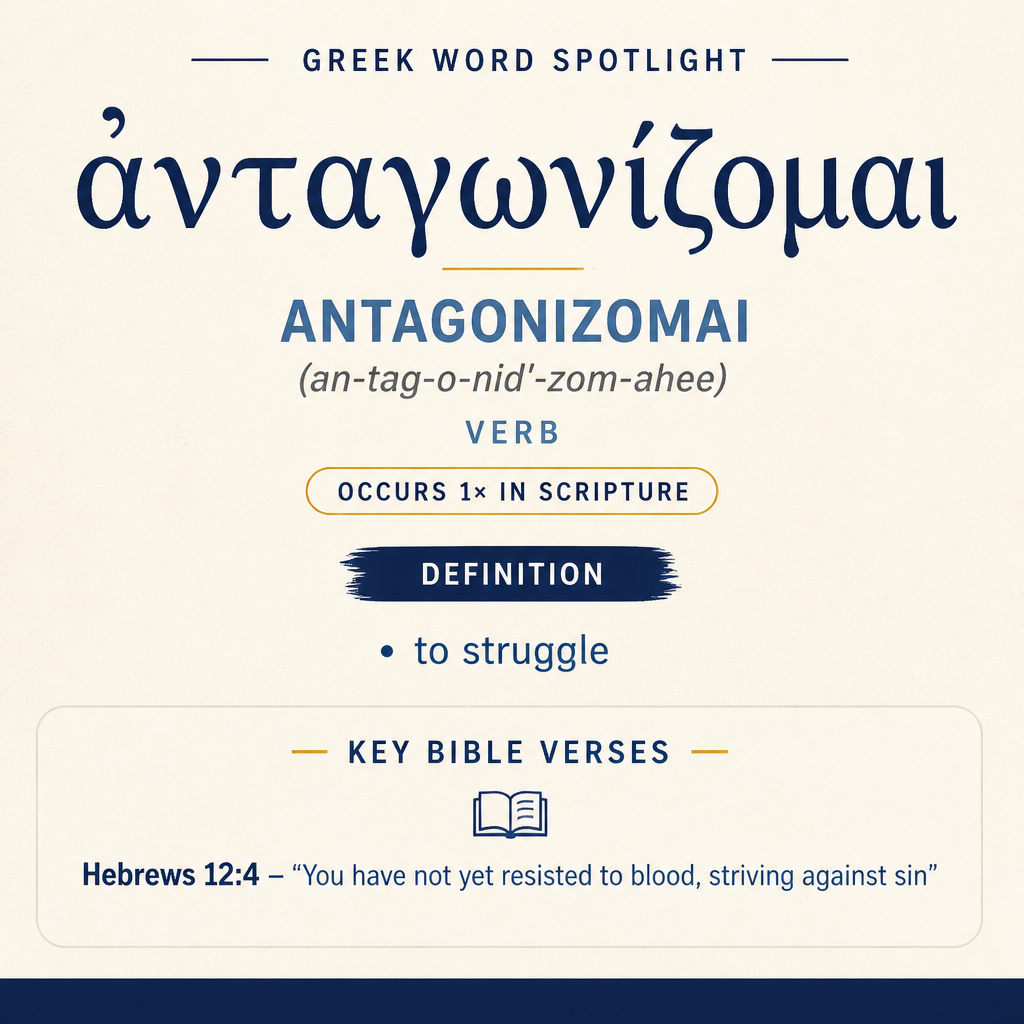
ἀνταγωνίζομαι means “to struggle” and appears once in Scripture, in Hebrews 12:4.
Scripture Occurrence
This verb occurs one time in Scripture. Its single occurrence is in Hebrews 12:4.
Learn More →Hebrews Context
In Hebrews 12:4 it describes striving against sin: “You have not yet resisted to blood, striving against sin.”
Learn More →Antagonizomai means “to struggle” and appears once in the New Testament, in Hebrews 12:4. In that setting it frames the readers’ moral conflict as strenuous effort directed “against sin.”
Root and Related Words
Antagonizomai is connected with anti (ἀντί), “for,” and agonizomai (ἀγωνίζομαι), “to struggle.” The combination places the action within the sphere of contest, highlighting struggle in relation to an opposing force.

Occurrences
“You have not yet resisted to blood, striving against sin.” (Hebrews 12:4)
Here antagonizomai is rendered “striving,” and the sentence sets the struggle inside a vivid measure of costly resistance: “to blood.” The readers are addressed directly (“You have not yet…”), and their experience is described as real resistance, but resistance that has not reached the extreme of bloodshed. Within that frame, the word marks their engagement with sin as more than passive avoidance; it is pictured as exertion.
The object of the struggle is named explicitly: “against sin.” The phrase gives the struggle a clear direction. The conflict is not presented as generalized hardship or merely internal discomfort, but as an oppositional contest in which sin stands as the adversarial reality. The sentence also balances two descriptions—“resisted” and “striving”—so that antagonizomai contributes the sense of sustained effort that accompanies resistance. The readers have been resisting; antagonizomai adds the idea of strenuous engagement as they do so.
The wording “not yet” implies an ongoing situation rather than a completed episode. In that context, antagonizomai helps characterize the readers’ present moral life as continuing struggle. It also works rhetorically: the author acknowledges real striving while also placing it on a scale where an even more severe level (“to blood”) has not been reached. The word therefore supports both recognition of their conflict and a summons to take the struggle seriously.
Sense and Usage
In Hebrews 12:4, “to struggle” is not abstracted into a mere attitude; it is embedded in language of resistance with potential cost. Antagonizomai depicts effort that is active and oppositional. The readers are not simply told that sin exists; they are portrayed as contending with it, pressing against it, and doing so with the kind of exertion that can be measured in terms as concrete as “blood.”
The immediate pairing of “resisted” with “striving” gives the struggle a practical profile. Resistance can be momentary—an act of refusal in a specific test—but antagonizomai adds the sense of ongoing exertion. The struggle has duration and intensity, and it is oriented “against” a defined opponent. The definition “to struggle” thus plays out as sustained contest, where effort is required precisely because the opposition is real.
Because the verse addresses the community (“You have not yet…”), antagonizomai also functions as a shared description of the readers’ experience. The struggle is not presented as a private, eccentric battle; it is spoken of as a common moral contest faced by those being addressed. The word fits the verse’s direct, evaluative tone: their struggle is acknowledged, evaluated (“not yet…to blood”), and placed within a framework where perseverance under pressure is assumed to be necessary.
Imagery
The imagery carried by antagonizomai in Hebrews 12:4 is the imagery of a contest that can draw blood. Even without describing a particular scene, the verse paints struggle in physical terms—resistance pushed to an extreme limit—while locating the opposition in the moral realm (“against sin”). The result is a picture of strenuous effort: a conflict that demands real exertion and may call for costly endurance.
Sources: Lexical data from Strong’s Exhaustive Concordance and the Translators Brief Lexicon of Extended Strongs for Greek (STEPBible, CC BY). Occurrence data from the Translators Amalgamated Greek New Testament (STEPBible, CC BY). Scripture quotations from the World English Bible (public domain).




