
Exploring the Meaning of Anothen in Greek
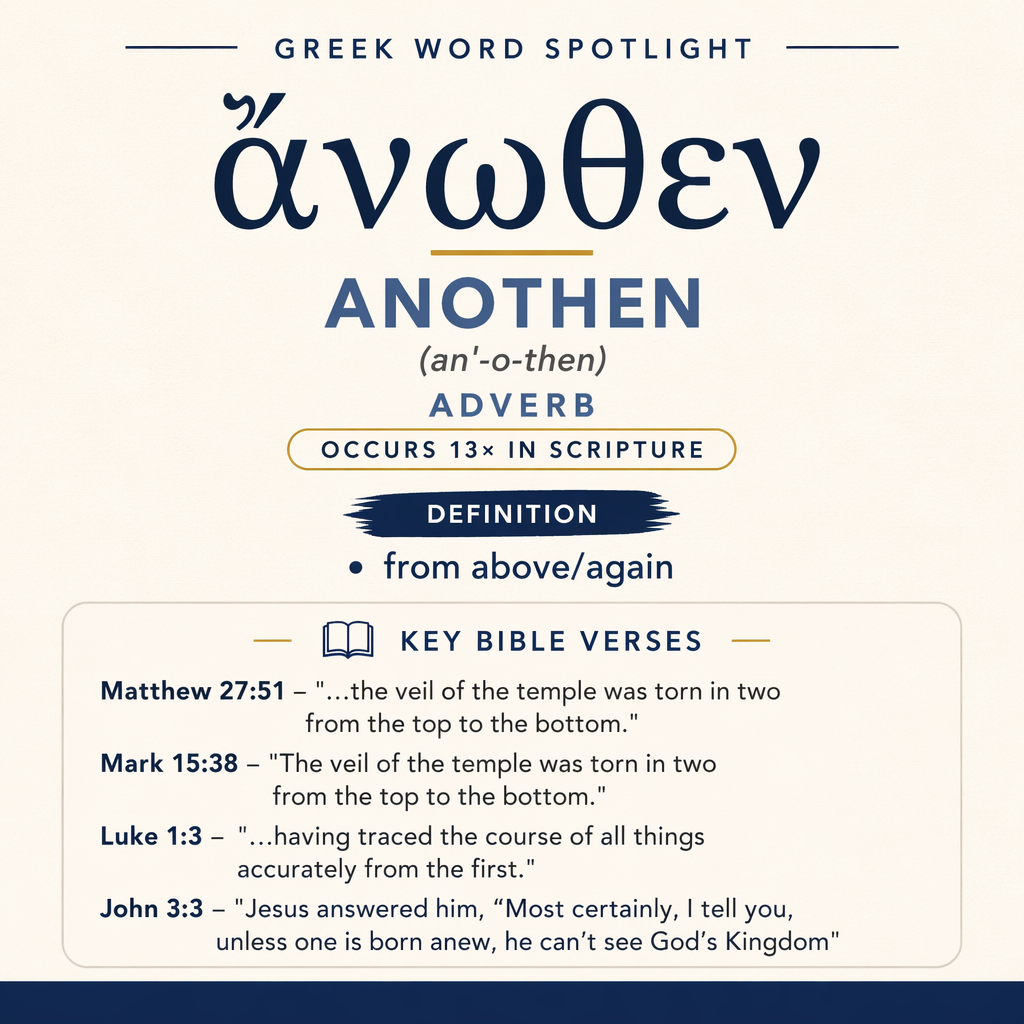
ἄνωθεν means “from above/again” and occurs 13 times in Scripture, including Matthew 27:51; Mark 15:38; Luke 1:3; and John 3; 19.
Core Meaning
ἄνωθεν is defined as “from above/again.” In John 3:3 and 3:7 it appears in the call to be “born anew.”
Learn More →Temple Veil
In Matthew 27:51 and Mark 15:38, ἄνωθεν describes the veil torn “from the top to the bottom.” This usage highlights direction from above.
Learn More →Johannine Use
In John 3:31 it describes “He who comes from above.” In John 19:11 it refers to authority “given…from above.”
Learn More →ἄνωθεν expresses a perspective of origin or repetition: what comes “from above” or happens “again.” Across the passages where it appears, it can mark a direction from top to bottom, an origin “from above,” or a renewed beginning “again.”
Occurrences
“Behold, the veil of the temple was torn in two from the top to the bottom. The earth quaked and the rocks were split.” (Matthew 27:51)
Here ἄνωθεν anchors the tearing of the veil to a starting point “from the top,” specifying the direction of the action as it proceeds “to the bottom.” The wording highlights an initiating point above, setting the tear’s course and emphasizing that the opening begins at the uppermost edge.
“The veil of the temple was torn in two from the top to the bottom.” (Mark 15:38)
Again the adverb fixes the tear’s origin at the top. In this brief statement, ἄνωθεν functions almost like a spatial marker: the veil’s division is not merely described as complete (“in two”) but as proceeding from an upper starting point downwards.
“it seemed good to me also, having traced the course of all things accurately from the first, to write to you in order, most excellent Theophilus;” (Luke 1:3)
With “from the first,” ἄνωθεν frames the narrator’s investigation as starting at the beginning point. The adverb sets the scope of the account: the writer has followed events from their initial stage and therefore writes “in order.”
“Jesus answered him, “Most certainly, I tell you, unless one is born anew, he can’t see God’s Kingdom.”” (John 3:3)
In this saying, ἄνωθεν carries the sense of being born “anew,” marking a new beginning that is required for seeing “God’s Kingdom.” The adverb modifies the birth itself: it is not merely a first entry into life that is in view, but a birth characterized by repetition—a beginning again.
“Don’t marvel that I said to you, ‘You must be born anew.’” (John 3:7)
The repetition of the phrase reinforces ἄνωθεν as a decisive requirement rather than a metaphorical flourish. The command “You must” ties the adverb to necessity: the new birth is framed as an essential re-beginning.
“He who comes from above is above all. He who is from the earth belongs to the earth and speaks of the earth. He who comes from heaven is above all.” (John 3:31)
Here ἄνωθεν is explicit in the phrase “from above,” and the verse immediately builds a contrast between two origins: “from above” and “from the earth.” The adverb serves as a marker of source and, in the sentence’s logic, the one who “comes from above” is “above all,” so the origin described by ἄνωθεν is presented as determinative for status and perspective.
“Jesus answered, “You would have no power at all against me, unless it were given to you from above. Therefore he who delivered me to you has greater sin.”” (John 19:11)
In this exchange, ἄνωθεν locates the origin of authority: any “power” that exists is “given…from above.” The adverb functions to qualify power as derivative rather than self-generated, grounding the limits of human authority in an originating gift that comes down from a higher source.
“Then the soldiers, when they had crucified Jesus, took his garments and made four parts, to every soldier a part; and also the coat. Now the coat was without seam, woven from the top throughout.” (John 19:23)
The adverb appears in a concrete, material description: the coat is “woven from the top throughout.” ἄνωθεν fixes the starting point of the weaving at the top, emphasizing the garment’s construction as a single continuous piece, beginning at the upper portion and extending through the whole.
“having known me from the first, if they are willing to testify, that after the strictest sect of our religion I lived a Pharisee.” (Acts 26:5)
In Paul’s defense, ἄνωθεν (“from the first”) situates the witnesses’ knowledge of his life at its earliest point. The adverb underscores the long-standing nature of the testimony: they have known him from the beginning and can attest to his way of life.
“But now that you have come to know God, or rather to be known by God, why do you turn back again to the weak and miserable elemental principles, to which you desire to be in bondage all over again?” (Galatians 4:9)
In this admonition, ἄνωθεν contributes the idea of recurrence: “again” and “all over again” express a return to a prior state of bondage. The adverb sharpens the rebuke by portraying their movement not as a small detour but as a repetition—a renewed submission to what they had left behind.
“Every good gift and every perfect gift is from above, coming down from the Father of lights, with whom can be no variation, nor turning shadow.” (James 1:17)
James uses ἄνωθεν to identify the source of gifts: “from above.” The following participle, “coming down,” matches the adverb’s vertical orientation and presents giving as a downward movement from a higher origin, tied here to “the Father of lights.”
“This wisdom is not that which comes down from above, but is earthly, sensual, and demonic.” (James 3:15)
With “from above,” ἄνωθεν again marks origin, but this time by denial: the wisdom in question does not descend from that higher source. The contrast that follows (“but is earthly, sensual, and demonic”) uses the origin signaled by ἄνωθεν as a dividing line between types of wisdom.

Sense and Usage
Across these passages, ἄνωθεν consistently serves as an adverb of starting point—either in space (“from the top”) or in source (“from above”)—and, in several key lines, as an adverb of renewed beginning (“again/anew”). The spatial uses are tangible and directional: a veil is torn “from the top to the bottom” (Matthew 27:51; Mark 15:38), and a garment is woven “from the top throughout” (John 19:23). In each case, ἄνωθεν identifies where a process begins, and the rest of the clause traces what proceeds from that beginning: the tear runs downward; the weaving extends through the whole garment.
The temporal uses also focus on an initial point, but now in time rather than height: “from the first” (Luke 1:3; Acts 26:5). In Luke, that starting point supports the claim to an orderly narrative based on careful tracing; in Acts, it supports the reliability of witnesses whose acquaintance with Paul reaches back to his earliest life in view.
The “from above” uses emphasize a higher origin as the decisive qualifier for what is described. In John 3:31, the one who “comes from above” is set over against what is “from the earth,” and the adverb becomes a way of locating the speaker’s realm and therefore what he speaks. In John 19:11, “power” is treated as something granted; ἄνωθεν specifies the direction and source of that grant, placing human authority under a higher giving. James 1:17 similarly sets the origin of “every good gift and every perfect gift” as “from above,” and the accompanying “coming down” turns the adverb into vivid downward motion. James 3:15 shows the same framework can be used negatively: a claim about origin (“comes down from above”) can be denied to expose a wisdom’s true character by contrast.
The “again/anew” uses in John 3 (3:3, 3:7) and Galatians 4:9 treat ἄνωθεν as the marker of repetition, but with strikingly different moral and theological weight in their respective settings. In John 3, being born ἄνωθεν is required and life-defining: it is the condition for seeing God’s Kingdom, and it is spoken as necessity. In Galatians, the “again” is a regression: turning back to “bondage all over again.” In both, the adverb’s force is that something is not merely continuing but starting over—either as a necessary new beginning or as a tragic re-entry into what had been left.
Imagery
Several scenes make ἄνωθεν visible: a veil ripped from its upper edge downward (Matthew 27:51; Mark 15:38), and a coat begun at the top and worked through as one piece (John 19:23). Other passages carry the same “from above” orientation without physical objects: gifts “coming down” (James 1:17), wisdom that does—or does not—descend (James 3:15), and authority “given…from above” (John 19:11). Together these uses give ἄνωθεν a consistent profile: it points to what begins at the top, begins at the first, comes down from above, or begins again.
Sources: Lexical data from Strong’s Exhaustive Concordance and the Translators Brief Lexicon of Extended Strongs for Greek (STEPBible, CC BY). Occurrence data from the Translators Amalgamated Greek New Testament (STEPBible, CC BY). Scripture quotations from the World English Bible (public domain).




