
Exploring the Meaning of Ano in Greek
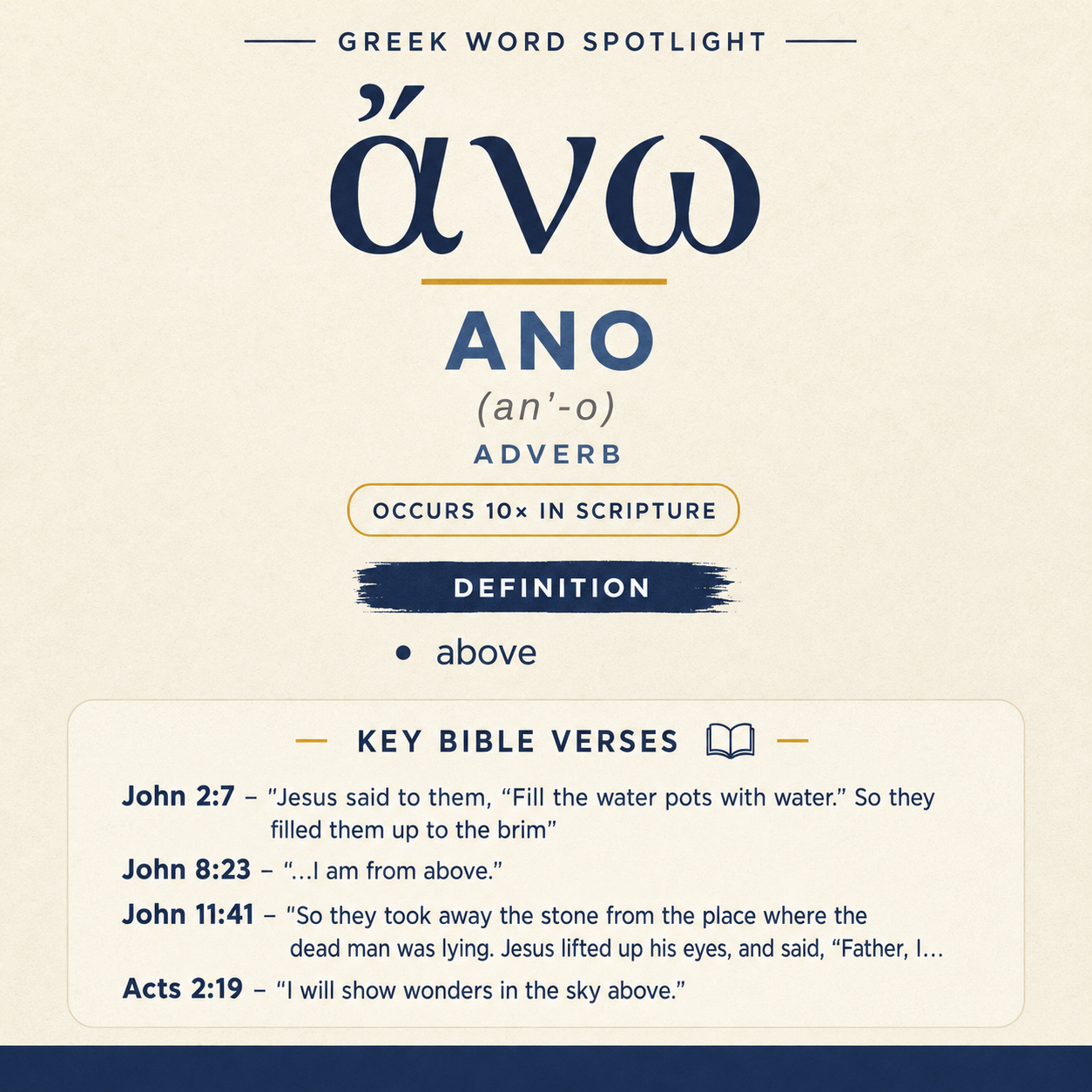
ἄνω means “above” and appears 10 times in Scripture, including John, Acts, Galatians, Philippians, and Colossians.
Core Meaning
ἄνω means “above.” It is used to contrast what is above with what is beneath or on the earth.
Learn More →Key Occurrences
It appears in John 8:23 (“I am from above”) and Acts 2:19 (“wonders in the sky above”). It also occurs in Galatians 4:26; Philippians 3:14; and Colossians 3:1–2.
Learn More →Colossians Focus
Colossians 3:1–2 uses ἄνω in the repeated call to seek and set the mind on “the things that are above.” These verses connect “above” with where Christ is seated.
Learn More →ἄνω means “above,” marking what is higher in position, origin, or reference point. In the New Testament it appears in narrative scenes, sayings about identity and belonging, cosmic contrasts of “above” and “beneath,” and exhortations that direct attention upward.
Occurrences
John 2:7: “Jesus said to them, “Fill the water pots with water.” So they filled them up to the brim.”
Within the action of filling, “above” functions as the upward limit that completes the task: the jars are filled all the way to their highest point. The statement that they filled them “to the brim” presents fullness measured by an “above” boundary rather than a partial level.
John 8:23: “He said to them, “You are from beneath. I am from above. You are of this world. I am not of this world.”
Here “above” is placed in a direct contrast with “beneath,” and the contrast is immediately expanded by parallel lines about being “of this world” or “not of this world.” “Above” thus works as a marker of origin and realm: it distinguishes where someone is “from,” and it supports the difference between two kinds of belonging.
John 11:41: “So they took away the stone from the place where the dead man was lying. Jesus lifted up his eyes, and said, “Father, I thank you that you listened to me.”
The setting is physical and visible: a stone is removed, and Jesus “lifted up his eyes.” “Above” contributes the direction implied by that gesture. The upward look frames the address to “Father” as directed toward a higher location, matching the natural orientation of eyes lifted upward.
Acts 2:19: “I will show wonders in the sky above, and signs on the earth beneath: blood, and fire, and billows of smoke.”
“Above” locates “wonders” in “the sky,” pairing it with “beneath” for “the earth.” The effect is to map the whole scene vertically: phenomena are distributed in the upper and lower regions, so that the signs are portrayed as encompassing both heights and depths.
Galatians 4:26: “But the Jerusalem that is above is free, which is the mother of us all.”
“Above” identifies a Jerusalem characterized by its higher placement. The statement links that “above” Jerusalem with freedom and with maternal imagery (“the mother of us all”), so “above” serves to distinguish this Jerusalem from another point of reference and to anchor the description of its status.
Philippians 3:14: “I press on toward the goal for the prize of the high calling of God in Christ Jesus.”
Even though the verse speaks of “the high calling,” “above” shapes the idea of height as the direction of the calling. The upward orientation fits the athletic-like language of striving (“press on toward the goal”) and positions the calling as something elevated rather than low or ordinary.
Colossians 3:1: “If then you were raised together with Christ, seek the things that are above, where Christ is, seated on the right hand of God.”
“Above” here marks the location of the things to be sought, and it is specified further: it is “where Christ is.” The verse ties “above” to a seated position “on the right hand of God,” so “above” carries a concrete spatial sense while also functioning as the sphere in which Christ is situated.
Colossians 3:2: “Set your mind on the things that are above, not on the things that are on the earth.”
This occurrence uses “above” as the counterpart to “on the earth.” The contrast is explicit and directional: attention is to be set toward what is higher rather than what is earthly. “Above” provides the vertical axis for the command, giving “mind” a defined orientation.
Hebrews 12:15: “looking carefully lest there be any man who falls short of the grace of God, lest any root of bitterness springing up trouble you, and many be defiled by it,”
In this warning, “above” contributes to the imagery of something that “spring[s] up.” The “root of bitterness” is pictured as rising upward into view and effect, moving from hidden beginnings toward an upper growth that “trouble[s]” and spreads defilement. “Above” thus supports the upward motion implied by the growth metaphor.
Revelation 5:3: “No one in heaven above, or on the earth, or under the earth, was able to open the book or to look in it.”
“Above” locates “heaven” in the vertical structure of the cosmos, contrasted with “on the earth” and “under the earth.” The threefold division uses “above” to establish the highest realm in a comprehensive sweep, reinforcing the scope of “No one” across every level.

Sense and Usage
Across these passages, “above” consistently supplies an upward reference point, but it does so with several distinct functions shaped by context. In straightforward physical description, it defines a top boundary and completes an action: the jars in John 2:7 are brought up to the highest fill-line. It also marks bodily direction: in John 11:41 the upward direction of the eyes matches the address that follows, making “above” an implied line of sight.
Other uses develop “above” into a marker of realm and belonging. John 8:23 sets “above” against “beneath” and pairs that spatial contrast with the language of being “of this world” or not, allowing “above” to signal a different point of origin and a different sphere of identity. A similar vertical contrast structures Acts 2:19, where “the sky above” and “the earth beneath” distribute signs across the upper and lower regions; “above” helps the reader imagine the whole world as a layered field in which wonders and signs appear.
In the epistles, “above” often functions as a directional category for desire and thought. Philippians 3:14 speaks of a “high calling,” and the upward term fits the forward-and-upward momentum of “press[ing] on toward the goal.” Colossians 3:1–2 makes the contrast explicit: the community is to “seek” and “set [the] mind” toward “the things that are above,” defined as the place “where Christ is,” rather than toward “the things that are on the earth.” Here “above” is not merely a point on a map; it becomes a stable orientation for pursuit, attention, and valuation, while remaining spatially intelligible through the added clause locating Christ.
Two further occurrences show how “above” can distinguish and classify without losing its vertical force. Galatians 4:26 speaks of “the Jerusalem that is above,” using height language to differentiate this Jerusalem, and then immediately describing it in terms of freedom and motherhood. Revelation 5:3 uses “heaven above” as the uppermost part of a three-tiered structure (“in heaven above, or on the earth, or under the earth”), where “above” serves the rhetorical purpose of total coverage: the inability to open the book extends through every level, from highest to lowest. Finally, Hebrews 12:15 uses upward imagery in a moral warning: the “root of bitterness springing up” is pictured as rising into active influence. In that growth image, “above” aligns with emergence—what begins below can rise upward into visibility and spread.
Imagery
The repeated upward orientation of “above” creates a consistent vertical imagination: vessels filled to their top, eyes lifted upward, wonders displayed in the sky, a Jerusalem placed “above,” a calling described as high, and a realm “above” where Christ is seated. Alongside these, the word participates in stark vertical contrasts—above and beneath, heaven and earth and under the earth—that frame the world as layered from highest to lowest. Even the warning about bitterness gains force through this same verticality, picturing trouble as something that rises up and affects many.
Sources: Lexical data from Strong’s Exhaustive Concordance and the Translators Brief Lexicon of Extended Strongs for Greek (STEPBible, CC BY). Occurrence data from the Translators Amalgamated Greek New Testament (STEPBible, CC BY). Scripture quotations from the World English Bible (public domain).




