Understanding the Meaning of Anoterikos in Greek
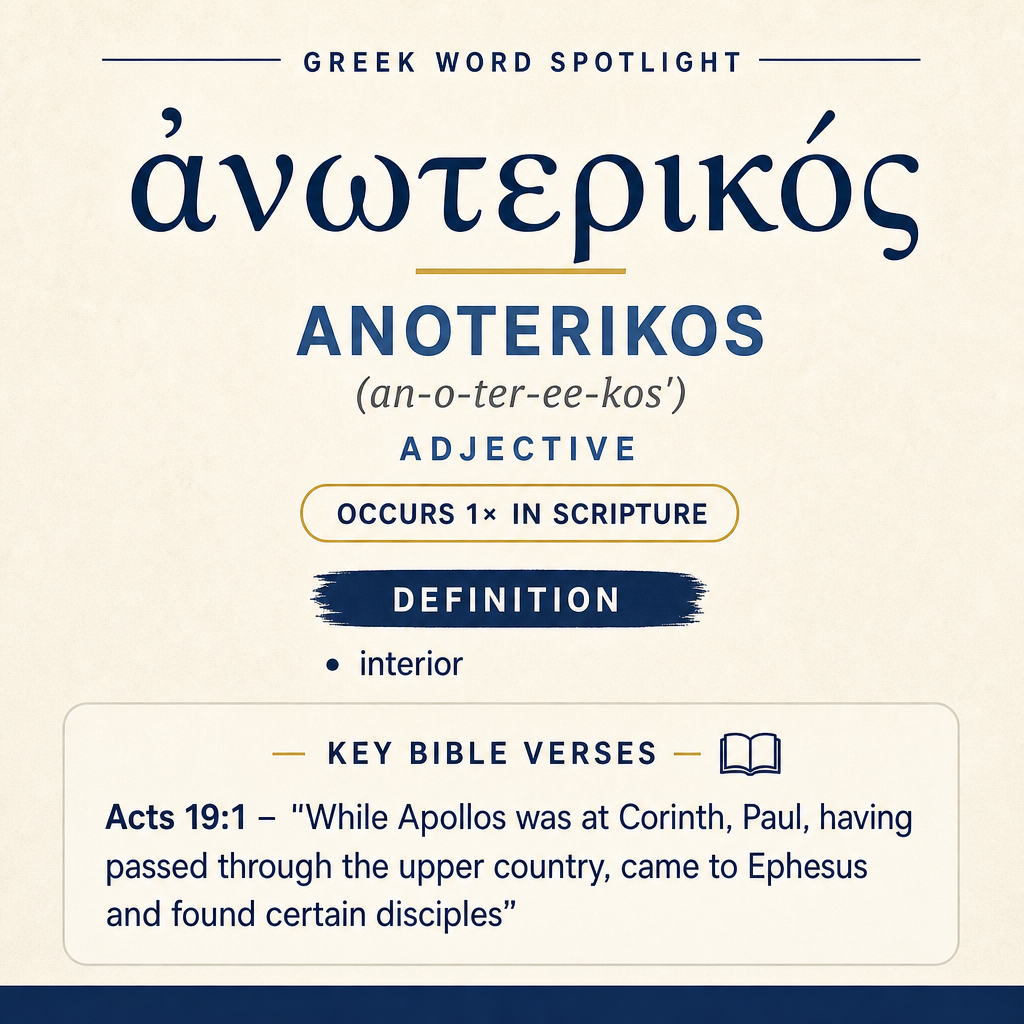
ἀνωτερικός means “interior” and appears once in Scripture in Acts 19:1.
Verse Context
Acts 19:1 describes Paul passing through the upper country, coming to Ephesus, and finding certain disciples.
Learn More →ἀνωτερικός refers to what is “interior,” and it appears once in the New Testament in the travel notice that brings Paul from one region to another. In its lone context, it helps specify the kind of route or region Paul traversed on his way to Ephesus.
Root and Related Words
ἀνωτερικός is related to the comparative adjective anoteros (ἀνώτερος), “higher” (Strong’s G511). The relationship points to a formed adjective that draws on the idea expressed by anoteros.
Occurrences
“While Apollos was at Corinth, Paul, having passed through the upper country, came to Ephesus and found certain disciples.” (Acts 19:1)
In Acts 19:1 the word occurs inside a compact itinerary. The sentence places Apollos at Corinth and then shifts attention to Paul, who is depicted in motion: he “passed through” a described region and then “came to Ephesus.” Within this travel framework, ἀνωτερικός functions as a locator that qualifies the “country” through which Paul traveled, distinguishing it from other possible approaches and giving the reader a clearer sense of the movement that precedes the arrival at Ephesus.
The narrative effect is twofold. First, it bridges scenes: the reference to travel compresses an interval between earlier activity and the new setting in Ephesus. Second, it quietly sets up what follows in the same verse: once Paul arrives, he “found certain disciples.” The mention of the route/region contributes to the realism and sequencing of the account—Paul does not simply appear at Ephesus; he comes there by way of a particular kind of “country.” ἀνωτερικός therefore serves the storytelling purpose of marking transition and orientation, anchoring the discovery of “certain disciples” in the concrete geography of Paul’s approach.
Sense and Usage
The definition “interior” fits a spatial description that contrasts an area characterized as inside, inland, or away from an edge. In Acts 19:1 the term modifies a geographic noun (“country”), so its sense is not abstract but topographical: it characterizes a tract of land as the interior portion in relation to some implied boundary. Even though the verse does not spell out that boundary, the phrase “passed through the upper country” shows how such an adjective can guide the reader’s mental map by placing Paul’s travel within a particular zone rather than leaving the route undifferentiated.
Because the word appears in a travel summary rather than in direct speech or in a theological argument, its contribution is primarily descriptive. It belongs to the kind of vocabulary that helps Luke’s narrative move efficiently across distance while still preserving specificity. The “interior” idea is not used to evaluate Paul or Apollos, nor to label the disciples; it is used to situate Paul’s movement. That placement matters narratively: Paul’s arrival at Ephesus is introduced as the result of an intentional passage through a defined region, and the scene’s next action—finding disciples—unfolds immediately upon reaching the destination.
Imagery
In its single occurrence, ἀνωτερικός evokes the image of travel through inland country before reaching a major city. Acts 19:1 invites the reader to picture a journey that moves across the “country” and ends at Ephesus, with the interior route functioning as the corridor through which the story advances to the encounter with “certain disciples.”
Sources: Lexical data from Strong’s Exhaustive Concordance and the Translators Brief Lexicon of Extended Strongs for Greek (STEPBible, CC BY). Occurrence data from the Translators Amalgamated Greek New Testament (STEPBible, CC BY). Scripture quotations from the World English Bible (public domain).