
Exploring the Meaning of ‘Aguwr in Hebrew
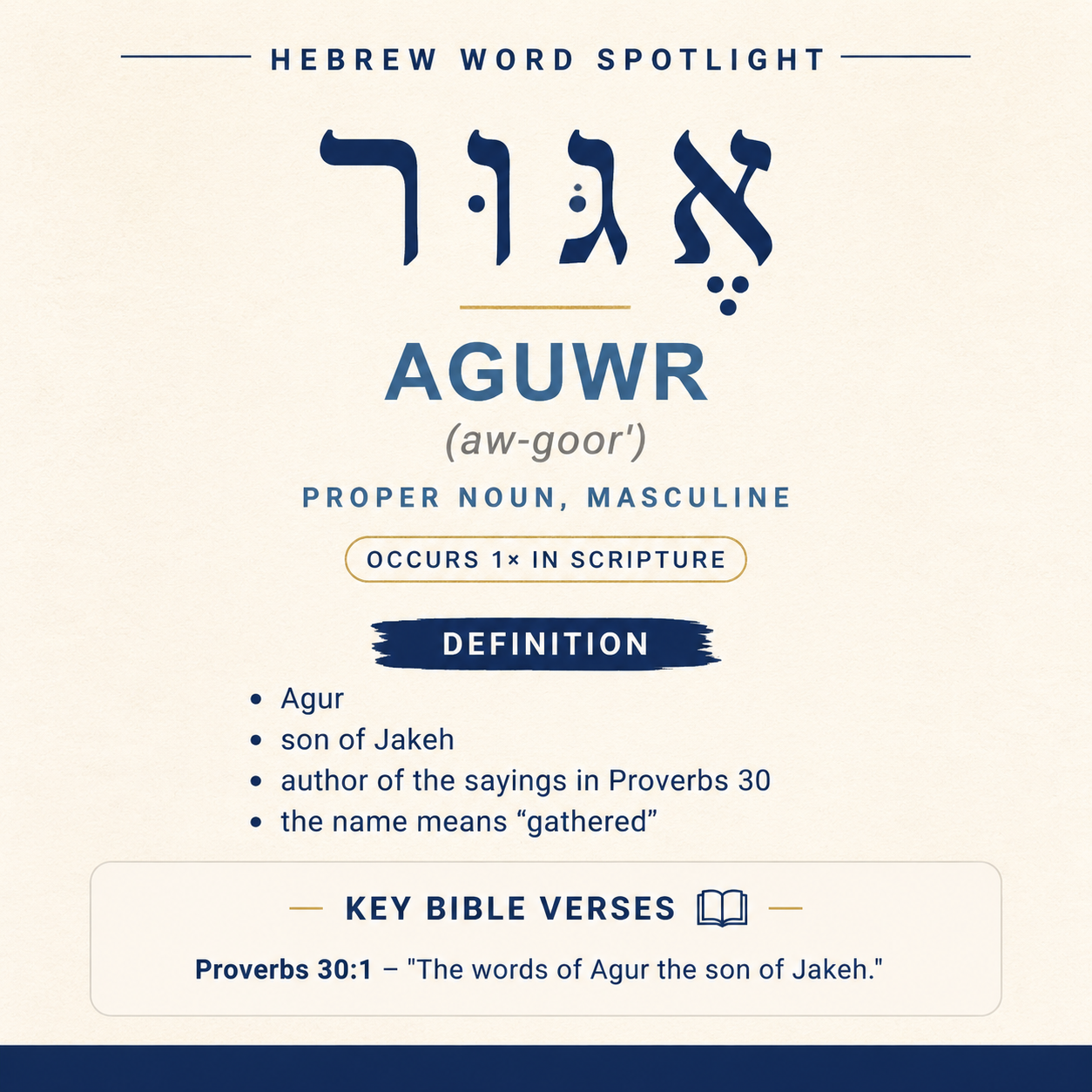
אָגוּר means “gathered” and appears in Proverbs 30:1 as Agur, son of Jakeh, author of the sayings in Proverbs 30.
Name & Meaning
אָגוּר is the name Agur, meaning “gathered.” He is identified as the son of Jakeh.
Learn More →Biblical Occurrence
The name occurs 1 time in Scripture. Its single occurrence is in Proverbs 30:1.
Learn More →Context in Proverbs
Proverbs 30:1 introduces “the words of Agur the son of Jakeh.” The verse addresses Ithiel and Ucal.
Learn More →אָגוּר (Aguwr) is the name of Agur, son of Jakeh, presented as the author of the sayings that follow in Proverbs 30. The name is explicitly tied to the sense “gathered” and appears in the heading line that introduces the section.
Root and Related Words
The name Aguwr is derived from the verb agar, “to gather” (Strong’s H103). In the form of a personal name, that root sense (“gathered”) functions as a compact characterization attached to the speaker who is about to be heard.

Occurrences
“The words of Agur the son of Jakeh; the revelation: the man says to Ithiel, to Ithiel and Ucal:” (Proverbs 30:1)
Here Aguwr stands in the opening label that frames everything that follows as “The words of Agur the son of Jakeh.” In that single line, the name performs two tasks at once. First, it anchors the coming material in a particular voice: these are “words” attributed to a named speaker rather than anonymous maxims. Second, it situates that speaker by immediate family identification, “the son of Jakeh,” which gives the reader a fixed personal reference point for the sayings.
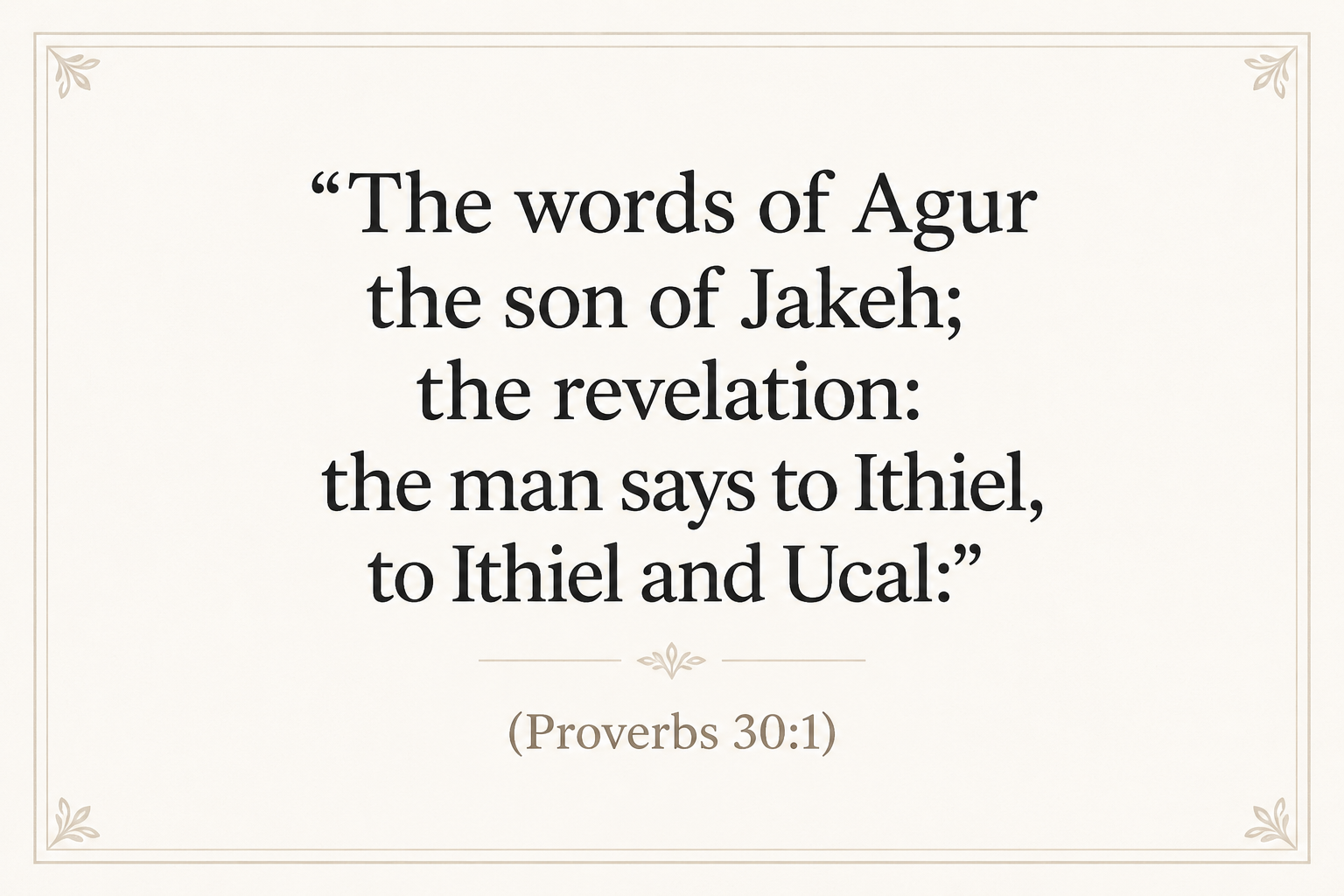
The rest of the line extends the heading with a second descriptor, “the revelation,” and then shifts into reported speech: “the man says to Ithiel, to Ithiel and Ucal.” Within this compact introduction, Aguwr is therefore connected with a setting of communication. The name appears at the head of a discourse that is both addressed (spoken “to Ithiel … and Ucal”) and framed as a revealed message (“the revelation”). In this scene, the function of Aguwr is not merely to supply a label, but to mark the sayings as transmitted from a specific speaker in a particular speech situation: a man speaking to named hearers.
Sense and Usage
As a proper name, Aguwr designates an individual—“Agur, son of Jakeh”—and, in this context, identifies him as the author of the sayings introduced in Proverbs 30. The heading’s phrasing treats him as the source from whom “the words” come, making the personal name an organizing marker for the section. The name’s stated sense, “gathered,” fits naturally within a superscription that presents a collected body of instruction as “words”: the opening line signals that what follows has been assembled and handed on under this speaker’s name.
The wording of Proverbs 30:1 also places Aguwr at the intersection of wisdom speech and disclosure. The phrase “the revelation” indicates that these are not presented merely as casual observations, but as a message cast in the form of an utterance delivered to others. The name Aguwr therefore functions in a literary heading that does more than identify a person; it frames a chain of communication: from the named author (“Agur the son of Jakeh”), through the category of the material (“The words …; the revelation”), into an address to specific hearers (“to Ithiel … and Ucal”). Within that framing, the proper name helps establish accountability and voice—whose words these are—and prepares the reader to receive what follows as a coherent set of sayings associated with a particular speaker.
Because Aguwr appears in a heading rather than within the body of the discourse (as quoted here), its usage is primarily identificatory and introductory. The name signals authorship and introduces a speech act (“the man says”), so that the reader is oriented both to the speaker’s identity and to the fact that these “words” are presented as spoken instruction directed toward named recipients. The meaning “gathered,” attached to the name itself, contributes a subtle resonance to this introductory function: the sayings are presented as a gathered set of words associated with a gathered-name speaker, set at the threshold of a section marked as revealed instruction.
Imagery
Proverbs 30:1 paints the opening picture of a spoken exchange: “the man says to Ithiel, to Ithiel and Ucal.” In that scene, Aguwr stands as the named voice from whom the “words” come, and the name’s sense “gathered” sits naturally beside the image of words collected into a teachable message and delivered to hearers.
Sources: Lexical data from Strong’s Exhaustive Concordance and the Open Scriptures Hebrew Lexicon. Occurrence data from the Westminster Leningrad Codex with STEPBible reference data (CC BY). Scripture quotations from the World English Bible (public domain).





