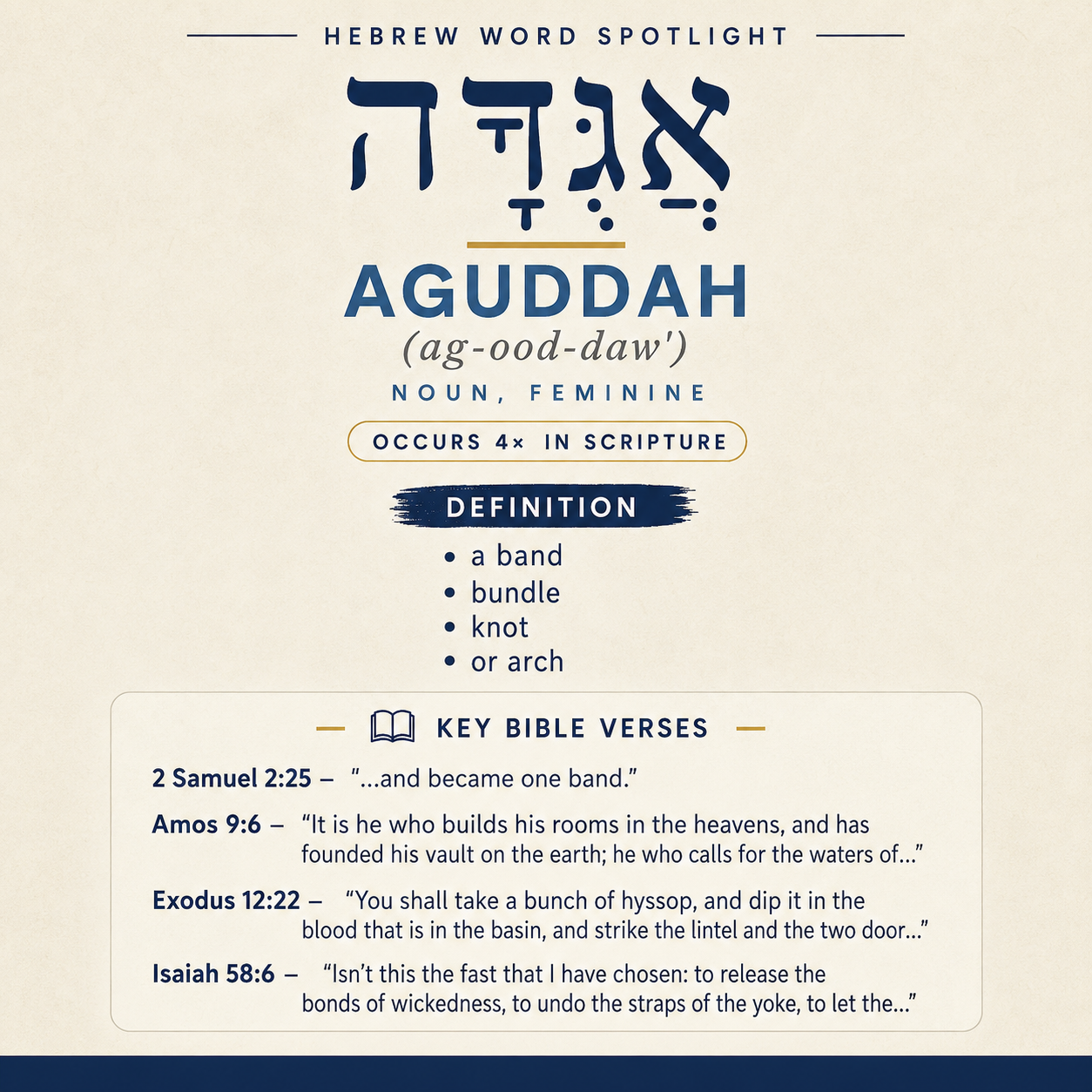
Exploring the Meaning of ‘aguddah in Hebrew
אֲגֻדָּה (aguddah) means a band, bundle, knot, or arch, appearing four times in 2 Samuel 2:25, Exodus 12:22, Amos 9:6, and Isaiah 58:6.
Core Meaning
אֲגֻדָּה means a band, bundle, knot, or arch. Each sense reflects something bound together or formed as a unit.
Learn More →Biblical Usage
In 2 Samuel 2:25 it describes the Benjaminites becoming “one band.” In Exodus 12:22 it refers to a “bunch of hyssop.”
Learn More →Other Occurrences
Amos 9:6 uses it in the context of God founding his vault on the earth. Isaiah 58:6 uses it in a call to undo bonds related to wickedness and oppression.
Learn More →אֲגֻדָּה (aguddah) names something bound or gathered: a band, bundle, knot, or an arch. In Scripture it appears in scenes as varied as soldiers forming a single unit, a ritual bunch used for application, a cosmic “vault” founded on the earth, and the loosening of oppressive bonds.
Occurrences
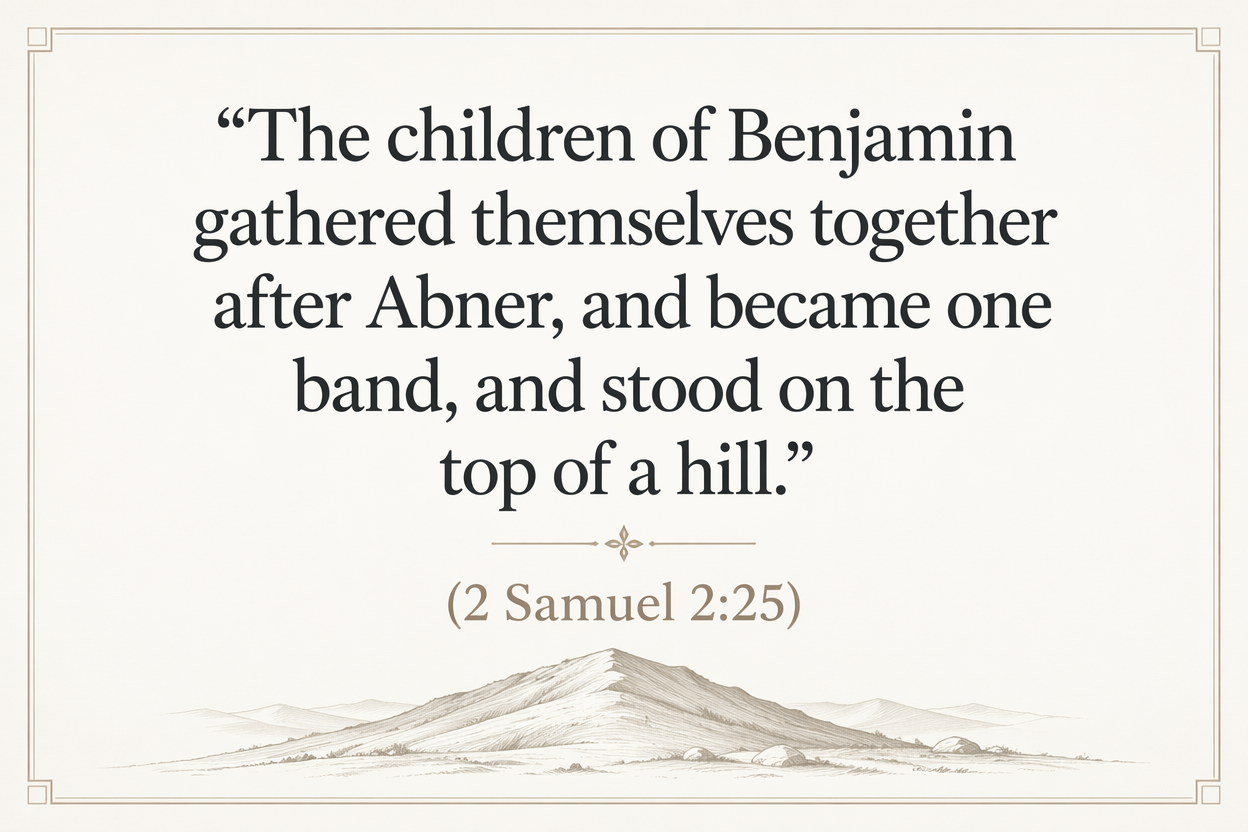
“The children of Benjamin gathered themselves together after Abner, and became one band, and stood on the top of a hill.” (2 Samuel 2:25)
Here אֲגֻדָּה marks a newly unified formation. The verse moves from action (“gathered themselves together”) to result (“became one band”) to posture and location (“stood on the top of a hill”). The word contributes the sense of a group bound into a single entity—no longer merely individuals following Abner, but a consolidated unit able to hold a position. The setting on “the top of a hill” underscores cohesion: the band presents itself as one body in a defensible stance.
“It is he who builds his rooms in the heavens, and has founded his vault on the earth; he who calls for the waters of the sea, and pours them out on the surface of the earth; Yahweh is his name.” (Amos 9:6)
In this doxological description of divine power, אֲגֻדָּה is rendered “vault,” pairing with “rooms in the heavens.” The word contributes architectural and structural imagery: something set in place, spanning or curving, “founded…on the earth.” Within the verse, the “vault” sits between two acts of cosmic ordering—building above (“rooms in the heavens”) and directing the sea’s waters below (“calls for the waters of the sea, and pours them out”). The term thus serves as a concrete picture of an ordered world, in which even what arches overhead or is fixed upon the earth rests on purposeful design.
“You shall take a bunch of hyssop, and dip it in the blood that is in the basin, and strike the lintel and the two door posts with the blood that is in the basin. None of you shall go out of the door of his house until the morning.” (Exodus 12:22)
In this instruction, אֲגֻדָּה appears as a “bunch of hyssop,” an explicitly gathered bundle suited for a precise act: dipping and striking. The bundle is not an incidental detail; it is the instrument that makes the application possible—hyssop gathered into a usable unit, then used to transfer “the blood that is in the basin” onto “the lintel and the two door posts.” The verse’s repeated reference to the blood and its placement emphasizes careful, bounded action: a single “bunch” becomes the means of marking the entryway, and the household is then to remain inside until morning. The word’s sense of bundled-togetherness fits the practical need for an implement that holds together and can be grasped.
““Isn’t this the fast that I have chosen: to release the bonds of wickedness, to undo the straps of the yoke, to let the oppressed go free, and that you break every yoke?” (Isaiah 58:6)
Isaiah uses אֲגֻדָּה in the sphere of restraint and release: “bonds of wickedness.” The verse piles up expressions of binding and loosening—“bonds,” “straps,” “yoke”—and answers them with actions that reverse constraint: “release,” “undo,” “let…go free,” “break.” In this rhetorical description of the fast God chooses, the word contributes the image of tightened ties that hold people under wrong and weighty control. It stands alongside the “straps of the yoke,” presenting oppression as something secured by cords and fastenings; true fasting is pictured as the untying and breaking of those fastenings.

Sense and Usage
The uses of אֲגֻדָּה cluster around the idea of multiple elements held together or fixed into a unit, whether that unit is social, physical, structural, or metaphorical. In 2 Samuel 2:25, it describes people gathered into a single fighting body; the word gives a name to the cohesion that results when individuals become one band. In Exodus 12:22, it denotes a bundle of plant material, gathered for a ritual action; the bunch functions because its many stems or sprigs are bound into one manageable implement.
Amos 9:6 extends the term beyond what can be held in the hand or counted as a troop, applying it to the built environment of the world: a “vault” that is “founded…on the earth.” Here the word’s range reaches architectural form, allowing a “band/bundle/knot” concept to serve the image of something spanning and set firmly in place—an arch-like structure belonging to the ordered cosmos. The verse’s building language (“builds,” “rooms,” “founded”) makes the word feel like part of a constructed whole, as though the world’s layout is assembled and secured.
Isaiah 58:6 takes the binding idea into moral and social reality: “bonds of wickedness.” The word’s contribution lies in depicting wrongdoing and oppression as something that ties people up. It sits in parallel with “straps” and “yoke,” which likewise depend on being fastened to be effective. The actions commanded—release, undo, break—implicitly treat these bonds as knotted or strapped systems that can be loosened or snapped. Thus the term’s semantic field includes both literal bundling and the figurative “knotting” of persons into unjust constraint.
Across these four passages, the word’s flexibility is notable: it can point to a coherent group, a gathered tool, a structural feature of the world, or binding restraints. In each case the core idea is not mere plurality but plurality made one—many people as one band, many sprigs as one bunch, a spanning structure as one vault, and constraining forces as bonds that hold. The word naturally fits contexts that emphasize unity, fastening, and the practical effects of being tied together, whether for strength and formation, for application and marking, for stable architecture, or for control that must be undone.
Imagery
The passages that use אֲגֻדָּה paint vivid “bound” pictures. A band of Benjamites stands together on a hill (2 Samuel 2:25), a bundled plant is dipped and applied to a doorway (Exodus 12:22), the world is described with a vault founded on earth (Amos 9:6), and unjust life is portrayed in bonds and yokes that must be released and broken (Isaiah 58:6). Taken together, the word carries a concrete feel: unity that can be seen in a formation, held in the hand as a bunch, envisioned as an arching structure, or recognized in the tightness of restraint—and, in Isaiah’s call, in the liberating act of loosening what has been tied.
Sources: Lexical data from Strong’s Exhaustive Concordance and the Open Scriptures Hebrew Lexicon. Occurrence data from the Westminster Leningrad Codex with STEPBible reference data (CC BY). Scripture quotations from the World English Bible (public domain).