Exploring the Meaning of ‘agmown in Hebrew
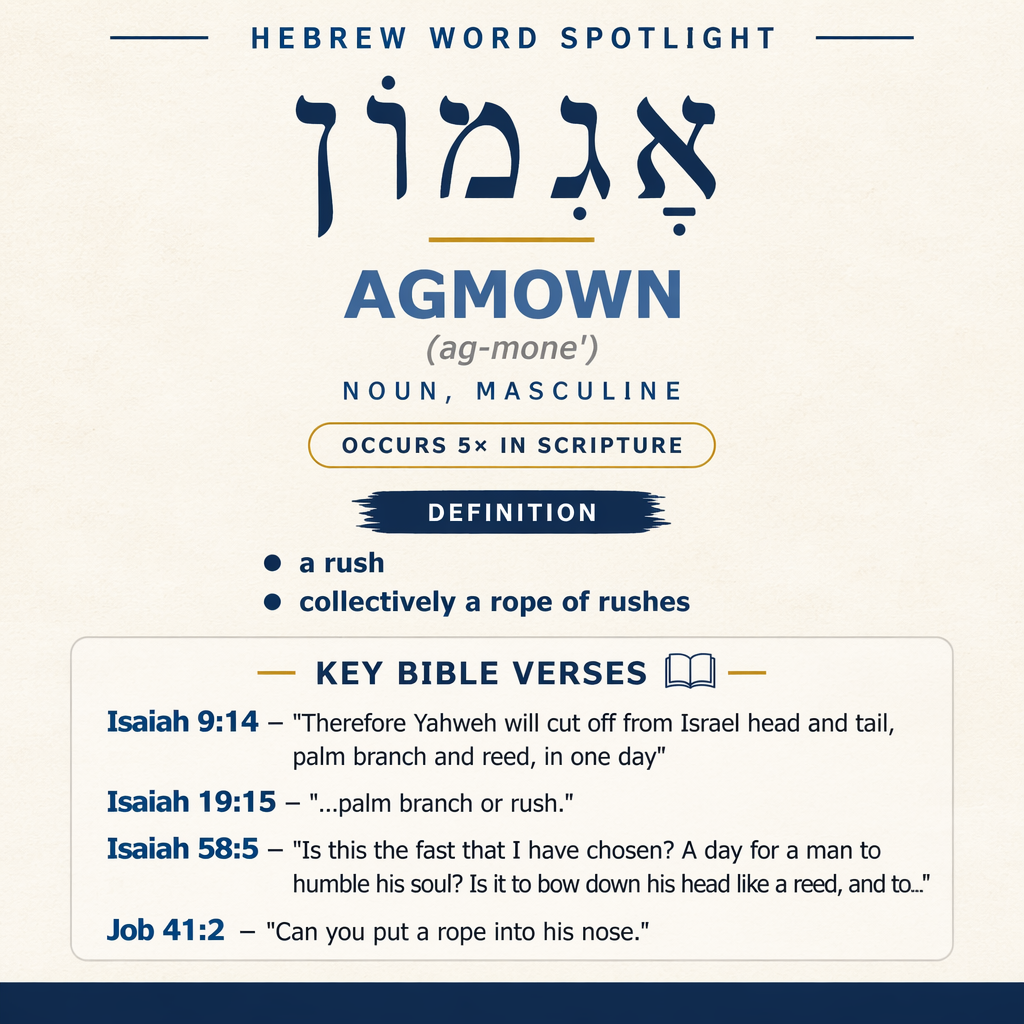
אַגְמוֹן means “a rush,” collectively “a rope of rushes,” appearing five times in Isaiah (9:14; 19:15; 58:5) and Job (41:2, 41:20).
Isaiah Occurrences
In Isaiah 9:14 and 19:15, it appears alongside “head and tail” and “palm branch.” In Isaiah 58:5, it is used in the image of bowing the head like a reed.
Learn More →Job Occurrences
In Job 41:2, it refers to a rope used in the context of putting something into the nose. In Job 41:20, it appears in the phrase “a fire of reeds.”
Learn More →אַגְמוֹן (agmown) denotes “a rush; collectively a rope of rushes.” It appears in poetic-prophetic contrasts in Isaiah and in vivid, concrete imagery in Job 41.

Occurrences
“Therefore Yahweh will cut off from Israel head and tail, palm branch and reed, in one day.” (Isaiah 9:14)
Here the word stands in a paired expression with “palm branch,” set within a larger image of total removal: “head and tail” and then “palm branch and reed.” The rush functions as one end of a merism-like set of plant imagery, so that what is “cut off” is not a single item but a whole range. The rush, a slender wetland plant, fits the sense of something easily severed, and the verse’s force lies in the suddenness and completeness: “in one day.” In this line, the rush is not described for its own sake; it is part of a stock of images that together communicate thorough cutting off.
“Neither shall there be any work for Egypt, which head or tail, palm branch or rush, may do.” (Isaiah 19:15)
This occurrence echoes the same pairing (“head or tail, palm branch or rush”), but now the point is not cutting off; it is the absence of effective action: “Neither shall there be any work for Egypt.” The rush, again juxtaposed with “palm branch,” participates in a comprehensive statement that no segment—however pictured—can accomplish the needed “work.” The plant-pair intensifies the breadth of the negation: whether one imagines the “head” or the “tail,” the “palm branch” or the “rush,” none can produce the outcome implied by “work.” The rush helps fill out that picture of total incapacity.
“Is this the fast that I have chosen? A day for a man to humble his soul? Is it to bow down his head like a reed, and to spread sackcloth and ashes under himself? Will you call this a fast, and an acceptable day to Yahweh?” (Isaiah 58:5)
In this verse the rush provides a simile for posture: “to bow down his head like a reed.” The comparison depends on the physical behavior of a rush: it can bend, droop, or fold over. The imagery places external gestures (“bow down,” “spread sackcloth and ashes”) under scrutiny by posing the rhetorical question of what constitutes the fast Yahweh has chosen. The rush image is therefore not ornamental; it sharpens the critique by picturing humility as a mere physical act, easy to perform and as visually conspicuous as a bent reed. Within the sentence, the rush is a benchmark for a visible but potentially superficial self-abasement.
“Can you put a rope into his nose, or pierce his jaw through with a hook?” (Job 41:2)
Here the definition’s collective sense (“a rope of rushes”) comes to the foreground through the English word “rope.” The line imagines restraining a powerful creature by threading something through “his nose” or controlling him with “a hook” through the jaw. Against that question, the “rope” becomes an emblem of human attempts at mastery and restraint. If the rope is conceived as made from rushes, the implied contrast is between a made, pliable binding and the formidable strength of the animal being addressed. The rushes are not described as a plant in this verse; they lie behind the concrete object “rope,” which is central to the challenge: can such control actually be imposed?
“Out of his nostrils a smoke goes, as of a boiling pot over a fire of reeds.” (Job 41:20)
In this scene the rushes appear as fuel: “a fire of reeds.” The verse builds an intense picture with domestic and elemental comparisons—“a boiling pot,” “a fire,” and smoke—linked to the creature’s “nostrils.” Rushes, gathered and burned together, fit the phrase “a fire of reeds,” evoking quick, crackling combustion and visible smoke. The comparison is not abstract; it turns the creature’s exhalation into a sensory experience: heat, smoke, and the image of a pot set above a rapidly burning fire. The rush here contributes to the plausibility and vividness of the simile by anchoring it in common materials used to kindle flame.
Sense and Usage
The provided definition contains two closely connected ideas: the rush as a plant and the rushes collectively as a rope. Across the passages, both come into view through different angles of imagery. In Isaiah 9:14 and Isaiah 19:15, the rush belongs to a fixed poetic pairing (“palm branch and reed/rush”) that works as shorthand for breadth and totality. The rush is the light, flexible counterpart in that pair, and it helps carry the rhetorical weight of “head and tail,” reinforcing that the statement reaches from one end to the other and leaves no remainder. These uses treat the rush as part of a class of natural items invoked to communicate comprehensiveness, rather than to offer botanical detail.
Isaiah 58:5 shifts from merism to simile. The rush becomes a model for bodily movement—specifically, the way a head can be bent down. This use draws on a rush’s physical properties (its bending, its slenderness) in order to illustrate a gesture of humbling oneself. In that context, the rush functions as a visible, easily recognized picture: the person’s posture is as conspicuous as a drooping reed. The verse’s questions set that visual performance against the larger issue of what makes a fast “acceptable,” and the rush image tightens the contrast between outward form and the deeper matter under interrogation.
In Job 41, the word’s collective sense surfaces in two different material domains: binding and burning. In Job 41:2, “rope” is the implement of restraint imagined as placed “into his nose.” The underlying idea of rushes gathered into a cord suits that tool: it is something made by humans from ordinary materials, intended to control. The question is designed to expose the mismatch between human implements and the creature’s untamable power. In Job 41:20, rushes are not twisted into a cord but bundled and ignited; they form “a fire of reeds” that produces smoke and heat. The word therefore spans both crafted and combustible uses: rushes can be collected into a binding rope, or collected into fuel for flame. Together, these Job scenes treat rushes as common, graspable materials set beside something overwhelming, heightening the sense of scale and intensity.
Across these five occurrences, the rush is consistently concrete and physical. Whether it is pictured standing as a plant, drooping like a bent head, woven into a rope, or burned as fuel, it contributes tangible texture to the lines in which it appears. The rush can mark a range (with the palm branch), model a posture (as something that bends), and supply a human-scale object (rope) or a quick-burning fire—each fitting within the immediate wording of its verse.
Imagery
The passages that use אַגְמוֹן (agmown) make it carry two kinds of imagery at once: fragility and usefulness. In Isaiah, the rush is part of a set that can be “cut off,” or can stand for segments that cannot do “any work.” In Isaiah 58:5 it is an image of a head bowed low. In Job 41, the same word can evoke something made for control (“a rope”) and something that flares up under a pot (“a fire of reeds”). Taken together, these lines keep returning to the rush as an ordinary, accessible material—one that can be cut, bent, gathered, twisted, and burned—set into speech that emphasizes totality, critique, and awe.
Sources: Lexical data from Strong’s Exhaustive Concordance and the Open Scriptures Hebrew Lexicon. Occurrence data from the Westminster Leningrad Codex with STEPBible reference data (CC BY). Scripture quotations from the World English Bible (public domain).