Unraveling the Meaning of ‘Aggaph in Hebrew
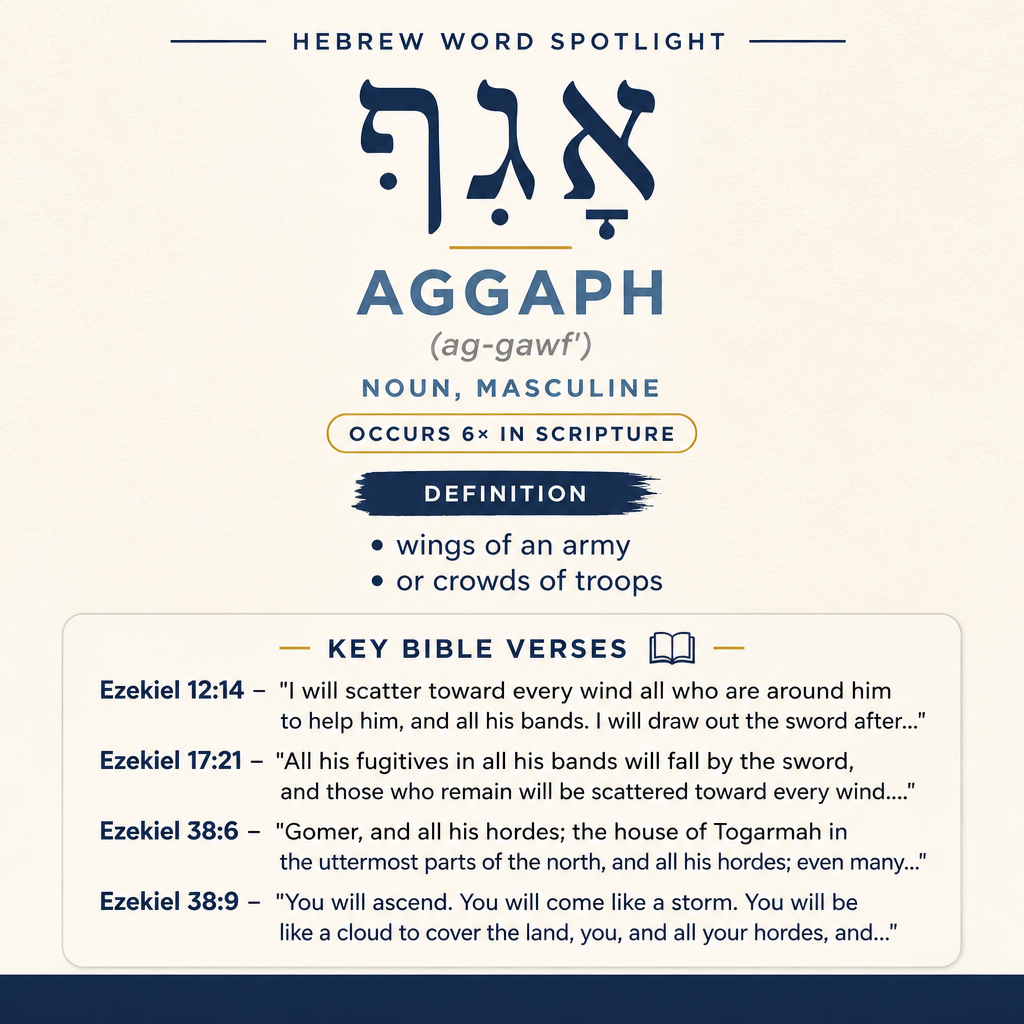
אַגָּף means “wings of an army” or “crowds of troops,” appearing six times in Scripture, all in Ezekiel (12, 17, 38, 39).
Core Meaning
אַגָּף refers to military groupings: “wings of an army” or “crowds of troops.”
Learn More →Where It Appears
This word occurs six times in the book of Ezekiel. The references are Ezekiel 12:14; 17:21; 38:6, 38:9, 38:22; and 39:4.
Learn More →Context in Ezekiel
In Ezekiel 12:14 and 17:21 it is used of “bands” scattered and struck down. In Ezekiel 38–39 it describes “hordes” associated with invading forces.
Learn More →אַגָּף (aggaph) refers to the wings of an army, that is, crowds of troops. In Scripture it appears in Ezekiel, where it helps depict military groupings that scatter, advance in mass, and fall under judgment.

Occurrences
Ezekiel 12:14: “I will scatter toward every wind all who are around him to help him, and all his bands. I will draw out the sword after them.”
Here aggaph is expressed in English as “bands,” placed alongside “all who are around him to help him.” The pairing presents two concentric realities: helpers close at hand, and the broader troop groupings attached to them. The focus is not on a single soldier but on the military “wings” or troop-crowds as a body—units that can be scattered “toward every wind.” The word contributes a sense of organized numbers that, despite their cohesion as bands, are made vulnerable to dispersal and pursuit: “I will draw out the sword after them.”
Ezekiel 17:21: “All his fugitives in all his bands will fall by the sword, and those who remain will be scattered toward every wind. Then you will know that I, Yahweh, have spoken it.’”
In this setting, aggaph again appears as “bands,” but now framed by “fugitives” who belong to them: “All his fugitives in all his bands.” The word helps describe the structure within which people attempt escape—fugitives are not pictured as detached individuals but as part of troop-crowds. Two outcomes then divide the bands: many “will fall by the sword,” and “those who remain will be scattered toward every wind.” Aggaph thus supports a scene where military crowding does not guarantee protection; even the army’s “wings” break apart under defeat, leaving a remnant that is dispersed rather than regrouped.
Ezekiel 38:6: “Gomer, and all his hordes; the house of Togarmah in the uttermost parts of the north, and all his hordes; even many peoples with you.”
Here aggaph is rendered “hordes,” shifting the feel from smaller “bands” to a larger mass. The verse lists groups brought together: “Gomer, and all his hordes,” then “the house of Togarmah… and all his hordes,” and finally “many peoples with you.” Aggaph contributes to the impression of breadth and depth—each named partner arrives not merely with a token force but with the full crowding strength of its troops. The repeated “all his hordes” stresses completeness: not a fraction, but the gathered “wings” of military power accompanying each ally.
Ezekiel 38:9: “You will ascend. You will come like a storm. You will be like a cloud to cover the land, you, and all your hordes, and many peoples with you.”
In this vivid advance, aggaph (“hordes”) is embedded in storm-and-cloud imagery. The movement is upward and forward—“You will ascend. You will come like a storm”—and the army is compared to an overwhelming weather front: “like a cloud to cover the land.” Aggaph helps supply the human scale that makes the metaphor concrete: “you, and all your hordes, and many peoples with you.” The word marks the troops as a mass capable of filling the horizon, the kind of crowd that makes “cover the land” feel like more than poetry; it is the felt effect of huge military wings pressing forward together.
Ezekiel 38:22: “I will enter into judgment with him with pestilence and with blood. I will rain on him, and on his hordes, and on the many peoples who are with him, an overflowing shower, with great hailstones, fire, and sulfur.”
This occurrence places aggaph within a targeted judgment that is both judicial (“enter into judgment”) and catastrophic in its means (“pestilence and with blood”). The object of the onslaught is expanded in three layers: “on him,” then “on his hordes,” then “on the many peoples who are with him.” Aggaph serves as the principal term for the leader’s troop-crowds—his military “wings”—which are not incidental to the judgment but explicitly included. The rain imagery is intense and particular: “an overflowing shower, with great hailstones, fire, and sulfur.” In that setting, aggaph helps keep the judgment from being only a strike against a commander; it is judgment that reaches the assembled crowds of troops themselves.
Ezekiel 39:4: “You will fall on the mountains of Israel, you, and all your hordes, and the peoples who are with you. I will give you to the ravenous birds of every sort, and to the animals of the field to be devoured.”
The final use continues the language of massed forces—“all your hordes”—but now in the aftermath of defeat. The fall is located: “on the mountains of Israel.” Aggaph contributes to the scale of the collapse: not only the addressed leader (“you”) but also the full troop-crowds attached to him, along with allied “peoples.” The grim disposal that follows—given “to the ravenous birds of every sort, and to the animals of the field to be devoured”—assumes a battlefield littered with many bodies. In this scene, aggaph supports the portrayal of an army’s “wings” brought low together, their numbers underscoring the completeness of the reversal.
Sense and Usage
Across these six occurrences, aggaph consistently marks military groupings as a crowd—troops considered in the aggregate rather than as isolated combatants. The definition allows two complementary angles: as “wings of an army,” aggaph can suggest the spread of forces around a leader, the extensions of his power that flank and support him; as “crowds of troops,” it highlights sheer numbers, bodies gathered into a moving mass. Ezekiel uses the term in contexts where those groupings either fail to protect (they scatter “toward every wind,” they “fall by the sword”) or intensify the sense of threat (they come “like a storm… like a cloud to cover the land”).
The English renderings “bands” (Ezekiel 12:14; 17:21) and “hordes” (Ezekiel 38:6; 38:9; 38:22; 39:4) show how the same Hebrew term can be heard on a spectrum from organized detachments to immense hosts. In the “bands” passages, aggaph is close to the immediate circle of a central figure—helpers and fugitives attached to “him,” implying troop units associated with a specific leader. In the “hordes” passages, aggaph expands the canvas: multiple peoples join with their full troop-crowds, and the host is so numerous that weather metaphors—storm and cloud—fit naturally.
In each scene, aggaph is also tightly linked to verbs of movement and outcome. The troop-crowds can be “scatter[ed] toward every wind,” they can “fall by the sword,” they can “ascend” and “come,” they can be rained upon in judgment, and they can “fall on the mountains.” The word thus functions as a carrier for corporate fate: what happens is not merely a private end but the unraveling, advance, or destruction of the assembled wings of military power.
Imagery
Ezekiel’s repeated pairing of aggaph with expansive images—winds scattering in multiple directions, a cloud covering the land, and a deluge of judgment—casts military crowds as something that fills space. The troop “wings” spread out and seem to dominate, yet the same breadth becomes the stage on which defeat is made visible: scattered “toward every wind,” struck under an “overflowing shower,” and fallen across the “mountains of Israel” for birds and animals. Aggaph therefore carries a strong sense of scale in these passages: the gathered crowd that looks overwhelming in motion is also the gathered crowd that can be comprehensively broken.
Sources: Lexical data from Strong’s Exhaustive Concordance and the Open Scriptures Hebrew Lexicon. Occurrence data from the Westminster Leningrad Codex with STEPBible reference data (CC BY). Scripture quotations from the World English Bible (public domain).