Unraveling the Meaning of ‘Admoniy in Hebrew
אַדְמֹנִי means “reddish” and appears three times in Scripture: 1 Samuel 16:12, 1 Samuel 17:42, and Genesis 25:25.
Esau Described
In Genesis 25:25, the firstborn is described as red all over and named Esau.
Learn More →אָדְמֹנִי describes a reddish appearance and is used of two figures introduced by their outward look: David in the narratives of his anointing and his meeting with the Philistine, and Esau at birth. In each setting it functions as a concrete visual descriptor embedded among other details of physical appearance.
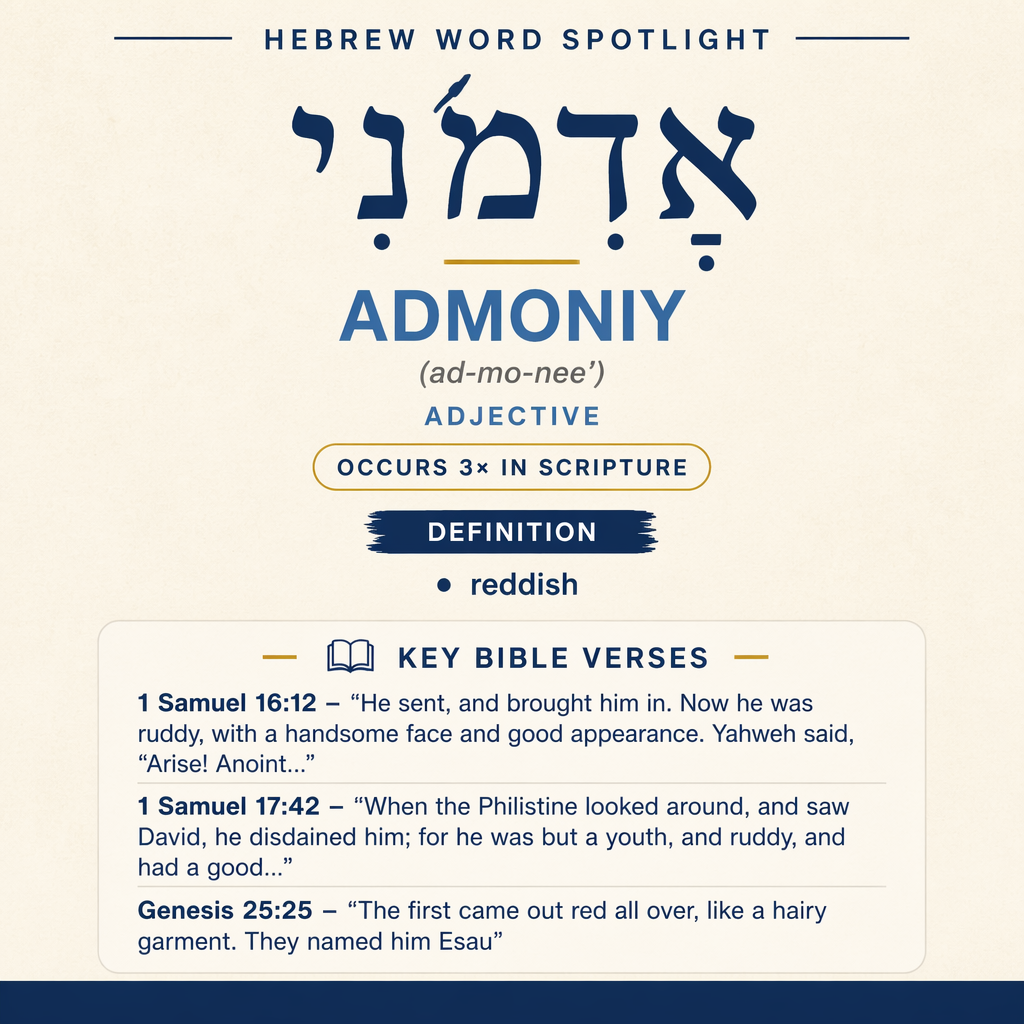
Occurrences
“He sent, and brought him in. Now he was ruddy, with a handsome face and good appearance. Yahweh said, “Arise! Anoint him, for this is he.”” (1 Samuel 16:12)
Here the word appears in a compact portrait that precedes a decisive action: David is brought in, his appearance is described, and Yahweh immediately identifies him as the one to be anointed. “Ruddy” stands alongside “a handsome face and good appearance,” so the reddish coloring is not isolated as a flaw or defect but forms part of a favorable overall impression. Within the flow of the sentence, the description functions as the reader’s first visual access to David at the moment he is selected; the narrative invites the audience to see him as he enters, before any spoken word from him is recorded. In this scene, the adjective helps paint a vivid, lifelike entrance: the selection is attached to a recognizable human figure with observable features, not a merely abstract choice.

“When the Philistine looked around, and saw David, he disdained him; for he was but a youth, and ruddy, and had a good looking face.” (1 Samuel 17:42)
In this episode the word is placed in the mouth of the narrator’s explanation for the Philistine’s contempt: he “disdained him” because David looked a certain way. The list is telling: “but a youth” (age and apparent inexperience) is paired with “ruddy” and “a good looking face” (features that can read as softness or lack of battle-hardness to an enemy evaluating an opponent at a glance). The reddish look thus participates in a perception-event: the Philistine “looked around, and saw David,” and the contempt is anchored in what is visible. The adjective helps underscore the mismatch between the enemy’s assessment—based on appearance—and the conflict that is about to unfold. It also connects this scene to David’s earlier introduction, keeping his outward description consistent across different moments: first as the one brought in to be anointed, and later as the one dismissed by an adversary.
“The first came out red all over, like a hairy garment. They named him Esau.” (Genesis 25:25)
In Genesis the descriptor belongs to the moment of birth and is intensified by the phrasing “red all over,” reinforced by the striking comparison “like a hairy garment.” The adjective here does not merely point to a localized feature (such as cheeks) but to an overall coloration that covers the newborn. The text pairs color with texture: redness is presented together with hairiness, producing a strong, memorable image. The clause “The first came out” marks this as an initial identifying characteristic, and the naming that follows (“They named him Esau”) highlights how closely early observable traits and identity can be linked within the narrative. The adjective contributes to the birth scene by making it visually immediate and somewhat unusual—an entry into the world marked by a distinctive look.

Sense and Usage
Across these passages, אָדְמֹנִי functions as a straightforward color-term used for bodily appearance, but its narrative role varies with the scene. In the two Samuel occurrences, it is one element in a triad of descriptors (“ruddy … handsome/good looking … good appearance”) that frames how David is seen by others at key turning points: his anointing and his being appraised by an enemy. In 1 Samuel 16:12, the color descriptor sits within a positive presentation that immediately precedes Yahweh’s command to anoint him; the emphasis is on recognizability and immediacy—David is not introduced by lineage or speech in the quoted line, but by what is visible as he arrives. In 1 Samuel 17:42, the same kind of visibility becomes the basis for misunderstanding: the Philistine’s disdain is linked to the combination of youthfulness and attractive appearance, with “ruddy” contributing to the impression that David is not an imposing warrior.
Genesis 25:25 uses the reddish descriptor differently. Instead of balancing it with remarks about handsomeness, it amplifies and illustrates it: “red all over, like a hairy garment.” The simile evokes a full-body covering and makes the color feel pervasive. In this context, the word’s force lies in its capacity to create a vivid first impression at a foundational moment—birth—so that the reader can picture the child instantly. The narrative attaches the adjective to the timing “The first came out,” so the redness serves as an inaugural marker, the earliest observable description in the quoted line.
These uses show the adjective’s flexibility within physical description: it can be one feature among several that together present a person as visually appealing (David), or it can be the dominant feature that defines an unusual appearance (Esau). In all three occurrences, the word is anchored to seeing: the reader is guided to picture the person—either by an onlooker’s gaze (“saw David”) or by the narrator’s report of what was observed at birth (“came out red all over”). The adjective thus carries a strong pictorial quality; it is economical, but it gives enough color-detail to make the scene tangible.
Imagery
The three passages place reddish coloring at moments of introduction and evaluation. David’s ruddy look is presented first in the quiet, decisive setting of being brought in and chosen for anointing, and later in the tense setting of being measured by an opponent’s eyes. Esau’s redness fills the birth scene with a striking, almost tactile image when paired with “like a hairy garment.” Taken together, these texts use a simple color-description to make key figures instantly visible in the mind: the chosen youth who is both attractive and underestimated, and the firstborn whose appearance at birth is rendered in bold, memorable detail.
Sources: Lexical data from Strong’s Exhaustive Concordance and the Open Scriptures Hebrew Lexicon. Occurrence data from the Westminster Leningrad Codex with STEPBible reference data (CC BY). Scripture quotations from the World English Bible (public domain).