Understanding the Meaning of Admatha in Hebrew
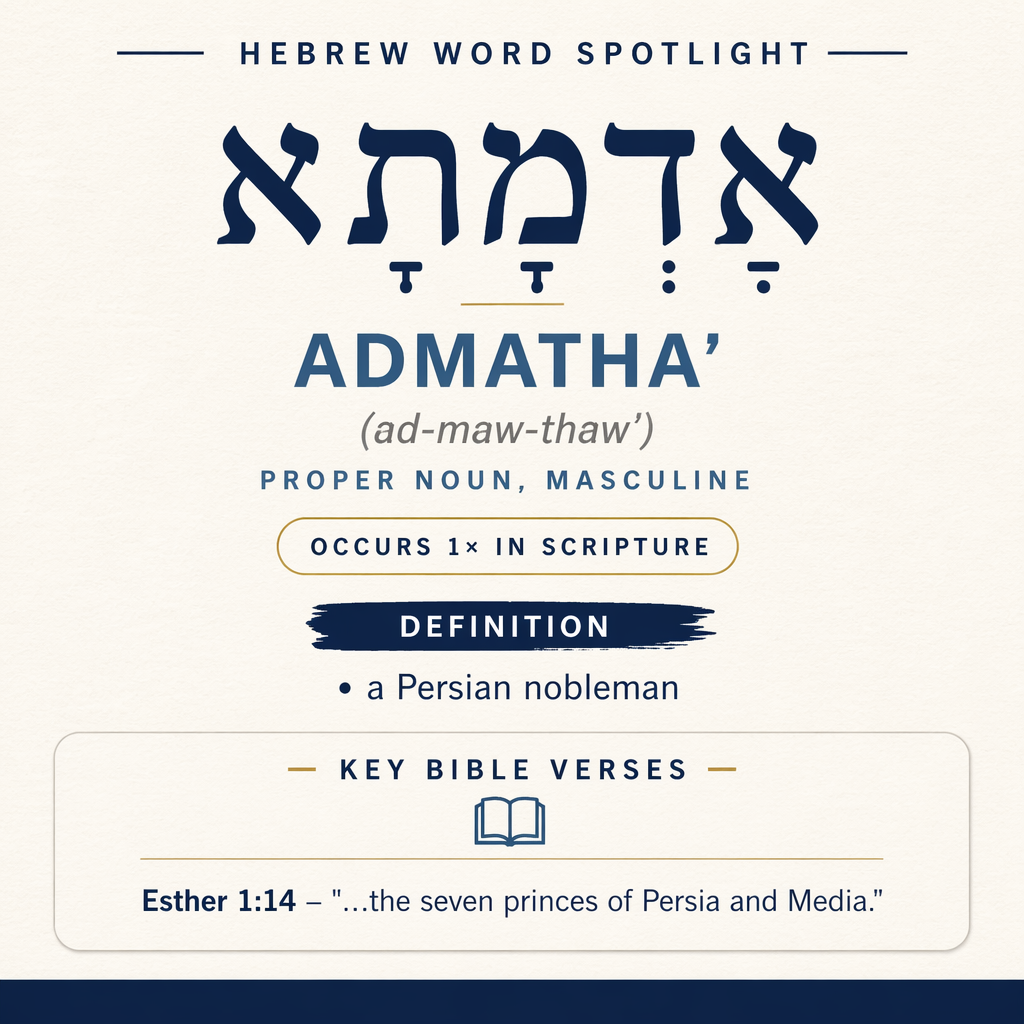
אַדְמָתָא (Admatha’) means a Persian nobleman and appears once in Scripture in Esther 1:14.
Scripture Context
In Esther 1:14, Admatha is listed among the seven princes of Persia.
Learn More →Admatha’ refers to a Persian nobleman named among the highest officials surrounding a king. The name appears in the court setting of Esther 1:14, within a formal list of princes who enjoyed privileged access and rank.
Occurrences
“and the next to him were Carshena, Shethar, Admatha, Tarshish, Meres, Marsena, and Memucan, the seven princes of Persia and Media, who saw the king’s face, and sat first in the kingdom),” (Esther 1:14)
Admatha’ occurs as one element in a carefully ordered roster: “Carshena, Shethar, Admatha, Tarshish, Meres, Marsena, and Memucan.” The placement of the name inside this sequence functions like a roll call at court, presenting Admatha’ not as an isolated figure but as part of a defined group with shared standing and duties. The verse frames these men as “the seven princes of Persia and Media,” and that designation sets the social and political weight carried by each individual name in the list, including Admatha’.
The description that follows the list provides the immediate narrative force of the mention: these princes are those “who saw the king’s face, and sat first in the kingdom.” In this setting, the name Admatha’ gains significance from proximity—proximity to the king (“saw the king’s face”) and proximity to power (“sat first in the kingdom”). The verse does not isolate Admatha’ for a separate action or speech; instead, it uses the name to fill out the composition of the inner circle. Admatha’ thus contributes to the picture of a structured, ranked court where authority is both personal (access to the king) and institutional (seating and precedence).
Because the text identifies the group as “the seven princes,” the list is not merely decorative. It signals completeness and official capacity: a fixed set of leading nobles who stand “next” to the king and occupy the foremost places. Admatha’ is presented as one of these, and the narrative effect is to anchor the court’s deliberative or administrative environment in named individuals rather than an anonymous mass. The mention of Admatha’ in this context works as a marker of legitimacy and formality—this is the recognized leadership tier, described in terms of both privilege and rank.

Sense and Usage
As a proper name belonging to “a Persian nobleman,” Admatha’ functions primarily to specify membership within a governing elite. In Esther 1:14, the definitional idea of noble status is not abstract: the verse expresses noble standing through visible court realities—named association with other princes, access to the king’s presence, and precedence in seating. Admatha’ is therefore a concrete instance of nobility as portrayed in a royal setting: identity is established by being counted among the principal men and by holding the right to approach and attend.
The verse’s explanatory apposition—“the seven princes of Persia and Media”—places Admatha’ within a dual-regional political frame (“Persia and Media”), which adds breadth to the courtly scene. The name belongs in a context where rank is tied to the empire’s leadership structure, and where those nearest the king embody the administrative reach of the realm. Within that structure, Admatha’ is not defined by personal biography or deeds in the verse; the usage centers on status and role as implied by the company kept and the privileges described.
The phrase “who saw the king’s face” conveys that Admatha’ belongs to an intimate circle distinguished from others by direct access. In many courtly settings, access itself is a form of power: the ability to be present, to be recognized, and to participate in decisions or counsel simply by proximity. The verse uses that criterion to characterize the group, so the naming of Admatha’ carries the implication of recognized standing at the highest level of royal society. The second descriptor, “sat first in the kingdom,” complements access with hierarchy. Seating is a visible sign of order, and “sat first” depicts precedence as a public, embodied reality. Admatha’ is one of those whose noble standing is both relational (near the king) and ceremonial (foremost seating).
The list form itself is part of the word’s usage. A nobleman’s name in such a list does more than identify; it signals that the narrative is speaking about a defined group with recognized positions. The string of names suggests an official enumeration, and the accompanying description clarifies the kind of men these are. Admatha’ contributes to the collective authority of the seven: each name reinforces the impression of a stable court hierarchy populated by identifiable nobles.
Because Admatha’ appears only within this roster, the semantic value is concentrated: the name functions to populate the elite cadre described by the verse. The definition “a Persian nobleman” is enacted through the verse’s depiction of noble privilege and rank, rather than through any separate storyline attached to the individual. The usage shows how a personal name can serve as a narrative instrument for depicting a political environment—here, the structured closeness of the ruling order around the king.
Courtly Imagery
Esther 1:14 frames Admatha’ within the imagery of a throne room governed by access and precedence: princes “saw the king’s face” and “sat first in the kingdom.” The name evokes the atmosphere of a formal court where identity is tied to position—standing near the king, being counted among the principal nobles, and occupying places of honor that make hierarchy visible.
Sources: Lexical data from Strong’s Exhaustive Concordance and the Open Scriptures Hebrew Lexicon. Occurrence data from the Westminster Leningrad Codex with STEPBible reference data (CC BY). Scripture quotations from the World English Bible (public domain).