
Exploring the Meaning of Adikeo in Greek
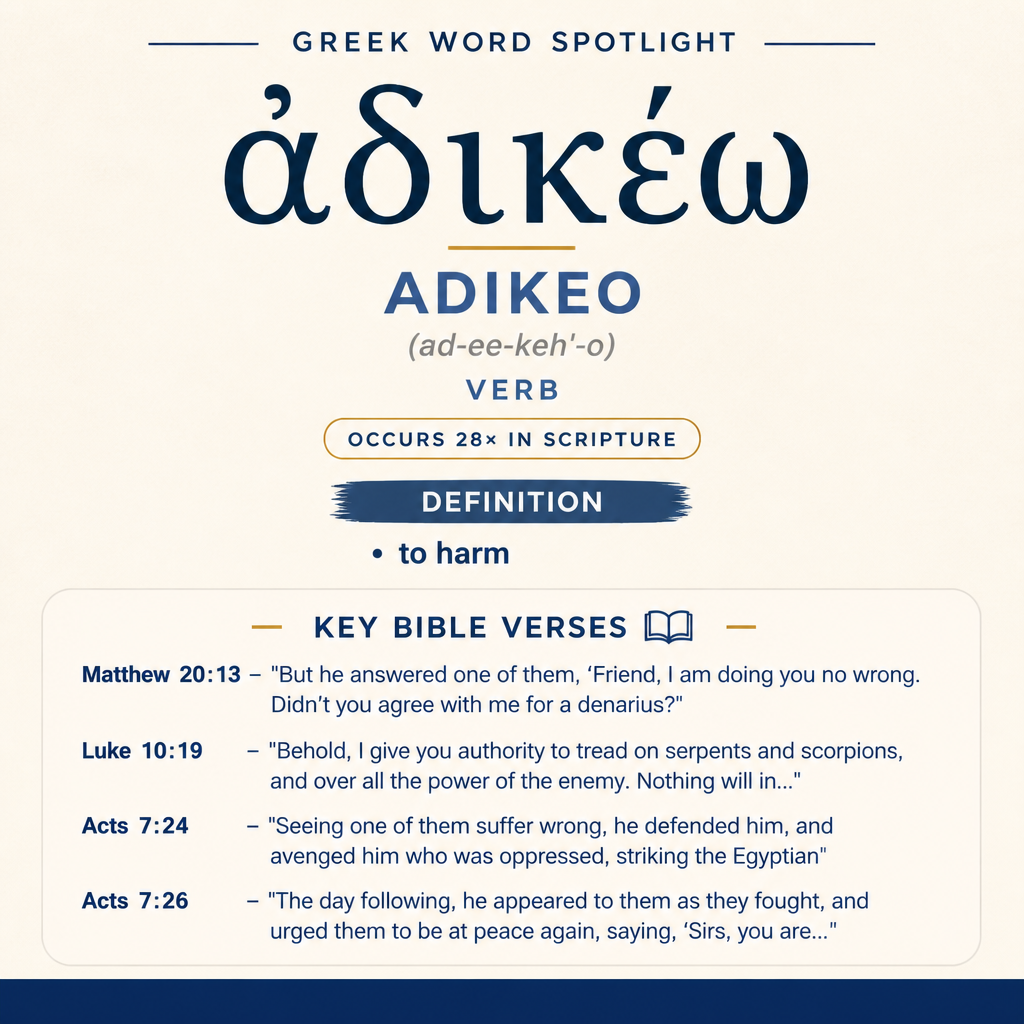
ἀδικέω (Adikeo) means “to harm” and occurs 28 times in Scripture, including Matthew 20:13; Luke 10:19; Acts 7:24, 26–27; Acts 25:10–11; 1 Corinthians 6:7.
Core Meaning
ἀδικέω is defined as “to harm.” In several passages it is expressed as doing “wrong” or being “wronged.”
Learn More →Scripture Examples
In Matthew 20:13 and Acts 25:10 Paul speaks of having done “no wrong.” In Acts 7:24, 26–27 it describes suffering wrong and doing a neighbor wrong.
Learn More →Community Context
1 Corinthians 6:7 uses ἀδικέω in the setting of lawsuits among believers, asking, “Why not rather be wronged?” This highlights its use in interpersonal conflict.
Learn More →ἀδικέω expresses the act of causing harm, whether by overt injury, unfair dealing, or the infliction of wrong. In the passages where it appears, it is heard in disputes about fairness, in assurances of protection from danger, and in conflicts within and outside the community.
Occurrences
“But he answered one of them, ‘Friend, I am doing you no wrong. Didn’t you agree with me for a denarius? (Matthew 20:13)
Here ἀδικέω appears as a denial of harm in a conflict over perceived fairness. The speaker answers a complaint by insisting that no wrong has been done, grounding that claim in the prior agreement: “Didn’t you agree with me for a denarius?” The word frames the issue as whether the other party has been harmed by the decision, not whether the decision matches someone else’s expectations.
Behold, I give you authority to tread on serpents and scorpions, and over all the power of the enemy. Nothing will in any way hurt you. (Luke 10:19)
In this promise of protection, ἀδικέω describes harm in its most tangible form: injury that might be expected from “serpents and scorpions” or from “all the power of the enemy.” The word gathers physical threat and hostile power under a single assurance: “Nothing will in any way hurt you.” The focus is not on the mechanics of danger but on the outcome—harm will not land on them.
Seeing one of them suffer wrong, he defended him, and avenged him who was oppressed, striking the Egyptian. (Acts 7:24)
In this narrative, ἀδικέω marks the wrong that provokes intervention. One man is seen “suffer[ing] wrong,” which is immediately paired with oppression and answered by defense and revenge. The word thus functions as the moral description of a harmful act done to someone vulnerable; it supplies the rationale for the defender’s response in the scene.
“The day following, he appeared to them as they fought, and urged them to be at peace again, saying, ‘Sirs, you are brothers. Why do you wrong one another?’ (Acts 7:26)
Here ἀδικέω is used to confront internal conflict: “you are brothers. Why do you wrong one another?” The harm in view is not accidental; it is something they do to each other while “they fought.” The word presses the mismatch between their relationship (“brothers”) and their actions (mutual harm), making the appeal for peace a call to stop injuring one another.
But he who did his neighbor wrong pushed him away, saying, ‘Who made you a ruler and a judge over us? (Acts 7:27)
In this continuation, ἀδικέω identifies the one at fault: “he who did his neighbor wrong.” The word distinguishes the wrongdoer from the would-be peacemaker and highlights the social rupture: instead of receiving correction, the wrongdoer “pushed him away” and rejects his authority. Harm here is interpersonal and neighbor-directed, and the word helps locate responsibility within the dispute.
But Paul said, “I am standing before Caesar’s judgment seat, where I ought to be tried. I have done no wrong to the Jews, as you also know very well. (Acts 25:10)
In a legal setting, ἀδικέω is part of a formal defense: “I have done no wrong to the Jews.” The statement places harm at the center of the charge—whether Paul has wronged them—and he denies it while appealing to the other party’s knowledge: “as you also know very well.” The word functions as a criterion for culpability in judgment: wrongdoing is framed as harm done to a people.
For if I have done wrong and have committed anything worthy of death, I don’t refuse to die; but if none of those things is true that they accuse me of, no one can give me up to them. I appeal to Caesar!” (Acts 25:11)
Still within the same proceeding, ἀδικέω is used hypothetically: “if I have done wrong.” Harm is linked to serious criminal liability (“anything worthy of death”), showing that the word can stand in for the kind of wrongdoing that merits the highest penalty in the speaker’s argument. Yet the other side of the sentence denies the accusation’s truth and argues that without such harm, surrendering him would itself be unjustified.
Therefore it is already altogether a defect in you, that you have lawsuits one with another. Why not rather be wronged? Why not rather be defrauded? (1 Corinthians 6:7)
In community life, ἀδικέω appears in a striking rhetorical challenge: “Why not rather be wronged?” The harm envisioned is what one might suffer at another’s hands, and it is placed alongside “defrauded,” suggesting that harm can be borne in disputes involving loss. The word is used to contrast two paths: pressing a case through lawsuits versus accepting being wronged as a way of avoiding escalation within the group.
No, but you yourselves do wrong and defraud, and that against your brothers. (1 Corinthians 6:8)
Here ἀδικέω is accusatory and direct: “you yourselves do wrong.” The harm is not generic; it is relational and aggravated by the target: “against your brothers.” The parallel with “defraud” keeps the focus on concrete injury done by one member to another, and the word names that conduct as culpable harm within a family-like bond.
Open your hearts to us. We wronged no one. We corrupted no one. We took advantage of no one. (2 Corinthians 7:2)
In an appeal for restored relationship, ἀδικέω is a denial offered to remove suspicion: “We wronged no one.” The surrounding negatives (“We corrupted no one. We took advantage of no one.”) paint a portrait of integrity, and the word contributes the specific claim that no person has been harmed by their actions. It serves as reassurance that the requested openness is not a setup for injury.
So although I wrote to you, I wrote not for his cause that did the wrong, nor for his cause that suffered the wrong, but that your earnest care for us might be revealed in you in the sight of God. (2 Corinthians 7:12)
In this explanation of motive, ἀδικέω appears twice, marking both sides of a harmful incident: “his cause that did the wrong” and “his cause that suffered the wrong.” The word thus spans perpetration and victimization, allowing the writer to acknowledge real harm without centering the correspondence on either party’s personal case. It also shows how wrongdoing, as harm, creates a relational and communal situation that demands attention beyond the individuals immediately involved.
I beg you, brothers, become as I am, for I also have become as you are. You did me no wrong, (Galatians 4:12)
In a personal plea, ἀδικέω is used to clear the relational ground: “You did me no wrong.” The statement protects the appeal from being heard as resentment or retaliation. By explicitly denying harm received from them, the speaker frames his request as coming from identification (“I also have become as you are”) rather than from grievance.

Sense and Usage
Across these contexts, ἀδικέω consistently marks harm as something that can be assessed, denied, endured, or charged. In Matthew 20:13 it belongs to the language of complaint and reply: a disputed action is evaluated by whether it wrongs another, and the prior agreement is offered as the measure by which harm is rejected. In Luke 10:19 it is projected forward into danger: harm is what serpents, scorpions, and hostile power could do, yet it is ruled out by a promise that “Nothing will in any way hurt you.”
Acts 7 uses the word to narrate both sides of conflict. It labels the harm suffered by the oppressed (Acts 7:24), confronts the mutual harming that keeps brothers fighting (Acts 7:26), and singles out the one who wronged his neighbor (Acts 7:27). The word’s value in these scenes is its clarity: it names the action as harmful and thereby becomes the pivot for defense, peace-making, or the exposure of a wrongdoer’s resistance to correction.
In Acts 25, ἀδικέω belongs to courtroom speech, where the central question is whether harm has been done and whether that harm rises to the level of capital guilt. Paul’s denial (“I have done no wrong”) and conditional concession (“if I have done wrong… I don’t refuse to die”) show that the word can function both as a blanket claim of innocence and as a category under which specific, punishable acts would fall. The harm is not abstract; it is tied to persons (“to the Jews”) and to accusations that would justify being “give[n] up.”
In 1 Corinthians 6, the word moves from courts to community discipline and ethics. It can describe what one might choose to absorb (“be wronged”) and what some are actively doing (“you yourselves do wrong”), especially when paired with defrauding. Harm here is interpersonal and intensified by kinship language (“brothers”), so ἀδικέω becomes a diagnostic term for conduct that fractures the community from within. In 2 Corinthians 7 and Galatians 4, the word supports appeals for trust and unity by denying personal injury (“We wronged no one”; “You did me no wrong”), and in 2 Corinthians 7:12 it can describe an event from both angles—harm done and harm suffered—while still moving the focus toward the wider concern of communal earnestness “in the sight of God.”
Imagery in Context
The passages give ἀδικέω a range of scenes: a wage dispute answered with calm insistence on fairness (Matthew 20:13), threatened injury underfoot from “serpents and scorpions” (Luke 10:19), a street-level clash between an oppressor and an oppressed man (Acts 7:24), and the uglier harm of brother-against-brother fighting (Acts 7:26). Elsewhere the word sits in the formal atmosphere of “Caesar’s judgment seat” (Acts 25:10–11) and in the internal tensions of lawsuits and defrauding among “brothers” (1 Corinthians 6:7–8). In the personal letters, its denial becomes a relational balm: it clears away the suspicion of injury so that hearts can open and pleas can be heard without the shadow of harm (2 Corinthians 7:2; Galatians 4:12).
Sources: Lexical data from Strong’s Exhaustive Concordance and the Translators Brief Lexicon of Extended Strongs for Greek (STEPBible, CC BY). Occurrence data from the Translators Amalgamated Greek New Testament (STEPBible, CC BY). Scripture quotations from the World English Bible (public domain).




