
Discovering the Meaning of ‘adown in Hebrew
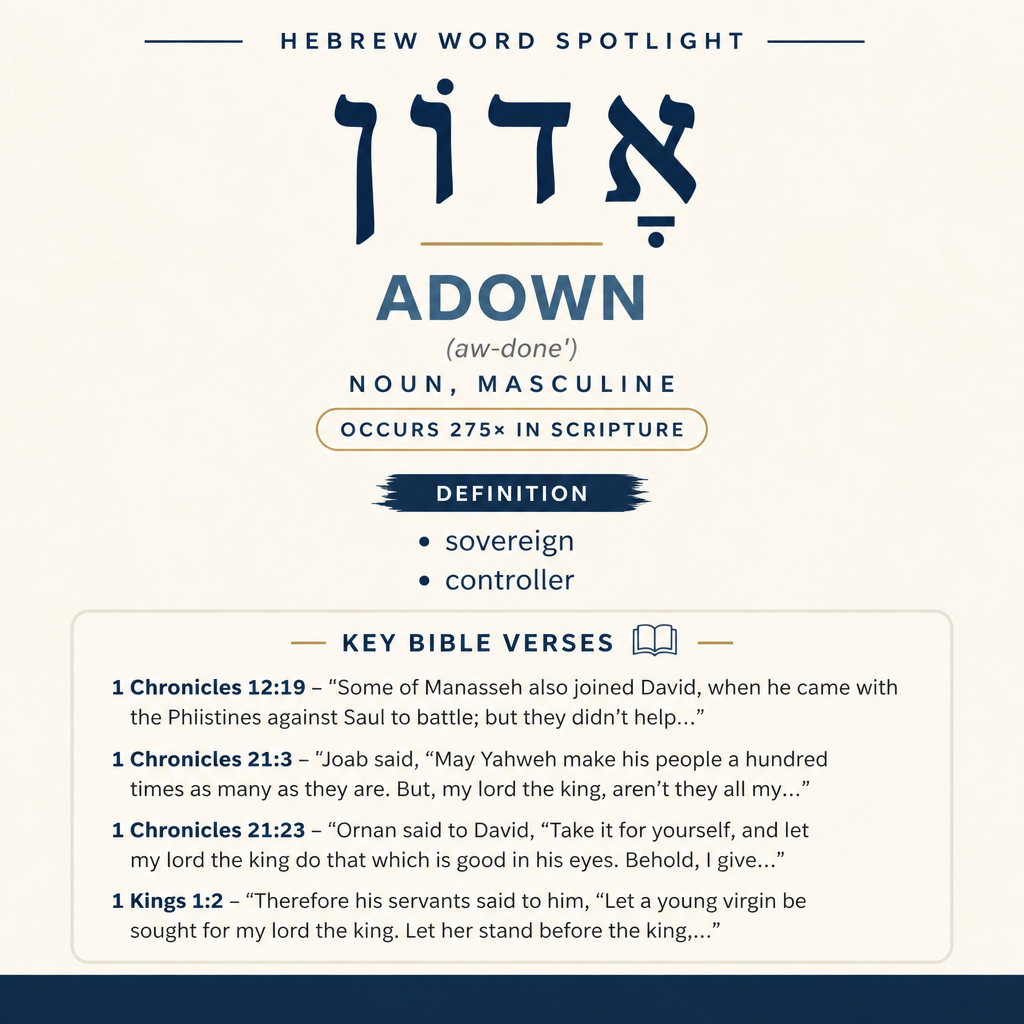
אָדוֹן means “sovereign; controller” and appears 275 times in Scripture, including in 1 Chronicles and 1 Kings.
Sample Occurrences
It appears in passages such as 1 Chronicles 21:3, 1 Chronicles 21:23, and 1 Kings 1:13, where speakers address “my lord the king.”
Learn More →אָדוֹן (adown) expresses the idea of a “sovereign; controller,” and in these passages it functions as a title of authority addressed to a superior. The selected occurrences cluster around courtly speech to a king and political decision-making among Philistine leaders.

Occurrences
“Some of Manasseh also joined David, when he came with the Philistines against Saul to battle; but they didn’t help them; for the lords of the Philistines sent him away after consultation, saying, “He will desert to his master Saul to the jeopardy of our heads.”” (1 Chronicles 12:19)
Here the word appears in the plural (“the lords of the Philistines”), depicting a body of high-ranking decision-makers who can “send him away after consultation.” The term marks their controlling authority within the Philistine camp: they evaluate risk (“to the jeopardy of our heads”) and exercise command over whether David may remain with them. In the same sentence, the contrast with “his master Saul” places the idea of a controlling superior in a personal, relational frame—one to whom loyalty may revert.
“Joab said, “May Yahweh make his people a hundred times as many as they are. But, my lord the king, aren’t they all my lord’s servants? Why does my lord require this thing? Why will he be a cause of guilt to Israel?”” (1 Chronicles 21:3)
Joab’s speech shows אָדוֹן as a deferential form of address within a hierarchical relationship: “my lord the king.” The repetition (“my lord… my lord’s servants… my lord require this thing”) highlights recognized control: the king can “require” an action of his servants. At the same time, the address becomes the framework for dissent. Joab questions the king’s directive while still speaking in language that affirms the king’s sovereign standing over “all my lord’s servants.”
“Ornan said to David, “Take it for yourself, and let my lord the king do that which is good in his eyes. Behold, I give the oxen for burnt offerings, and the threshing instruments for wood, and the wheat for the meal offering. I give it all.”” (1 Chronicles 21:23)
Ornan uses “my lord the king” while yielding property and decision-making to David: “Take it for yourself.” The expression “let my lord the king do that which is good in his eyes” portrays the king as the one who controls the course of action and whose judgment sets what is “good” in the situation. Ornan’s generous “I give it all” is framed not as negotiation between equals but as a subordinate placing resources at the disposal of a sovereign.
“Therefore his servants said to him, “Let a young virgin be sought for my lord the king. Let her stand before the king, and cherish him; and let her lie in your bosom, that my lord the king may keep warm.”” (1 Kings 1:2)
In a domestic-court setting, servants speak about arranging care for an aged ruler. “My lord the king” marks their relationship to him as both personal and official: they propose actions for his benefit (“be sought… stand before… cherish him”) yet the goal is centered on the king’s condition (“that my lord the king may keep warm”). The title signals that the one being cared for is not merely an elder but a sovereign whose well-being concerns the court.
“Then Nathan spoke to Bathsheba the mother of Solomon, saying, “Haven’t you heard that Adonijah the son of Haggith reigns, and David our lord doesn’t know it?”” (1 Kings 1:11)
“David our lord” identifies David as the acknowledged controller even while his knowledge and active control are being bypassed: “doesn’t know it.” The scene turns on a clash between rightful authority and a rival claim (“Adonijah… reigns”). Using the title for David frames Adonijah’s reigning as a serious political problem precisely because it proceeds without the sovereign’s awareness or direction.
“Go in to king David, and tell him, ‘Didn’t you, my lord, king, swear to your servant, saying, “Assuredly Solomon your son shall reign after me, and he shall sit on my throne?” Why then does Adonijah reign?’” (1 Kings 1:13)
Here the address “my lord, king” is embedded in a reminder of a binding royal oath and succession planning. The phrase positions David as the controller whose spoken commitment governs who may “sit on my throne.” The question “Why then does Adonijah reign?” is sharpened by the title: if David is truly sovereign, then rival rule should not be occurring contrary to his sworn intention.
“She said to him, “My lord, you swore by Yahweh your God to your servant, ‘Assuredly Solomon your son shall reign after me, and he shall sit on my throne.’”” (1 Kings 1:17)
Bathsheba’s “My lord” functions as direct address that acknowledges David’s authority to determine succession by oath. The remembered content—“he shall sit on my throne”—links lordship to control over the royal seat and its future occupant. The title also maintains courtly respect as she appeals to what the king has already exercised: his capacity to swear and thereby set a course that others should follow.
“Now, behold, Adonijah reigns; and you, my lord the king, don’t know it.” (1 Kings 1:18)
The tension intensifies: “my lord the king” is the one whose control is being undermined by secrecy—“don’t know it.” The title heightens the sense of disorder: a sovereign is present, yet events are unfolding that bypass his awareness. The phrase works rhetorically to press urgency, since ignorance is incompatible with the expected role of a controller in his own realm.
“You, my lord the king, the eyes of all Israel are on you, that you should tell them who will sit on the throne of my lord the king after him.” (1 Kings 1:20)
In this public dimension, “my lord the king” is not only personal respect but an assertion that the nation waits for the sovereign’s decision. The king’s controlling role is described as declarative: “that you should tell them who will sit on the throne.” The second mention (“the throne of my lord the king”) reinforces that the throne belongs to the present sovereign, and the future occupant is determined “after him” by his direction.
“Otherwise it will happen, when my lord the king sleeps with his fathers, that I and my son Solomon will be considered criminals.”” (1 Kings 1:21)
Here the title frames a warning about consequences tied to the end of a king’s life (“sleeps with his fathers”). While he lives as sovereign, there is opportunity for controlled resolution; once he is gone, others may define legitimacy and guilt. “My lord the king” thus carries the weight of present authority that can prevent a future reversal in which Bathsheba and Solomon are judged as “criminals.”
“Nathan said, “My lord, king, have you said, ‘Adonijah shall reign after me, and he shall sit on my throne?’”” (1 Kings 1:24)
Nathan’s question depends on the premise that the sovereign’s word controls succession: if the king has “said” it, then Adonijah’s reign has authorization. Addressing David as “my lord, king” keeps the focus on the one controller whose expressed decision would settle competing claims. The rhetorical structure implies that without such a statement from the sovereign, the situation is unauthorized and therefore alarming.
“Was this thing done by my lord the king, and you haven’t shown to your servants who should sit on the throne of my lord the king after him?”” (1 Kings 1:27)
In this final occurrence, “my lord the king” again frames accountability: either the matter was “done” by the sovereign or it was done without him. The line “you haven’t shown to your servants” presents a key function of lordship as making the controlling decision known. As in earlier verses, “the throne of my lord the king” connects sovereignty to ownership of the throne and to the authority to designate who will occupy it “after him.”
Sense and Usage
Across these passages, אָדוֹן operates as a title that marks a recognized hierarchy and the right to direct outcomes. In 1 Chronicles 12:19 it describes leaders whose authority is corporate and deliberative: they consult and then act, controlling access and managing risk. In 1 Chronicles 21:3 and 21:23 it is used toward Israel’s king in contexts where the king’s power to command (“require this thing”) and to decide what is “good in his eyes” is assumed, even as subordinates either challenge a policy or offer resources to support the king’s chosen course.
In 1 Kings 1:2, 11, 13, 17, 18, 20, 21, 24, and 27, the title saturates a crisis of succession. Speakers repeatedly anchor their arguments in David’s status as the acknowledged controller: the king’s knowledge matters; his oath matters; his declaration is awaited by “all Israel”; and his failure to “show” his servants who will sit on the throne creates instability. The word thus carries more than politeness in these scenes: it is the linguistic tool by which speakers locate responsibility and legitimacy in the person who has sovereign standing.
Imagery in Context
The passages present lordship in concrete, visible forms: councils that decide a commander’s fate, servants arranging care for a king, and urgent conversations about who will “sit on my throne.” In each case, אָדוֹן gathers the scene around one controlling center—whether a group of “lords” acting together or a single “lord the king” whose word and awareness are treated as decisive for the community’s direction.
Sources: Lexical data from Strong’s Exhaustive Concordance and the Open Scriptures Hebrew Lexicon. Occurrence data from the Westminster Leningrad Codex with STEPBible reference data (CC BY). Scripture quotations from the World English Bible (public domain).





