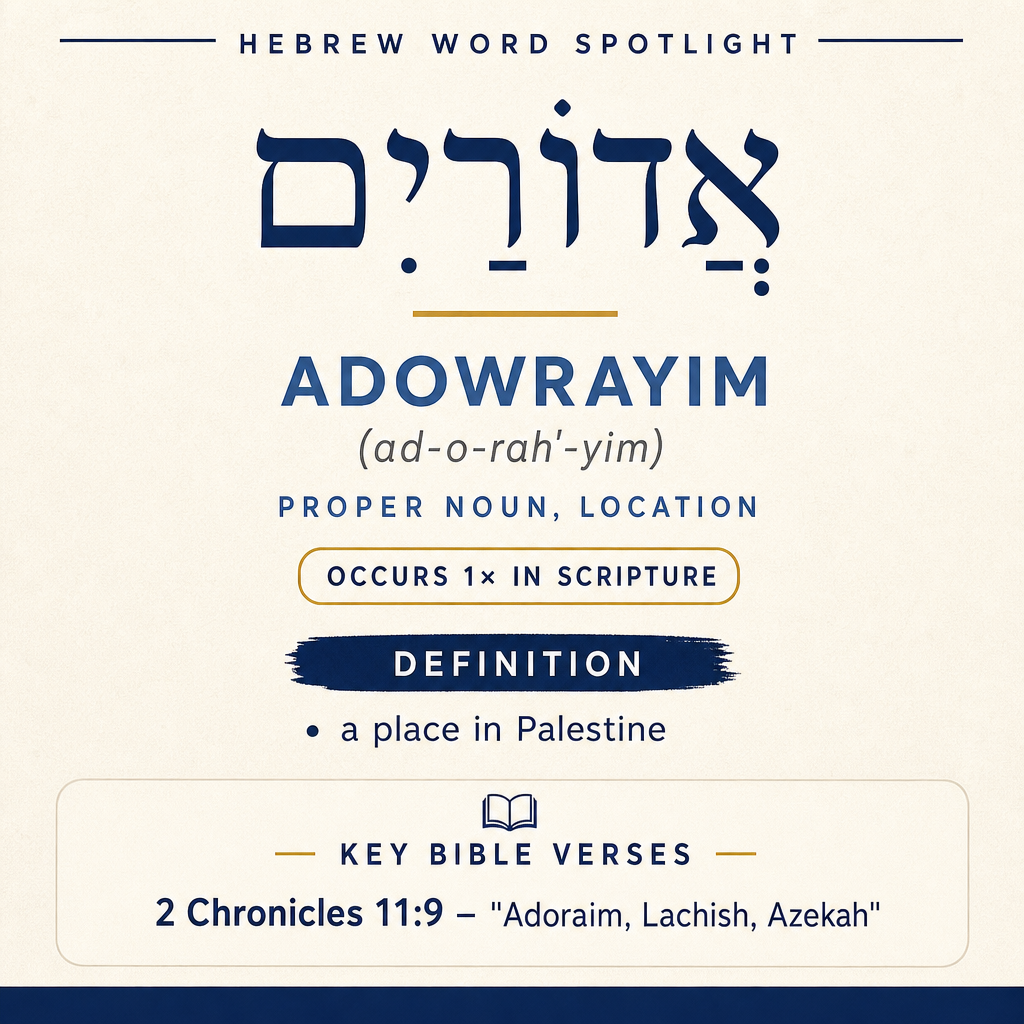
‘Adowrayim
‘Adowrayim Definition
Adoraim = “double glory”
- city in Judah fortified by Rehoboam about 5 miles or 8 km SW of Hebron
Understanding the Meaning of ‘Adowrayim in Hebrew
One might wonder what the Hebrew word ‘Adowrayim truly signifies and why it holds importance in biblical studies. The term ‘Adowrayim, found in various Hebrew texts, translates to “two witnesses” or can refer to the “two lords.” This duality in meaning offers a rich area for exploration within biblical literature, culture, and historical context.
The Biblical Context of ‘Adowrayim
The concept of ‘Adowrayim frequently ties to themes of testimony and divine authority in the Hebrew Bible. For instance, in ancient Hebrew culture, the testimony of two witnesses was crucial in establishing truth and validity in legal matters. This practice appears in Deuteronomy 19:15, where it states that “a matter must be established by the testimony of two or three witnesses.” This doctrine underlines the significance of reliability, truth, and accountability.
An applied hypothetical scenario might involve a community debating whether a specific law was broken. Two individuals witness the event, and based on their consistent and truthful testimony, the community can arrive at a judgment. The term ‘Adowrayim encapsulates the necessity of having two reliable witnesses to affirm a situation’s validity, emphasizing an ethical obligation in a community.
Linguistic Roots of ‘Adowrayim
The word ‘Adowrayim comes from the root word ‘ed, which means “to bear witness” or “to testify.” This root indicates that ‘Adowrayim fundamentally involves the act of sharing evidence to establish the truth. The concept can also connect to ancient legal practices where authority was grounded in testimony and assurance, meaning that the truthfulness of information shared by witnesses was paramount.
In historical context, this legal frame is especially pertinent. Hebrew society relied on these principles when conflict arose. The presence of two witnesses supported fairness and objective resolution of disputes, embedding moral wisdom into daily life.
Interpretation in Jewish Thought
Jewish interpretations of ‘Adowrayim highlight its relevance in discussions about justice and morality. The Talmud, which contains teachings and rabbinic discussions, elaborates on the importance of two witnesses, expanding on their roles in testimonies about crimes and legalities. This scholarly investigation entails clarifying how ethical considerations affected judicial outcomes, anchoring legal practices in moral philosophy.
For example, if a man is accused of theft, two witnesses can confirm or deny the claim. The reliance on dual testimonies encourages a check against false accusations and promotes truth. Jewish scholars emphasize that ‘Adowrayim isn’t just about the number of witnesses; it reflects a deeper moral responsibility to bear true witness.
Literary Dimensions of ‘Adowrayim
The term ‘Adowrayim also appears in literary contexts within biblical texts, revealing its significance in storytelling and prophecy. In prophetic literature, the duality often symbolizes the presence of God in the affairs of humanity, suggesting that divine omnipotence underlies justice and morality.
For example, in texts dealing with God’s covenant with His people, the presence of ‘Adowrayim may signify that both heaven and earth testify to God’s promise. This literary device serves to reinforce the idea that God himself stands as a witness, combining the human and divine authority to confirm the importance of truth and faithfulness.
Practical Applications in Modern Understanding
Today, understanding ‘Adowrayim can apply to both legal systems and community practices regarding the pursuit of justice and truth. In courtrooms, the principle of requiring multiple witnesses to corroborate facts continues to reflect the wisdom of ancient Hebrew customs. When establishing the credibility of evidence, modern systems emulate the biblical principle enshrined in ‘Adowrayim, ensuring fairness and accountability.
In casual or community settings, one might utilize the concept of ‘Adowrayim when seeking truth. Suppose a neighborhood dispute arises involving claims regarding property lines. Like ancient practices, community members may call upon two respected neighbors to share their knowledge of the history and help resolve the issue, ensuring that decisions are fair and fact-based.
Theological Insights of ‘Adowrayim
Beyond secular applications, ‘Adowrayim also bears significant theological implications. The duality in the term can illustrate the relationship between human beings and the divine. For theologians, ‘Adowrayim can symbolize the partnership between humanity’s witness to God’s work in the world and God’s recurring testimony of love and guidance toward humanity.
In various religious services, the concept can ground reflections on community and witness. Congregations may encourage members to live as witnesses to faith, embodying the essence of ‘Adowrayim by testifying to their experiences of grace and love. The duality reflects both the communal aspect of faith and the individual responsibility to stand as a witness to truth.
The Role of ‘Adowrayim in Religious Texts
In examining scriptural references to ‘Adowrayim, one might encounter passages where God’s authority is conveyed through this concept. The term acts as a connector between human experience and divine command, as biblical writers utilized it to emphasize the importance of accountability.
An example of this can be found in the account of the two faithful spies sent to scout the Promised Land in the Book of Numbers. Their faithful report and trust in God’s promise can be seen as a representation of ‘Adowrayim, as they bear witness to God’s power and intentions. Their testimony serves not only to provide legitimate evidence but also to inspire faith in others.
The Cultural Significance of ‘Adowrayim
In broader cultural studies, ‘Adowrayim represents a vital intersection of truth and community life. The necessity of multiple witnesses speaks not only to ancient Jewish legal practices but also to the cultural norms around truth-telling and accountability. Today, social movements uphold similar principles, advocating for transparency and justice in various areas of life.
Consider the examination of workplace ethics where colleagues are expected to uphold integrity in reporting misconduct or dishonesty. Here, the principle of ‘Adowrayim applies, showing that the collective responsibility to stand for truth enhances the moral fabric of any organization.
‘Adowrayim as a Symbol of Truth and Integrity
Ultimately, the connotation of ‘Adowrayim encompasses more than the mere presence of two witnesses. It emerges as a profound symbol of truth, integrity, and the relational dynamics among individuals, communities, and their expansive belief systems. The duality within ‘Adowrayim serves as a reminder of the necessity for accountability across all aspects of life, from individual conduct to societal norms.
Reflecting on societal practices, one can observe that many underlying legal expectations today stem from these dual principles. In various ways, the moral imperatives derived from ‘Adowrayim continue to influence discussions around justice and ethical responsibilities in everyday life.
The Eschatological Dimension of ‘Adowrayim
In eschatological discussions, which often involve ideas about the end times and divine judgments, ‘Adowrayim also finds relevance. The concept of two witnesses is often connected to prophetic observations regarding accountability before God. This theological understanding emphasizes that all actions are observed and noted, inviting believers to live with sincerity and truthfulness.
For instance, various texts suggest that the faithful will stand as witnesses to God’s ultimate truth in the final days. This perspective compels individuals to embody the spirit of ‘Adowrayim, aligning their lives with the truth of their faith in anticipation of a greater divine reality.
Conclusion: The Multifaceted Nature of ‘Adowrayim
As explored, ‘Adowrayim encompasses a rich tapestry of meanings relating to witness, integrity, and relational dynamics in biblical and cultural contexts. The term’s historical roots in legal frameworks, its application in modern settings, along with its theological implications contribute to an understanding that transcends simple translation. Each encounter with this term provides an opportunity to appreciate its role in shaping ethical principles and promoting a communal commitment to truth.
Little Known Secrets
The Hebrew word “Adowrayim” holds deeper meanings that many are unaware of.
- Translation Insight: “Adowrayim” translates to “two lords” in English, combining “Adon” (lord) with a plural suffix, hinting at a dual aspect of leadership or authority.
- Contextual Usage: It appears in the Bible in the context of leadership, particularly in the discussions about boundaries and territory in the land of Israel, emphasizing the shared responsibility.
- Symbolic Meaning: The word can symbolize unity and partnership, potentially representing the relationship between God and humanity, highlighting a divine-human interaction.
- Numerical Significance: In Hebrew, letters also have numerical values. The numerical value of “Adowrayim” adds up to 319, which can be related to concepts of balance and stability, reinforcing the idea of two forces working together.
- Cultural Reflection: The duality suggested in “Adowrayim” resonates with Jewish thoughts on leadership, where two heads are often seen as better than one, reflecting the importance of community and collaboration.
- Linguistic Roots: The root of “Adon” has connections to authority and reverence, indicating that the concept of leadership is not merely about power, but about the respect and duty that comes with it.
- Scriptural References: While “Adowrayim” itself is not commonly referenced, similar terms and phrases involving “Adon” appear throughout the Hebrew Bible, providing a broader context for understanding authority in biblical narratives.
- Theological Implications: The duality encapsulated in “Adowrayim” has been used to discuss the nature of God in various Jewish traditions, sometimes indicating a complex unity or a partnership in divine plans.
- Modern Usage: In contemporary Hebrew, the concept of dual leadership or teamwork is still prevalent, showcasing how ancient terms influence modern understanding of collaboration in society.
Conclusion
In summary, the Hebrew word “Adowrayim” holds a rich meaning that reflects its roots and uses in biblical texts. It often refers to the concept of “two lords” or “two masters.” This idea can remind us of important themes in life, like the balance of authority and the dualities we face. Understanding “Adowrayim” helps us see how language conveys deeper meanings in the Bible, guiding us to think about our own relationships and decisions. Whether in scripture or daily life, this word encourages us to reflect on who or what influences us the most.
Common Questions Related to What Does ‘Adowrayim Mean In Hebrew
Q. What is the meaning of the word ‘Adowrayim in Hebrew?
A. The word ‘Adowrayim refers to “two lords” or “two masters” and is often used in contexts that highlight dual authority or ownership.
Q. Where can ‘Adowrayim be found in the Bible?
A. ‘Adowrayim appears in biblical texts that discuss themes like servitude and loyalty, typically in related contexts involving multiple authorities.
Q. What is the root word of ‘Adowrayim?
A. The root word of ‘Adowrayim is ‘Adon, which means “lord” or “master” in Hebrew.
Q. How is ‘Adowrayim used in everyday Hebrew language?
A. In modern Hebrew, ‘Adowrayim may not be commonly used but still refers to having more than one authority or decision-maker in a situation.
Q. Are there any idiomatic expressions involving ‘Adowrayim?
A. While not common, you might hear phrases that revolve around servitude, highlighting the idea of loyalty to more than one master.
Q. What does the Bible say about having two masters?
A. The Bible warns against serving two masters in Matthew 6:24, saying that one cannot serve both God and money, which echoes the idea in ‘Adowrayim.
Q. Can ‘Adowrayim be related to any cultural practices in ancient Israel?
A. Yes, it can be related to the cultural practice of serving multiple leaders or patrons, which was common in ancient societies.
Q. How does ‘Adowrayim connect to teachings about loyalty?
A. ‘Adowrayim emphasizes the importance of loyalty, as serving two masters can lead to divided commitment and conflicts in values.
Q. Is ‘Adowrayim used in any well-known religious texts?
A. Yes, it is referenced in religious discussions and texts that explore themes of faithfulness and dual obligations.
Q. What lessons can be learned from the concept of ‘Adowrayim?
A. The main lesson is about the challenge of divided loyalty and the importance of dedicating oneself fully to one purpose or master.