
Discovering the Meaning of ‘Addereth in Hebrew
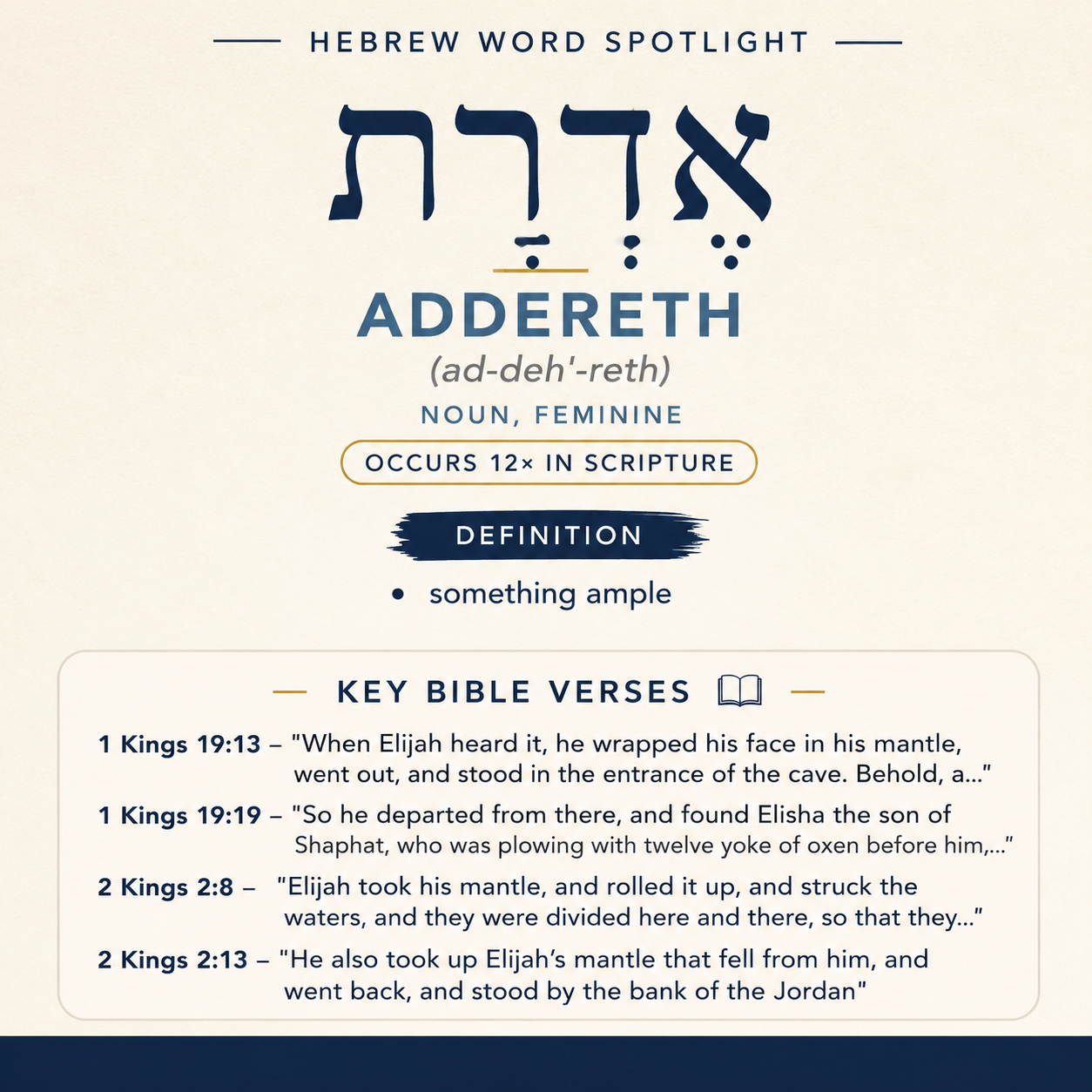
אַדֶּרֶת means “something ample” and appears 12 times in Scripture, including narratives in Kings and examples in Genesis, Jonah, and Ezekiel.
Core Meaning
אַדֶּרֶת is defined as “something ample.” In several passages it is rendered as a mantle or robe.
Learn More →Elijah’s Mantle
In 1 Kings 19:13 and 1 Kings 19:19, the word is used for Elijah’s mantle. It also appears repeatedly in 2 Kings 2:8, 2:13, and 2:14 in the Elijah–Elisha account.
Learn More →Other Contexts
Genesis 25:25 uses it for a “hairy garment” describing Esau’s appearance. Jonah 3:6 uses it for the king of Nineveh’s royal robe, and Ezekiel 17:8 includes it in its imagery.
Learn More →אַדֶּרֶת (addereth) means “something ample.” In Scripture it appears in scenes involving a mantle or robe (often worn, taken off, or passed on), and also in figurative language about growth and covering.

Occurrences
“When Elijah heard it, he wrapped his face in his mantle, went out, and stood in the entrance of the cave. Behold, a voice came to him, and said, “What are you doing here, Elijah?”” (1 Kings 19:13)
Here the word is a personal covering used at a moment of encounter and fear: Elijah “wrapped his face” in it. The action highlights the garment’s ample, concealing quality—it is large enough to envelop and to serve as a barrier between face and surroundings while he steps to the cave’s entrance.
“So he departed from there, and found Elisha the son of Shaphat, who was plowing with twelve yoke of oxen before him, and he with the twelfth. Elijah went over to him, and put his mantle on him.” (1 Kings 19:19)
The mantle is no longer just for covering; it becomes something that can be placed upon another person. The text’s simple gesture—Elijah “put his mantle on him”—depends on a garment that can drape over someone’s body. The amplitude of the garment makes it suitable for being laid across another in an unmistakable act.
“Elijah took his mantle, and rolled it up, and struck the waters, and they were divided here and there, so that they both went over on dry ground.” (2 Kings 2:8)
In this scene, the mantle is handled as an object with enough material to be “rolled… up.” The narrative focuses on physical manipulation: gathered into a compact form and used to strike water. The word therefore participates in a vivid picture of a substantial cloth item whose fullness allows it to be rolled and wielded.
“He also took up Elijah’s mantle that fell from him, and went back, and stood by the bank of the Jordan.” (2 Kings 2:13)
Now the mantle is something that can “fell” and be “took up,” an identifiable, portable possession associated with Elijah. The scene’s movement—picked up, carried back, and brought to the riverbank—treats it as a concrete, ample garment that remains after the person has gone.
“He took Elijah’s mantle that fell from him, and struck the waters, and said, “Where is Yahweh, the God of Elijah?” When he also had struck the waters, they were divided apart, and Elisha went over.” (2 Kings 2:14)
The same mantle is again gathered into purposeful use: it is used to “struck the waters.” The repetition of the action (striking water) draws attention to continuity in the object itself—Elijah’s ample garment is now in Elisha’s hands and functions as the tangible item through which the crossing occurs.
“It was planted in a good soil by many waters, that it might produce branches, and that it might bear fruit, that it might be a good vine.” ’” (Ezekiel 17:8)
Although this line speaks about planting and a vine, the word’s presence in the verse list places it within imagery of abundant growth. The scene is about conditions that allow something to spread out—branches, fruit, and the making of “a good vine.” In such a context, “something ample” contributes to the sense of fullness and expansiveness implied by thriving growth in “good soil by many waters.”
“The first came out red all over, like a hairy garment. They named him Esau.” (Genesis 25:25)
Here the word appears in a comparison: a newborn described “like a hairy garment.” The simile relies on a garment as a large, enveloping surface; the baby’s appearance is likened to something that covers widely and is noticeable in texture. The “hairy garment” picture depends on the notion of a substantial covering rather than a small accessory.
“The news reached the king of Nineveh, and he arose from his throne, and took off his royal robe, covered himself with sackcloth, and sat in ashes.” (Jonah 3:6)
The word functions within royal clothing: a “royal robe” that can be removed. The act of taking it off and replacing it with sackcloth contrasts one ample outer garment with another form of covering. The robe’s amplitude suits its role as a visible marker of status in the throne-room setting, and its removal is a clear, public gesture.
“When I saw among the plunder a beautiful Babylonian robe, two hundred shekels of silver, and a wedge of gold weighing fifty shekels, then I coveted them and took them. Behold, they are hidden in the ground in the middle of my tent, with the silver under it.”” (Joshua 7:21)
In Achan’s confession, the word describes a “beautiful Babylonian robe” singled out among valuable items. Its amplitude matters in two ways: it is an object of desire, and it is a sizeable item that must be concealed—“hidden in the ground in the middle of my tent”—with other valuables placed “under it.” The robe functions as a prominent, graspable piece of plunder.
“Joshua, and all Israel with him, took Achan the son of Zerah, the silver, the robe, the wedge of gold, his sons, his daughters, his cattle, his donkeys, his sheep, his tent, and all that he had; and they brought them up to the valley of Achor.” (Joshua 7:24)
The robe is listed again, now as evidence gathered along with the other items and household possessions. Its mention alongside silver and gold shows it is treated as a significant object, not a minor trinket. The word contributes to the sense of tangible goods being removed and carried as part of communal judgment.
“A voice of the wailing of the shepherds! For their glory is destroyed: a voice of the roaring of young lions! For the pride of the Jordan is ruined.” (Zechariah 11:3)
This verse is dominated by cries—wailing and roaring—and by the destruction of “glory” and the ruin of “the pride of the Jordan.” With the word attested here, it stands within a context of lost splendor. Even without explicit mention of clothing in the quoted line, the verse’s emphasis on “glory” being destroyed aligns naturally with the broader pattern of the word referring to an ample outer item associated with prominence and visibility.
“It will happen in that day, that the prophets will each be ashamed of his vision, when he prophesies; neither will they wear a hairy mantle to deceive:” (Zechariah 13:4)
Here the word clearly names a “hairy mantle” worn with deceptive intent. The mantle is portrayed as an external marker that can be put on to influence perception. Its ample, draping nature suits it to function as a recognizable costume; the text’s point depends on the mantle being a conspicuous covering that can be “wear” as part of an attempt “to deceive.”
Sense and Usage
Across these passages, “something ample” repeatedly takes the form of an outer covering that can envelop, drape, and be handled as a substantial piece of cloth. In narratives about Elijah and Elisha, the mantle is close to the body (wrapping the face), transferable (placed on another), and workable (rolled up, carried, and used in a decisive act at the waters). In other narratives, the word denotes robes that signal social standing (“royal robe”) or that attract desire because they are “beautiful,” and it can be a physical item large enough to be hidden in the ground and then retrieved as part of a public accounting.
The word also supports figurative or descriptive imagery: a newborn’s appearance compared to a “hairy garment,” and prophetic language where a “hairy mantle” serves as a recognizable outer sign that can be adopted for false appearances. Even where the immediate line is dominated by metaphor (as in the vine planted by many waters, or the ruin of glory and pride), the word’s broader attested use keeps it linked to the idea of an ample covering and, by extension, to the visibility and presence that such covering brings in human scenes.
Imagery
In these texts, the most persistent image is a large outer garment acting in public and memorable ways: wrapping a face at a cave entrance, being laid on a plowman in the field, rolled and swung at the Jordan’s waters, taken off by a king, coveted as plunder, and worn as a disguise. The word’s concreteness keeps the imagery grounded in what an ample covering can do—conceal, mark identity, be transferred, and remain as an object that carries significance beyond the moment it is worn.
Sources: Lexical data from Strong’s Exhaustive Concordance and the Open Scriptures Hebrew Lexicon. Occurrence data from the Westminster Leningrad Codex with STEPBible reference data (CC BY). Scripture quotations from the World English Bible (public domain).





