Discovering the Meaning of Addan in Hebrew
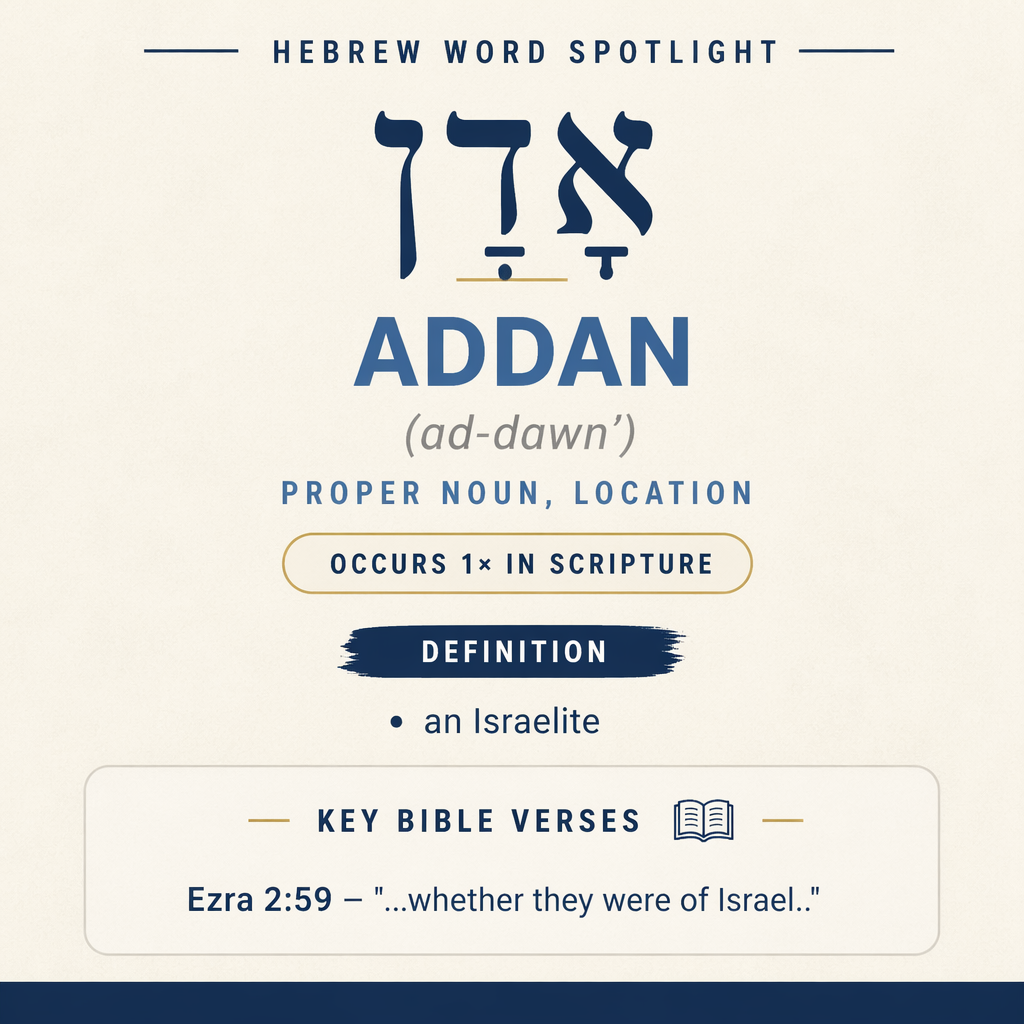
אַדָּן (Addan) means “an Israelite” and appears once in Scripture in Ezra 2:59.
Ezra Context
In Ezra 2:59, Addan is listed among places associated with those who went up but could not show their fathers.
Learn More →Addan means “an Israelite” and appears once in Scripture, in Ezra’s register of returnees. In that list, it functions within a cluster of names used to describe a group whose ancestry could not be documented.
Occurrences
“These were those who went up from Tel Melah, Tel Harsha, Cherub, Addan, and Immer; but they could not show their fathers’ houses, and their offspring, whether they were of Israel:” (Ezra 2:59)
In Ezra 2:59, Addan stands among several place- or clan-style designations—“Tel Melah, Tel Harsha, Cherub, Addan, and Immer”—that together identify those who “went up” with the returning community. The line immediately explains the problem that attends this group: “they could not show their fathers’ houses, and their offspring, whether they were of Israel.” Within the verse’s own logic, Addan is part of the identifying information for a set of people whose claimed status could not be demonstrated through recognized family documentation (“fathers’ houses”).
The wording ties Addan to a movement back into the land (“went up”), but it is not a triumphal note; the emphasis falls on uncertainty about lineage. The group is not described as outsiders arriving from nowhere; instead, they arrive with names attached—specific origins or affiliations are listed—yet those names do not resolve the central question of communal standing: proof of descent. Addan, placed in the middle of the series, contributes to the concreteness of the list: it is one element in the administrative record that tries to account for who is present, even when the most decisive credential (“their fathers’ houses”) cannot be produced.
The phrase “whether they were of Israel” makes the social stakes explicit. The verse frames “Israel” as a category that normally can be confirmed by tracing one’s paternal household and offspring within established genealogical structures. Addan thus belongs to a context where identity is being tested, not merely asserted. The name functions as part of the cataloging that precedes the stated inability to demonstrate ancestry: the return is recorded carefully, but this subset cannot substantiate the household lines that would settle their status.

Sense and Usage
As used in Ezra 2:59, Addan operates within a documentary setting where being “an Israelite” is treated as a matter with evidentiary requirements. The verse does not present Israelite identity as a vague cultural resemblance; it is tethered to the ability to “show their fathers’ houses” and to situate “their offspring” within that house-based structure. In that kind of setting, the meaning “an Israelite” touches not only self-understanding but also public recognition: the community’s record asks who belongs among the returnees, and the answer is expected to be demonstrable.
The list form itself shapes the word’s force. Ezra 2:59 is not narrative description of a person’s character or piety; it is a register line. Addan, therefore, is not developed by story details, speech, or action. Its contribution is classificatory and communal: it is one of the labels by which a group is sorted and remembered. The verse shows how names in such lists can carry social weight without additional explanation. Addan is placed alongside other identifiers, but the line that follows indicates that those identifiers are insufficient to settle the decisive question of Israelite descent.
The clause “but they could not show” creates a tension between what is named and what is proven. On the one hand, the register offers precise-sounding origins or affiliations (each item in the series gives the impression of traceable belonging). On the other hand, the register immediately qualifies this precision: these returnees lack the documentation that would connect the named group to a verified household lineage. In that context, Addan functions as one piece of the record that is accurate as far as it goes—these people are associated with the name Addan—yet the larger issue is that the association does not automatically establish “whether they were of Israel.”
The verse’s structure also suggests that Israelite identity is not treated as merely individual. The problem is not stated as an inability to prove one person’s claim but as the inability of “those who went up” from these named affiliations to show “their fathers’ houses, and their offspring.” This frames identity in corporate, generational terms: household and descendants are the arena where Israelite status is expected to be visible and traceable. In such a framework, the meaning “an Israelite” is inseparable from recognized continuity—household lines that can be shown, not only believed.
At the same time, the register’s inclusion of the group—despite the genealogical uncertainty—shows that the community’s records could preserve ambiguous cases rather than simply erasing them. Addan is therefore tied to an administrative realism: the return included people whose names and affiliations were known, yet whose proof of descent was missing. The word sits at the intersection of memory and verification. It belongs to the record of those who returned, but the record itself notes that their Israelite status could not be confirmed in the customary way.
Because Addan appears in a list that explicitly raises doubt “whether they were of Israel,” the word’s sense is pressed into a context of contested or unverified identity. The term “Israel” here is treated as a determinate category, and the inability to demonstrate household lineage makes that category uncertain for the named group. Addan, in this usage, is not a theological title but a practical descriptor caught up in the community’s need to distinguish what can be proven from what cannot.
Imagery
Ezra 2:59 evokes the scene of a return that is carefully recorded: a line of people associated with specific names, moving up from identifiable places or groups, yet accompanied by the unresolved question of ancestry. Addan contributes to the imagery of a ledger-like moment—names written and recited, households sought and compared—where belonging to Israel is treated as something that should be traceable through “fathers’ houses,” even as this particular group cannot supply that proof.
Sources: Lexical data from Strong’s Exhaustive Concordance and the Open Scriptures Hebrew Lexicon. Occurrence data from the Westminster Leningrad Codex with STEPBible reference data (CC BY). Scripture quotations from the World English Bible (public domain).