Understanding the Meaning of Addar in Hebrew
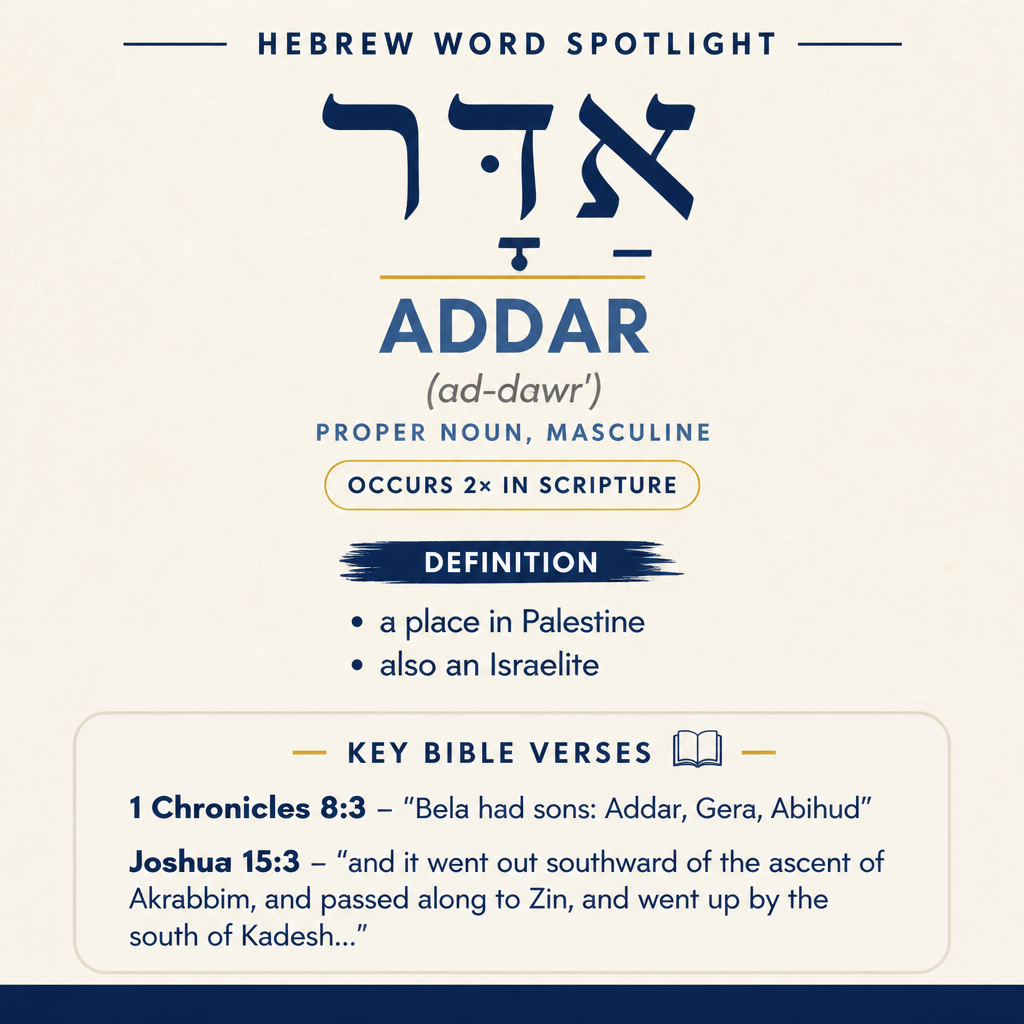
Addar refers to a place in Palestine and also an Israelite, appearing in 1 Chronicles 8:3 and Joshua 15:3.
Meaning
Addar names a place in Palestine. It also functions as the name of an Israelite.
Learn More →Scripture Occurrences
Addar occurs 2 times in Scripture. The references are 1 Chronicles 8:3 and Joshua 15:3.
Learn More →Verse Contexts
In 1 Chronicles 8:3, Addar is listed among the sons of Bela. In Joshua 15:3, it appears within a description of a boundary route.
Learn More →Addar names (1) an Israelite person within a brief genealogy and (2) a place in Palestine within a boundary description. These two appearances show the name functioning both as a family name and as a geographic marker in the land.
Occurrences
“Bela had sons: Addar, Gera, Abihud,” (1 Chronicles 8:3)
Here Addar appears as one item in a compact list of sons, attached to Bela. The verse is shaped like a genealogical register: a father is named, then his sons are enumerated. In that setting, Addar functions as a personal name that helps define Bela’s household and distinguishes one son from the others named alongside him (“Gera, Abihud”). The placement of Addar between other names in a simple series keeps the focus on lineage and identification rather than narrative action; the name’s main contribution is to mark an individual within a family line.
The grammar of the line also highlights how names serve as stable points in a record: the verb “had” frames the sons as belonging to the father, and the colon introduces the list. Addar therefore operates as a genealogical identifier—one of the fixed elements by which the family is remembered and ordered. Nothing in the verse describes Addar’s deeds or role; the name’s weight is carried by its inclusion in the family structure itself.
“and it went out southward of the ascent of Akrabbim, and passed along to Zin, and went up by the south of Kadesh Barnea, and passed along by Hezron, went up to Addar, and turned toward Karka;” (Joshua 15:3)
In Joshua 15:3, Addar is a waypoint in a boundary line traced through a sequence of locations. The repeated movement verbs (“went out,” “passed along,” “went up,” “turned”) create a sense of a border being followed carefully across the terrain. Within that chain, “went up to Addar” treats Addar as a recognizable place that can be approached along a route and used to orient the next shift in direction (“and turned toward Karka”).
The verse situates Addar amid other named points—“the ascent of Akrabbim,” “Zin,” “Kadesh Barnea,” “Hezron,” and “Karka.” This clustering of place-names gives Addar its role: it anchors a segment of the boundary, helping the reader imagine a line that runs from one known location to another. The phrase “went up to Addar” also presents Addar as a point reached after moving through earlier markers, implying a progression across land features and settlements. In this passage, the significance of Addar is practical and geographic: it is part of the framework used to define territory.

Sense and Usage
Addar functions as a proper name with two referents: a place in Palestine and an Israelite person. In the genealogical line of 1 Chronicles 8:3, Addar’s usage as a personal name fits the register-like style typical of family listings, where a name’s primary task is to identify an individual within kinship relations. The verse makes Addar one of “Bela[’s]…sons,” so the name is relationally framed: its meaning in context is to locate a person within a father’s household and within the ordered set of siblings recorded there.
In Joshua 15:3, Addar’s usage as a place-name fits a different kind of precision: boundary language depends on stable geographic reference points. The verse traces a line that “passed along” and “went up” from one location to the next, and Addar is one of those named points. In that setting, Addar’s function is not relational to a family line but relational to surrounding geography: it stands between “Hezron” and “Karka” as the border progresses. The name contributes to a map-like description, where meaning is carried by position in a sequence of movements.
Together, these two usages show how a single name can operate across two domains of identity in Scripture: people and places. In the genealogical context, Addar is embedded in a human network (father and sons). In the boundary context, Addar is embedded in a spatial network (a route traced by directional verbs and neighboring landmarks). Both contexts use the name to establish boundaries of a different sort: genealogies draw boundaries of lineage and belonging by naming members; boundary descriptions draw territorial boundaries by naming locations. Addar, whether as a person or a place, serves as a point of reference that helps define a larger structure—either a household list or a territorial line.
The two occurrences also illustrate how proper names gain their force from the literary form that carries them. Lists of sons can be dense and minimal, yet each name, including Addar, is a necessary unit within the record; removing one would alter the shape of the lineage being presented. Similarly, boundary descriptions are often composed of chained clauses and repeated verbs of movement; each place-name, including Addar, is a necessary hinge in the route that is being set out. In both genres, the name’s contribution is concrete: it identifies a specific person or a specific place, and in doing so it supports the larger aim of the passage—either preserving genealogical knowledge or communicating territorial definition.
Imagery
Joshua 15:3 gives Addar a vivid, grounded kind of imagery by placing it on a traveled line through the landscape: the border “went out,” “passed along,” “went up,” and then “turned.” Addar stands as a real stopping point within that movement, the moment just before the line changes direction “toward Karka.” In contrast, 1 Chronicles 8:3 presents Addar without landscape, action, or description—only the still imagery of a family register where names line up one after another. Read together, the passages set Addar in two frames: a point on the land that helps trace a boundary, and a name within a family that helps trace descent.
Sources: Lexical data from Strong’s Exhaustive Concordance and the Open Scriptures Hebrew Lexicon. Occurrence data from the Westminster Leningrad Codex with STEPBible reference data (CC BY). Scripture quotations from the World English Bible (public domain).