
Exploring the Meaning of ‘Abiyma’el in Hebrew
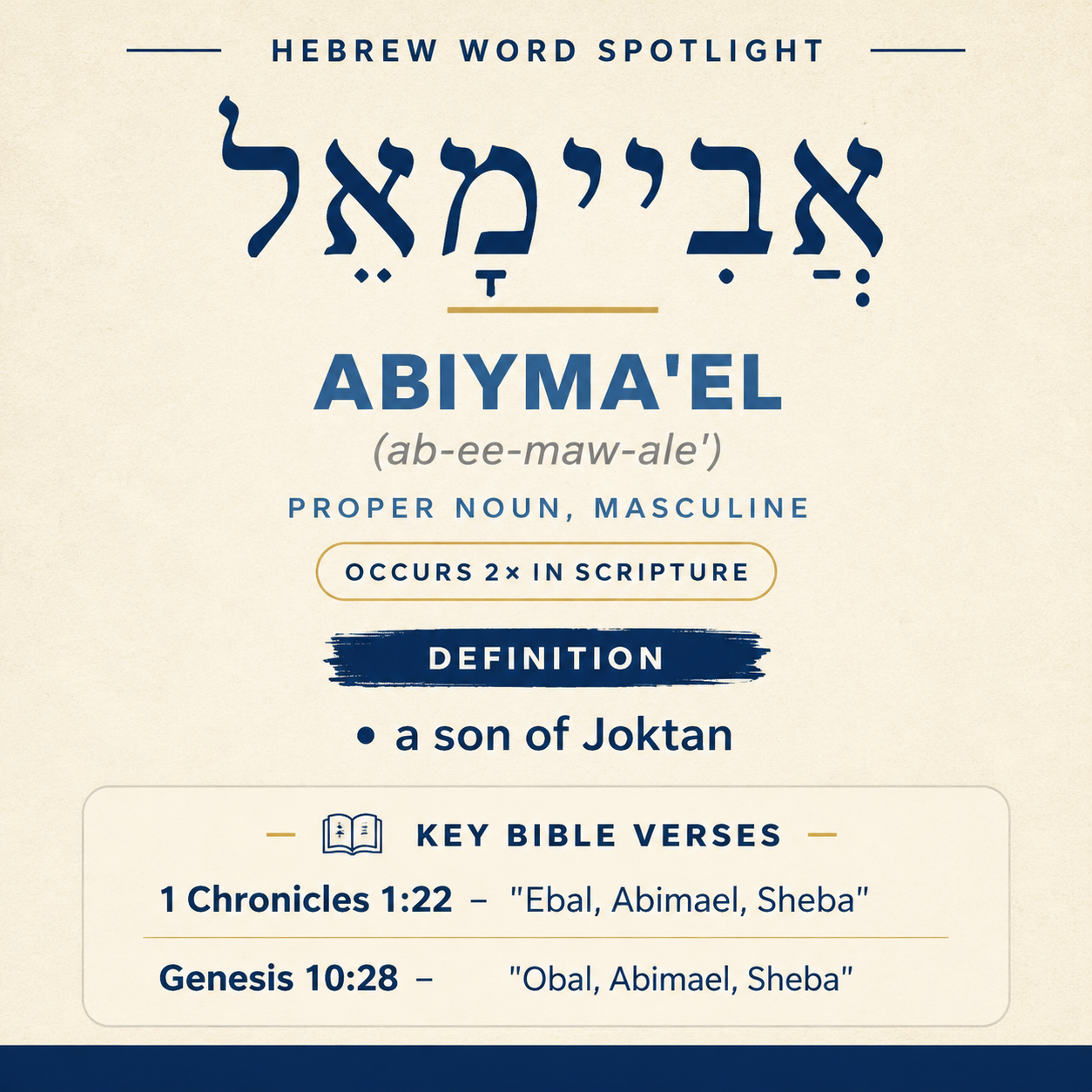
אֲבִימָאֵל (Abiyma'el) means “a son of Joktan” and appears in Genesis 10:28 and 1 Chronicles 1:22.
Scripture Occurrences
This name occurs 2 times in Scripture. It is listed in Genesis 10:28 and 1 Chronicles 1:22.
Learn More →Verse Lists
In Genesis 10:28 it appears among Obal and Sheba. In 1 Chronicles 1:22 it appears among Ebal and Sheba.
Learn More →אֲבִימָאֵל (Abiyma’el) names “a son of Joktan.” It appears in two genealogical lists, each placing the name among other descendants in a compact sequence of names.
Occurrences
“Ebal, Abimael, Sheba,” (1 Chronicles 1:22)
Here Abimael is presented as one item in a short run of names. The verse reads like a ledger line: three names set side by side, with no narrative frame, action, or descriptive detail attached. In this setting, the function of Abimael is purely genealogical—serving as an identifying link in a chain of descent. The placement between “Ebal” and “Sheba” shows the name operating as a marker of family structure: each name stands as a distinct individual within a larger family register, and Abimael’s role is to occupy one specific position in that register.
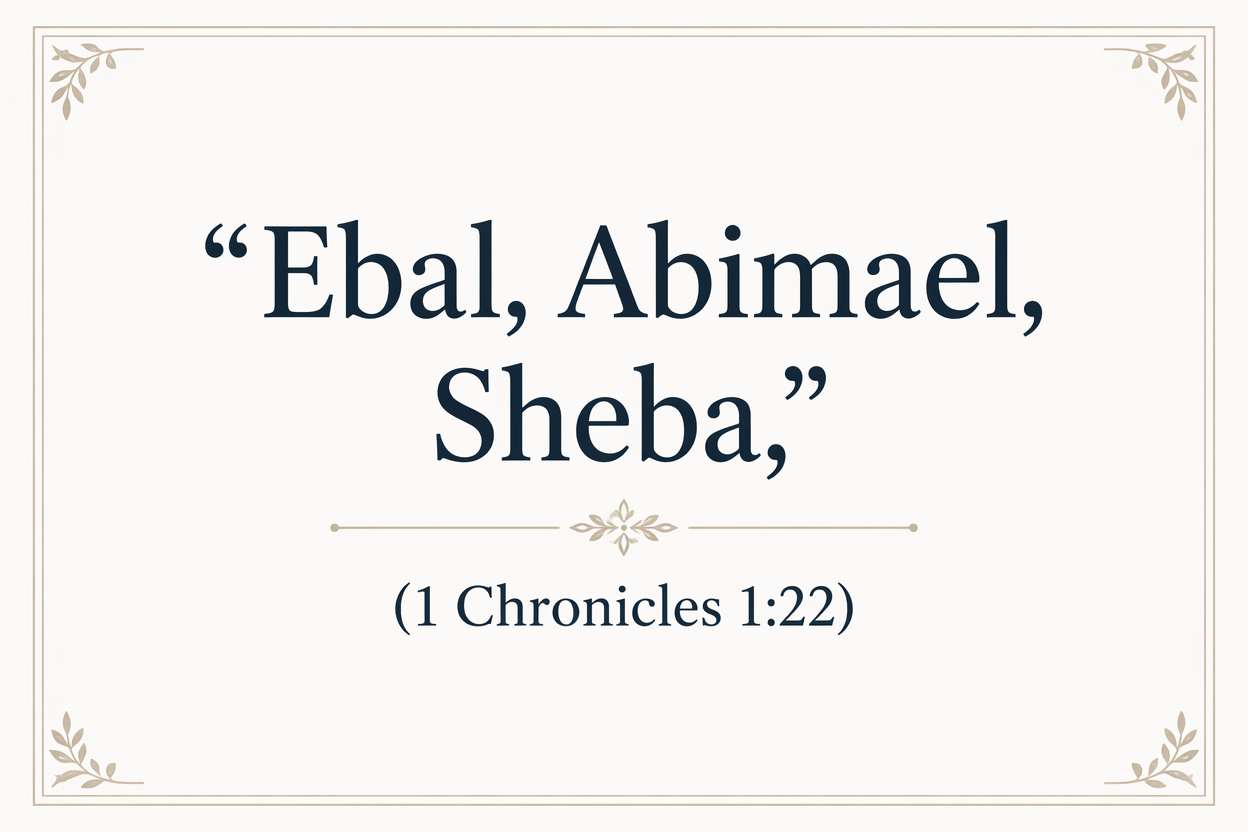
Because the verse offers the name without title or epithet, its contribution is to the list’s ordered completeness. The reader is meant to receive Abimael as part of a defined set of related persons, each included to preserve the integrity of the ancestral line being recorded.
“Obal, Abimael, Sheba,” (Genesis 10:28)
Genesis likewise places Abimael in a concise sequence of names. As in Chronicles, the writing does not pause to narrate deeds; it presents a line of descent through naming. Abimael functions here as a point of reference within a broader mapping of ancestry: the line advances by listing sons, and the name Abimael contributes one more branch—one more identifiable descendant—within the same family grouping.
The immediate context, visible in the verse itself, is the grouping of three names. Abimael is the central entry in that triad, positioned between “Obal” and “Sheba.” This ordering makes the name part of the textual structure that defines relationships: the list format assumes the reader is tracking lineage through successive names, and Abimael’s presence signals that the lineage includes this individual as one of Joktan’s sons.
Sense and Usage
Across both attestations, Abiyma’el serves as a fixed personal name with a single genealogical identification: “a son of Joktan.” The two passages use the name in the same way—without commentary, narrative, or evaluative description—so the sense is carried by its placement in a set of descendants rather than by any action associated with the bearer.
In both 1 Chronicles 1:22 and Genesis 10:28, Abimael appears as part of a list whose meaning is conveyed by structure: naming establishes connection. The name’s function is not to describe the individual’s character or role, but to preserve the identity of a particular son within a broader family record. The repetition of this usage in two separate genealogical settings reinforces the stability of the identification: Abimael is remembered and transmitted as one of Joktan’s sons, and the text treats that remembrance itself as the important contribution of the name.
The list context also shapes how the name is read. With no verbs and no surrounding explanation, the names operate almost like coordinates: each entry marks a point on a family line. Abimael’s appearance between two other names underscores how genealogies communicate through adjacency—placing individuals in relation to others by the simple sequence of names. The sense is therefore not expanded by additional nuance within these verses; instead, it is sharpened by the consistent way the name is embedded in a catalog of kin.
Genealogical Imagery
The imagery carried by Abimael in these passages is the imagery of a written register: a line of names standing in for generations. In both verses—“Ebal, Abimael, Sheba,” (1 Chronicles 1:22) and “Obal, Abimael, Sheba,” (Genesis 10:28)—the name contributes to a picture of ancestry preserved through orderly enumeration. The weight of the word in context lies in the act of naming itself: Abimael is a remembered son within a remembered line.
Sources: Lexical data from Strong’s Exhaustive Concordance and the Open Scriptures Hebrew Lexicon. Occurrence data from the Westminster Leningrad Codex with STEPBible reference data (CC BY). Scripture quotations from the World English Bible (public domain).





