
Understanding the Meaning of ‘Abiymelek in Hebrew
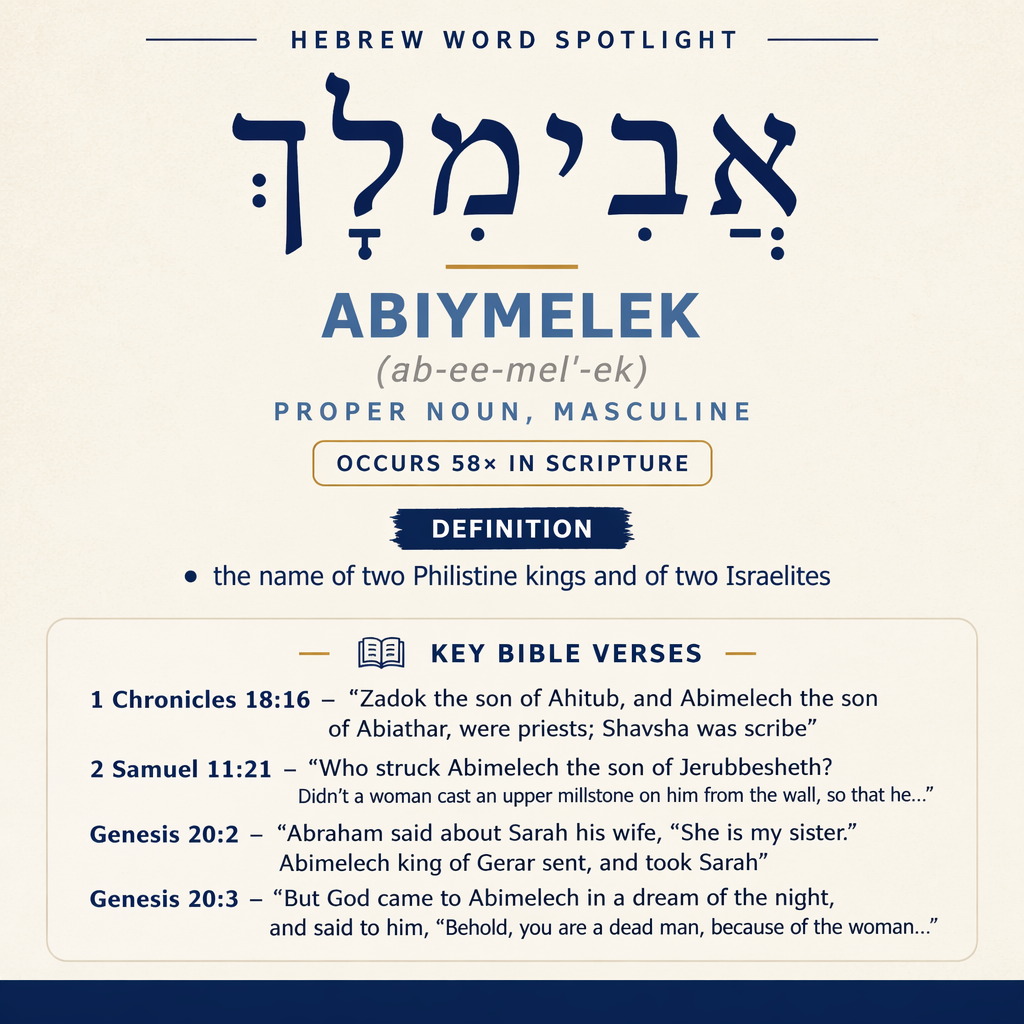
אֲבִימֶלֶךְ (Abiymelek) is the name of two Philistine kings and of two Israelites, appearing 58 times in Scripture, including Genesis 20 and 1 Chronicles 18:16.
Name & Referents
Abiymelek is used as the name of two Philistine kings and of two Israelites. It is a masculine Hebrew proper noun.
Learn More →Genesis 20 Usage
In Genesis 20:2–10, Abimelech is king of Gerar and takes Sarah after Abraham says she is his sister. God comes to Abimelech in a dream of the night and warns him.
Learn More →Other Occurrences
In 1 Chronicles 18:16, Abimelech the son of Abiathar is listed among priests. In 2 Samuel 11:21, Abimelech the son of Jerubbesheth is mentioned in a historical reference.
Learn More →אֲבִימֶלֶךְ (Abiymelek) is a masculine proper name used in Scripture for individuals who bear the same name across different settings, including Philistine kings and Israelites. In the passages below, the name marks key figures in royal courts, moral confrontation, and remembered tragedy.
Occurrences
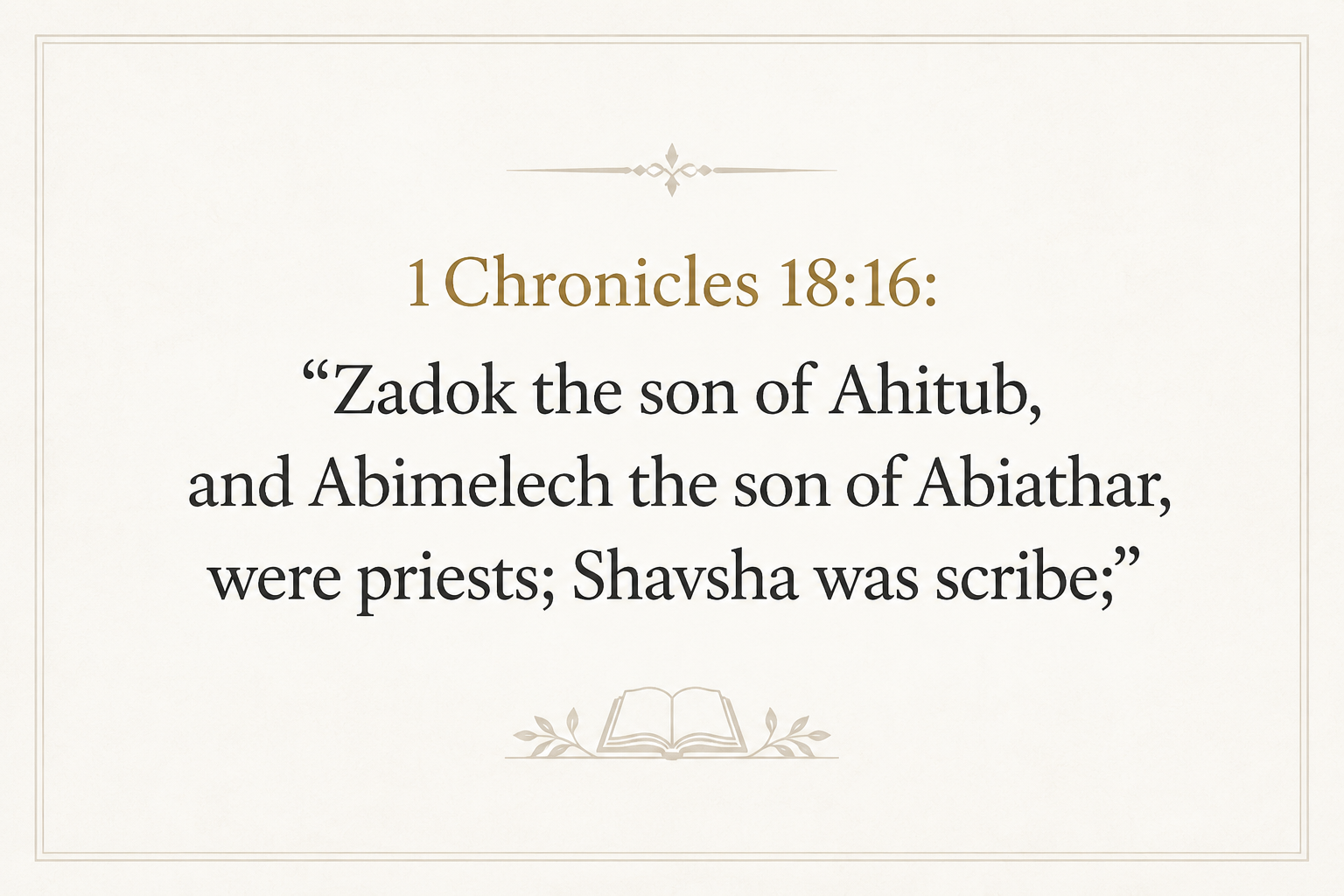
1 Chronicles 18:16: “Zadok the son of Ahitub, and Abimelech the son of Abiathar, were priests; Shavsha was scribe;”
Here אֲבִימֶלֶךְ identifies a priest within an organized leadership list. The name functions to distinguish him by lineage (“the son of Abiathar”) and by office (“were priests”), placing Abimelech alongside Zadok in a formal administrative setting that also includes a scribe.
2 Samuel 11:21: “Who struck Abimelech the son of Jerubbesheth? Didn’t a woman cast an upper millstone on him from the wall, so that he died at Thebez? Why did you go so near the wall?’ then you shall say, ‘Your servant Uriah the Hittite is also dead.’ ”
In this rhetorical question, אֲבִימֶלֶךְ is invoked as a well-known example of a fatal tactical mistake near a city wall. The name is tied to a particular remembered death: he is “the son of Jerubbesheth,” and the manner of death is vivid—an “upper millstone” thrown “from the wall,” leading to his dying “at Thebez.” The point of mentioning Abimelech is not to develop his story anew, but to make the warning memorable and forceful: a commander should anticipate that approaching a wall can bring disaster.
Genesis 20:2: “Abraham said about Sarah his wife, “She is my sister.” Abimelech king of Gerar sent, and took Sarah.”
Here אֲבִימֶלֶךְ appears with a royal title and location, “king of Gerar,” establishing him as a ruler acting with authority (“sent, and took Sarah”). The name anchors the episode in a courtly environment where the king’s actions have immediate personal consequences for Abraham and Sarah.
Genesis 20:3: “But God came to Abimelech in a dream of the night, and said to him, “Behold, you are a dead man, because of the woman whom you have taken; for she is a man’s wife.”
In this scene the name marks the recipient of divine warning. Abimelech is addressed directly in a “dream of the night,” and the speech places him under severe judgment (“you are a dead man”) due to Sarah’s true marital status (“she is a man’s wife”). The name thus stands at the center of a moral and judicial confrontation: the king is personally accountable for what has been done.
Genesis 20:4: “Now Abimelech had not come near her. He said, “Lord, will you kill even a righteous nation?”
אֲבִימֶלֶךְ here is portrayed as responding with an appeal for justice. The narrative comment “had not come near her” frames his question, and the name identifies the speaker who pleads not only for himself but for the people under his rule (“a righteous nation”).
Genesis 20:8: “Abimelech rose early in the morning, and called all his servants, and told all these things in their ear. The men were very scared.”
Abimelech’s name introduces decisive action: he “rose early,” assembled “all his servants,” and communicated what had happened. The effect spreads through the household—“The men were very scared”—showing that what touches the king reaches his entire court. The name is attached to the role of a ruler who leads by informing and mobilizing those under him.
Genesis 20:9: “Then Abimelech called Abraham, and said to him, “What have you done to us? How have I sinned against you, that you have brought on me and on my kingdom a great sin? You have done deeds to me that ought not to be done!”
Here the name belongs to the one who confronts Abraham with moral seriousness. Abimelech’s questions focus on injury (“What have you done to us?”), personal innocence (“How have I sinned against you”), and communal consequence (“on my kingdom a great sin”). The name is therefore linked to a ruler who sees wrongdoing not merely as private conflict but as something that can implicate an entire realm.
Genesis 20:10: “Abimelech said to Abraham, “What did you see, that you have done this thing?”
In a brief follow-up, Abimelech’s name marks the continued interrogation. The king presses for motive—“What did you see”—seeking an explanation for Abraham’s decision. The name functions as the voice of inquiry and accountability in the encounter.
Genesis 20:14: “Abimelech took sheep and cattle, male servants and female servants, and gave them to Abraham, and restored Sarah, his wife, to him.”
Here Abimelech’s name is attached to restitution and repair. He transfers substantial goods—“sheep and cattle,” “male servants and female servants”—and, most importantly, “restored Sarah, his wife, to him.” The name thus stands in a scene where royal capacity is used to make amends concretely, not merely with words.
Genesis 20:15: “Abimelech said, “Behold, my land is before you. Dwell where it pleases you.”
In this statement the name identifies a king extending hospitality and permission. “My land” emphasizes his authority and ownership, while “Dwell where it pleases you” shows freedom granted to Abraham. Abimelech’s name therefore carries the sense of royal discretion exercised in a favorable way.
Genesis 20:17: “Abraham prayed to God. God healed Abimelech, and his wife, and his female servants, and they bore children.”
Abimelech is named as the primary recipient of healing following Abraham’s prayer. The healing extends outward from the king to “his wife” and “his female servants,” and the result is renewed fertility (“they bore children”). The name operates as the hinge between Abraham’s intercession and the restoration of Abimelech’s household.
Genesis 20:18: “For Yahweh had closed up tight all the wombs of the house of Abimelech, because of Sarah, Abraham’s wife.”
In this explanation the name is used to designate an entire household under one head: “the house of Abimelech.” The impact is comprehensive—“closed up tight all the wombs”—and the cause is explicitly linked to Sarah and Abraham. Abimelech’s name therefore represents not only an individual king but the social unit associated with him, affected by the episode’s moral stakes.

Sense and Usage
Across these verses, אֲבִימֶלֶךְ functions as a shared personal name carried by different individuals, and the surrounding descriptions clarify which bearer is meant. In 1 Chronicles 18:16 the name is disambiguated by family (“the son of Abiathar”) and office (“were priests”), placing Abimelech within Israel’s cultic and administrative structure. In 2 Samuel 11:21 the name is fixed to a remembered event, again specified by lineage (“the son of Jerubbesheth”) and by the circumstances of death at a city wall, so that “Abimelech” becomes a reference point in an argument about battlefield prudence.
Genesis 20 uses the name repeatedly for “Abimelech king of Gerar,” where the constant repetition keeps the king himself in view as the narrative shifts between actions, divine address, and public consequences. The name is associated with royal authority (“sent, and took Sarah”; “Behold, my land is before you”), with accountability under divine scrutiny (a warning in a dream; an appeal for justice), and with responsibility for a broader community (“my kingdom”; “the house of Abimelech”). The household language in Genesis 20:17–18 shows how the king’s name can stand for those bound to him: his wife, servants, and the larger domestic sphere all share in the affliction and in the restoration.
Even within the limited set of quotations, the name’s use fits the definition’s range: it can refer to an Israelite within priestly leadership and to prominent figures tied to rulership and public memory. In every case, the narrative supplies additional identifiers—sonship, title, place, household—so that the reader knows which Abimelech is being spoken of and what weight the name carries in that moment.
Imagery
The passages attach strong concrete scenes to the name. One Abimelech is recalled with the striking image of a millstone falling “from the wall” (2 Samuel 11:21). Another Abimelech stands in a royal house where fear spreads among servants (Genesis 20:8), where restitution is measured in livestock and servants (Genesis 20:14), and where the opening and closing of wombs affects “the house of Abimelech” as a whole (Genesis 20:18). Even the brief priestly notice (1 Chronicles 18:16) places the name in the structured setting of public office, where persons are named alongside their roles and relationships.
Sources: Lexical data from Strong’s Exhaustive Concordance and the Open Scriptures Hebrew Lexicon. Occurrence data from the Westminster Leningrad Codex with STEPBible reference data (CC BY). Scripture quotations from the World English Bible (public domain).





