Discovering the Meaning of Abiy’ezer in Hebrew
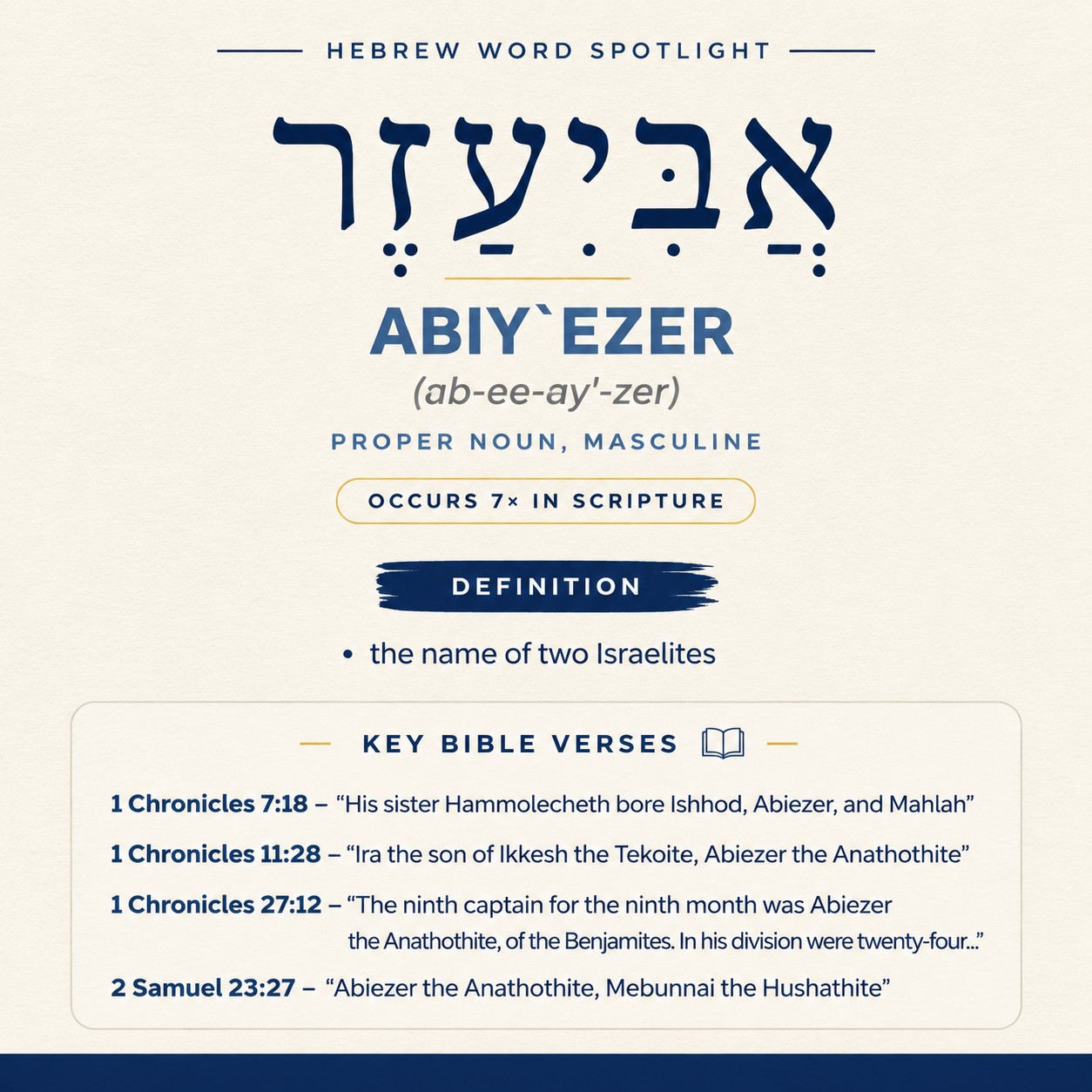
אֲבִיעֶזֶר (Abiy`ezer) is the name of two Israelites, appearing 7 times across Joshua, Judges, 2 Samuel, and 1 Chronicles.
Who It Names
אֲבִיעֶזֶר is used as the name of two Israelites. In 1 Chronicles 7:18, Abiezer is listed among Hammolecheth’s children.
Learn More →Clan References
Joshua 17:2 names “the children of Abiezer” among the families of Manasseh. In Judges 6:34, Abiezer is gathered to follow Gideon.
Learn More →Military Mentions
Abiezer the Anathothite appears in lists of warriors and leaders (2 Samuel 23:27; 1 Chronicles 11:28; 27:12). 1 Chronicles 27:12 calls him the ninth-month captain over a division of twenty-four thousand.
Learn More →אֲבִיעֶזֶר (Abiy`ezer) is the name of two Israelites. It appears in genealogical notice, tribal/family listing, and narratives that portray a group bearing this name as a recognizable kinship unit.
Occurrences
His sister Hammolecheth bore Ishhod, Abiezer, and Mahlah. (1 Chronicles 7:18)
Here Abiezer is presented within a tightly framed family record. The verse places the name alongside Ishhod and Mahlah as children borne by Hammolecheth, fixing Abiezer in a line of descent and giving the name its basic function as an identifier within a genealogy.
Ira the son of Ikkesh the Tekoite, Abiezer the Anathothite, (1 Chronicles 11:28)
In this list, Abiezer appears with a descriptive association: “the Anathothite.” The wording distinguishes him from others by tying the personal name to a place-linked designation, marking Abiezer as a particular individual known by both name and origin.
The ninth captain for the ninth month was Abiezer the Anathothite, of the Benjamites. In his division were twenty-four thousand. (1 Chronicles 27:12)
This occurrence portrays Abiezer in an official military-administrative role: “the ninth captain for the ninth month.” The same place-linked identifier (“the Anathothite”) is retained, and the clause “of the Benjamites” further situates him within Israelite tribal affiliation. The note that “In his division were twenty-four thousand” shows the scale of responsibility attached to this named person.
Abiezer the Anathothite, Mebunnai the Hushathite, (2 Samuel 23:27)
Abiezer is again named with the descriptor “the Anathothite,” placed in a roster beside another figure (“Mebunnai the Hushathite”). The verse uses the name as a point of identification within a listing of notable individuals, and the parallel structure of the two names highlights Abiezer as one member of a recognized group of men.
So this was for the rest of the children of Manasseh according to their families: for the children of Abiezer, for the children of Helek, for the children of Asriel, for the children of Shechem, for the children of Hepher, and for the children of Shemida. These were the male children of Manasseh the son of Joseph according to their families. (Joshua 17:2)
Abiezer here functions not merely as an individual but as the head-name of a family unit within Manasseh. The repeated phrasing “for the children of …” shows Abiezer as one among several named lines used to organize inheritance and identity “according to their families.” The verse’s closing emphasis on “the male children of Manasseh the son of Joseph” keeps the focus on descent and clan structure, with Abiezer serving as one of the family markers inside that structure.
But Yahweh’s Spirit came on Gideon, and he blew a trumpet; and Abiezer was gathered together to follow him. (Judges 6:34)
Abiezer is depicted as a collectivity that can respond in a unified way: “was gathered together to follow him.” The verse links Gideon’s trumpet blast to an assembled following, and Abiezer names the group that rallies. In this narrative moment, the name carries social weight: it denotes a body of people capable of being summoned and mobilized.
He said to them, “What have I now done in comparison with you? Isn’t the gleaning of the grapes of Ephraim better than the vintage of Abiezer? (Judges 8:2)
Abiezer appears within an agricultural comparison: “the vintage of Abiezer” is set against “the gleaning of the grapes of Ephraim.” The name serves as the label of a group whose harvest can be spoken of as a shared product, suggesting a collective identity with typical work and yield. The rhetorical contrast depends on the audience recognizing Abiezer as a distinct entity alongside Ephraim in order for the comparison to land.

Sense and Usage
The definition “the name of two Israelites” is reflected in two main patterns across the passages. First, Abiezer is used as an individual personal name: in the genealogical note of 1 Chronicles 7:18 and in the roster-style settings of 1 Chronicles 11:28, 1 Chronicles 27:12, and 2 Samuel 23:27. In these contexts, the name distinguishes one person among others, sometimes sharpened by a further identifier such as “the Anathothite” and, in the case of 1 Chronicles 27:12, by a stated role and troop number.
Second, Abiezer functions as a group designation tied to descent: “the children of Abiezer” in Joshua 17:2 explicitly frames Abiezer as a family name used for ordering Manasseh “according to their families.” Judges takes that family-group sense into action. In Judges 6:34, Abiezer is the gathered following that responds to Gideon’s trumpet; the name stands for a body that can assemble, move, and align itself behind a leader. In Judges 8:2, Abiezer is again collective, now in a peaceful image: a community with a “vintage,” set in comparison to Ephraim’s grape “gleaning.”
Taken together, these uses show how a personal name can operate at two levels in Scripture narrative and record-keeping: the individual identified as Abiezer, and the kinship group identified by the same name. Lists of people and lists of families are both organized by named units, and Abiezer moves naturally between those registers—appearing as a person in genealogies and rosters, and as a clan-like body in allotment language and in accounts of rallying and harvest.
Imagery in Context
In the quoted passages, Abiezer is linked to two vivid scenes: a trumpet-call that gathers followers (Judges 6:34) and a grape-harvest comparison between “gleaning” and “vintage” (Judges 8:2). These images place the name in ordinary communal life—mobilization in a moment of decision and agricultural labor in a moment of persuasion—while the genealogical and roster texts anchor the same name in the formal structures of family memory and public leadership.
Sources: Lexical data from Strong’s Exhaustive Concordance and the Open Scriptures Hebrew Lexicon. Occurrence data from the Westminster Leningrad Codex with STEPBible reference data (CC BY). Scripture quotations from the World English Bible (public domain).