
Discovering the Meaning of ‘Abiy’el in Hebrew
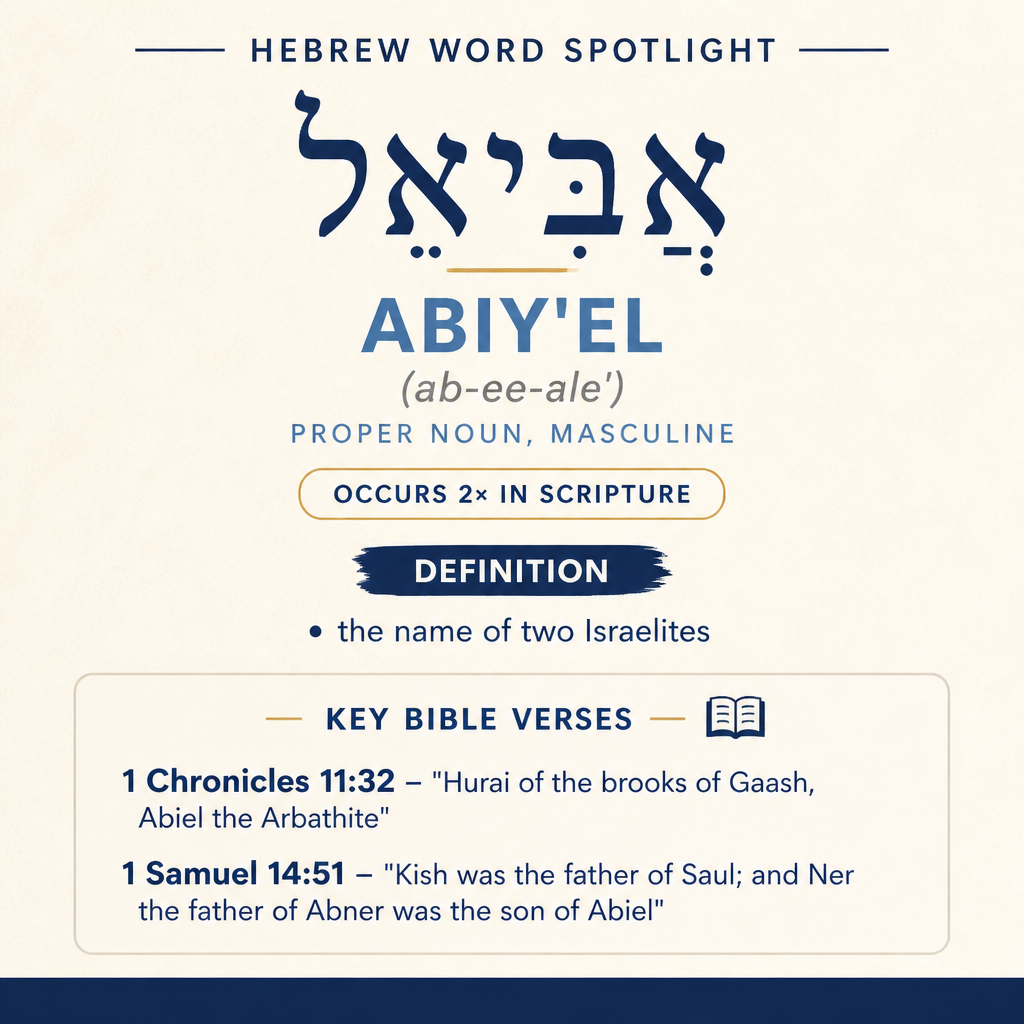
אֲבִיאֵל (Abiy'el) is the name of two Israelites, appearing in 1 Chronicles 11:32 and 1 Samuel 14:51.
Scripture Occurrences
It occurs 2 times in Scripture. The references are 1 Chronicles 11:32 and 1 Samuel 14:51.
Learn More →Verse Contexts
1 Chronicles 11:32 lists “Abiel the Arbathite.” 1 Samuel 14:51 names Abiel as the father of Ner, who was Abner’s father.
Learn More →אֲבִיאֵל (Abiy’el) is a personal name borne by two Israelites. It appears in a roster of warriors and in a brief genealogical notice connecting members of Saul’s family.
Occurrences
“Hurai of the brooks of Gaash, Abiel the Arbathite,” (1 Chronicles 11:32)
Here Abiel is listed among named men in a rapid sequence of identifications. The wording places Abiel alongside others who are distinguished by association—either with a geographic feature (“the brooks of Gaash”) or with a gentilic designation (“the Arbathite”). In this line the name functions as a fixed identifier within a catalogue, presenting Abiel as a recognized individual whose identity is further specified by attachment to a place or clan descriptor. The terse, appositional style (“Hurai… Abiel…”) is typical of lists that preserve memory of people by name, anchoring them within a wider community of notable figures.

“Kish was the father of Saul; and Ner the father of Abner was the son of Abiel.” (1 Samuel 14:51)
In this notice Abiel is not introduced through a place-label but through parentage. The sentence lays out two family lines in parallel: “Kish was the father of Saul” and “Ner the father of Abner was the son of Abiel.” Within the second line, Abiel stands as an ancestor, the point of reference that completes the chain of relationship for Ner and, by extension, for Abner. The name therefore serves a clarifying role in a compressed genealogy, locating Abner’s paternal line (“Ner the father of Abner”) within a broader family framework. Because the notice sets Saul’s father alongside Abner’s forebears, Abiel’s mention helps define the social and familial setting of prominent individuals named in the same breath.

Sense and Usage
The definition “the name of two Israelites” is borne out by the way Abiel appears in two distinct contexts that each require precise identification of persons. In 1 Chronicles 11:32, Abiel is one among several named individuals, presented without narrative development; the emphasis falls on recognition and inclusion within a remembered group, and the accompanying descriptor (“the Arbathite”) differentiates this Abiel from others who might share the same name. In 1 Samuel 14:51, the name operates in a different register: it is part of a relational statement, where meaning is carried not by a descriptive epithet but by the family linkage itself (“was the son of Abiel”). The same name thus functions in both public listing and kinship definition, each time helping the reader keep track of which person is in view.
Across these two occurrences, Abiel consistently acts as an anchor of identity, but the anchoring is achieved by different kinds of attachments. One attachment is geographic or group-based (“the Arbathite”), which marks a person by association with a locality or community. The other is genealogical (“the son of Abiel”), which marks a person by descent. Both methods are complementary ways ancient narrative and record-keeping distinguish individuals, especially where personal names recur. The briefness of each mention underscores that the name’s role is referential: it points to a known person in a network—either a network of companions remembered together, or a network of relatives traced across generations.
The two passages also show two ways a personal name can carry weight without additional description. In the list of 1 Chronicles 11, the name itself—paired with a descriptor—is enough to secure a place among notable men, suggesting that the roster assumes familiarity or at least preserves a tradition of identification. In the genealogical line of 1 Samuel 14, Abiel’s importance is indirect: he is significant because others are significant, and his name supplies the necessary link that situates Ner and Abner within their ancestry. In both, the name’s function is stable: it distinguishes one Israelite from another and situates him within the social memory of Israel through either place or lineage.
Imagery and Setting
The word Abiel carries the imagery of names spoken aloud in compact records: a roll call of men (“Hurai… Abiel…”) and a succinct chain of fathers and sons (“Ner… was the son of Abiel”). The settings suggested by these lines are not scenes of dialogue or action, but of preservation—people identified by the few details needed to place them reliably within a community and a family.
Sources: Lexical data from Strong’s Exhaustive Concordance and the Open Scriptures Hebrew Lexicon. Occurrence data from the Westminster Leningrad Codex with STEPBible reference data (CC BY). Scripture quotations from the World English Bible (public domain).




