Discovering the Meaning of ‘Abal in Hebrew
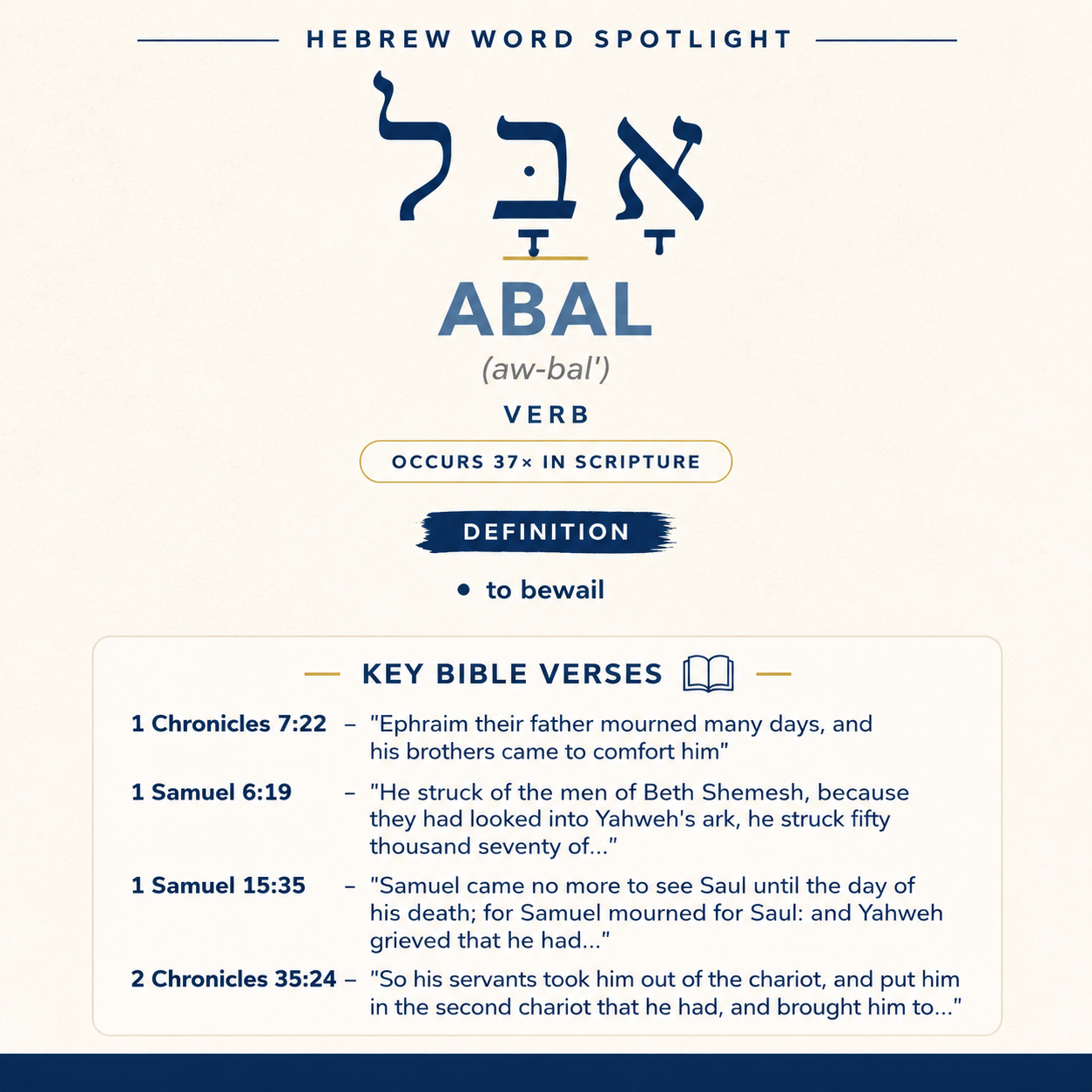
אָבַל means “to bewail” and occurs 37 times in Scripture, including 1 Chronicles 7:22, 2 Samuel 13:37, and 1 Samuel 15:35.
Human Mourning
It describes grief such as Ephraim mourning many days (1 Chronicles 7:22) and David mourning for his son (2 Samuel 13:37).
Learn More →Wider Use
It appears for Samuel mourning for Saul (1 Samuel 15:35) and for pastures that “mourn” (Amos 1:2).
Learn More →אָבַל (abal) expresses the act of bewailing in contexts of loss, calamity, or divine judgment. In the passages where it is quoted here, it ranges from private grief over family tragedy to communal lament and even a figurative mourning as the land itself is affected.

Occurrences
“Ephraim their father mourned many days, and his brothers came to comfort him.” (1 Chronicles 7:22)
Here אָבַל describes extended bereavement: Ephraim “mourned many days.” The verb frames grief as something that can endure over time and can draw a response from others—his brothers “came to comfort him,” showing that bewailing is both personal and socially recognized.
“He struck of the men of Beth Shemesh, because they had looked into Yahweh’s ark, he struck fifty thousand seventy of the men. Then the people mourned, because Yahweh had struck the people with a great slaughter.” (1 Samuel 6:19)
In this scene, אָבַל is the community’s response to sudden, large-scale death. The text ties the mourning directly to the cause: “because Yahweh had struck the people with a great slaughter.” The verb signals that bewailing is a fitting reaction to catastrophe that is understood as divine action.
“Samuel came no more to see Saul until the day of his death; for Samuel mourned for Saul: and Yahweh grieved that he had made Saul king over Israel.” (1 Samuel 15:35)
אָבַל characterizes Samuel’s ongoing sorrow “for Saul,” and it stands alongside a separate statement about Yahweh: “Yahweh grieved that he had made Saul king over Israel.” The verse places human bewailing within a broader picture of regret and rupture in leadership, with Samuel’s mourning expressed as a settled stance—he “came no more to see Saul.”
“So his servants took him out of the chariot, and put him in the second chariot that he had, and brought him to Jerusalem; and he died, and was buried in the tombs of his fathers. All Judah and Jerusalem mourned for Josiah.” (2 Chronicles 35:24)
After the king’s death and burial, the verb marks collective lament: “All Judah and Jerusalem mourned for Josiah.” Bewailing here becomes public and national in scale, attached to the loss of a particular figure whose death affects the whole community.
“But Absalom fled, and went to Talmai the son of Ammihur, king of Geshur. David mourned for his son every day.” (2 Samuel 13:37)
אָבַל depicts a father’s sustained grief, intensified by repetition and duration: “every day.” Even though Absalom has “fled,” the mourning is not delayed until death is confirmed; the verb frames David’s continual bewailing as the dominant emotional reality in the aftermath of the crisis.
“Joab sent to Tekoa, and brought a wise woman from there, and said to her, “Please act like a mourner, and put on mourning clothing, please, and don’t anoint yourself with oil, but be as a woman who has mourned a long time for the dead.” (2 Samuel 14:2)
This occurrence is distinctive because it treats mourning as a role that can be imitated. The command “Please act like a mourner” is then spelled out through embodied signals—“mourning clothing,” the absence of oil, and a demeanor “as a woman who has mourned a long time for the dead.” The verb thus reaches beyond inward feeling to visible practices that communicate bewailing to others.
“Joab was told, “Behold, the king weeps and mourns for Absalom.”” (2 Samuel 19:1)
Here אָבַל is paired with “weeps,” presenting bewailing as part of a fuller expression of grief. The report focuses attention on the king’s state, and the verb underscores that the mourning is conspicuous enough to be narrated to Joab as a fact of political and household importance.
“He said: “Yahweh will roar from Zion, and utter his voice from Jerusalem; and the pastures of the shepherds will mourn, and the top of Carmel will wither.”” (Amos 1:2)
In Amos, אָבַל moves into vivid imagery: “the pastures of the shepherds will mourn.” The verb is applied to a landscape, portraying the effects of Yahweh’s voice as so severe that the land is described with the language of lament. The parallel clause, “the top of Carmel will wither,” anchors this mourning in visible devastation.
“Won’t the land tremble for this, and everyone mourn who dwells in it? Yes, it will rise up wholly like the River; and it will be stirred up and sink again, like the River of Egypt.” (Amos 8:8)
Here bewailing becomes universal among inhabitants: “everyone mourn who dwells in it.” The question expects assent—mournfulness is presented as the inevitable human response to what is coming. The surrounding imagery of the land rising and sinking “like the River” connects mourning with destabilization and upheaval that affects the whole region.
“For the Lord, Yahweh of Armies, is he who touches the land and it melts, and all who dwell in it will mourn; and it will rise up wholly like the River, and will sink again, like the River of Egypt.” (Amos 9:5)
This occurrence reinforces the same horizon of judgment with a different emphasis: Yahweh “touches the land and it melts,” and as a consequence “all who dwell in it will mourn.” The verb stands as the human counterpart to cosmic-scale disturbance; melting land and rising-and-sinking waters form the setting in which bewailing spreads across “all” inhabitants.
“In those days I, Daniel, was mourning three whole weeks.” (Daniel 10:2)
In Daniel, the verb is anchored in a precise period: “three whole weeks.” The first-person framing (“I, Daniel”) makes the mourning intimate and deliberate, presenting bewailing as a sustained condition rather than a momentary reaction.
“When the people heard this evil news, they mourned; and no one put on his jewelry.” (Exodus 33:4)
Here אָבַל is prompted by “evil news,” and it is accompanied by a concrete sign of grief: “no one put on his jewelry.” The verb thus marks communal bewailing that affects ordinary behavior and adornment, turning the people’s appearance into an outward register of their inner response.
Sense and Usage
Across these passages, אָבַל consistently names bewailing as a response to a perceived blow—death (Josiah), a family rupture and its fallout (David and Absalom), calamity experienced as divine striking (Beth Shemesh), or ominous revelation (“evil news”). The verb can describe grief that lasts (“many days,” “every day,” “three whole weeks”), showing bewailing as an ongoing state rather than merely a brief outcry.
Several texts also clarify that this bewailing is not only emotional but observable. In 2 Samuel 14:2, the instruction to “act like a mourner” interprets mourning as a recognizable social performance with expected signs: clothing, grooming, and demeanor. Exodus 33:4 similarly links mourning with a visible change in adornment: jewelry is not worn. Even when no explicit rituals are named, the mourning is public enough to be reported (“Joab was told”) or shared by whole populations (“All Judah and Jerusalem,” “everyone…,” “all who dwell in it”).
Finally, prophetic usage broadens the field of the verb by applying it to non-human subjects (“the pastures of the shepherds will mourn”). This does not shift the basic idea of bewailing; rather, it intensifies the description of judgment by portraying the land itself in terms normally reserved for human lament, placed alongside tangible harm such as withering, trembling, melting, and flood-like rising and sinking.
Imagery
In these verses, bewailing is pictured as something that spreads: from a father’s prolonged grief, to a nation mourning its king, to all inhabitants lamenting under upheaval. The strongest images attach mourning to outward markers—mourning clothing, the absence of oil, jewelry set aside—and to a shaken creation where pastures “mourn” as Carmel “wither[s]” and the land rises and sinks “like the River.”
Sources: Lexical data from Strong’s Exhaustive Concordance and the Open Scriptures Hebrew Lexicon. Occurrence data from the Westminster Leningrad Codex with STEPBible reference data (CC BY). Scripture quotations from the World English Bible (public domain).