Discovering the Meaning of ‘Abak in Hebrew
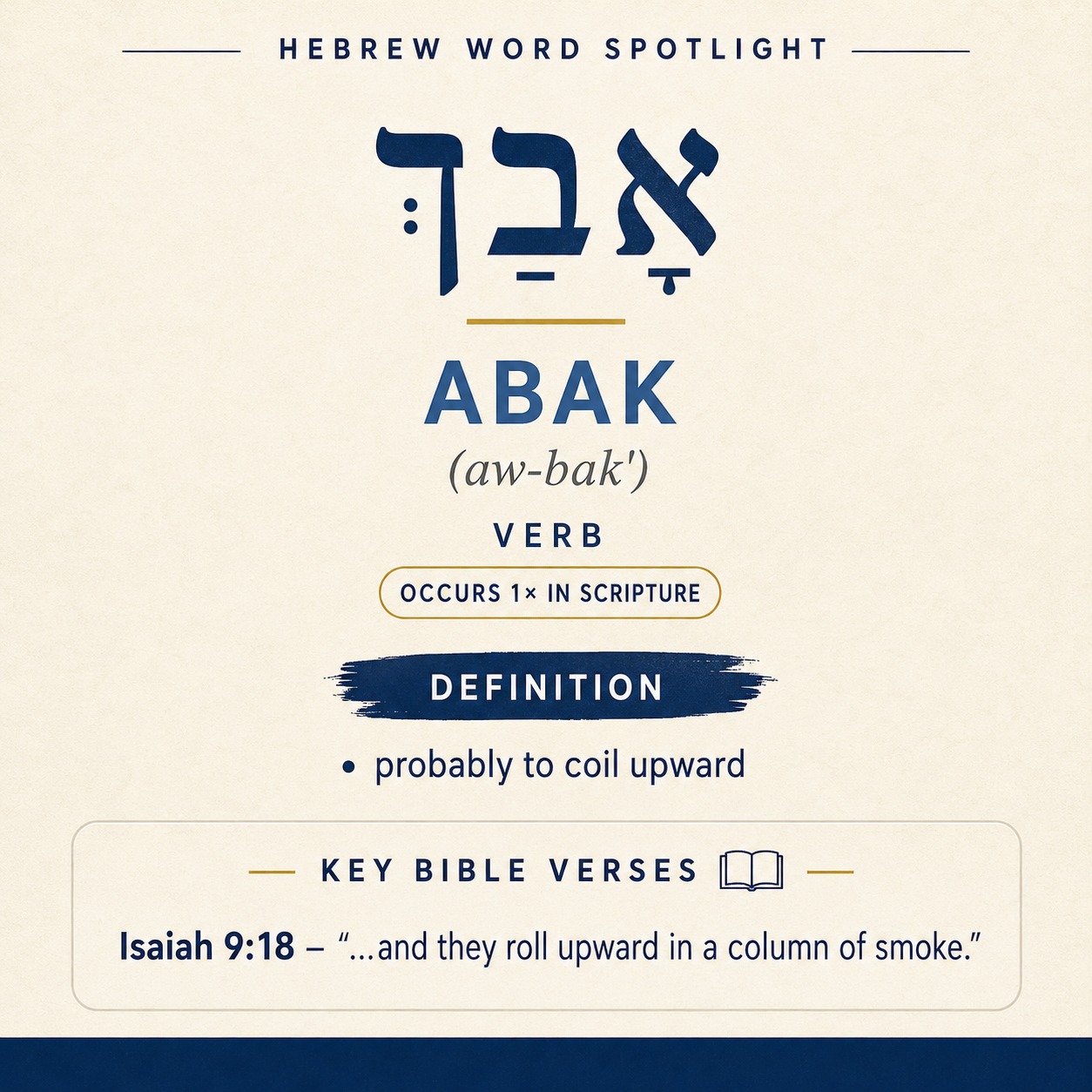
אָבַךְ means probably “to coil upward” and appears once in Scripture, in Isaiah 9:18.
Biblical Occurrence
This verb occurs 1 time in Scripture. Its single occurrence is in Isaiah 9:18.
Learn More →Verse Context
In Isaiah 9:18, the verse describes wickedness burning like a fire that devours and kindles.
Learn More →אָבַךְ describes something that probably coils upward, and it is attested in a single poetic context where smoke rises as a visible result of burning. In its lone occurrence, the verb strengthens the image of destruction by portraying the upward motion of what the fire produces.
Occurrences
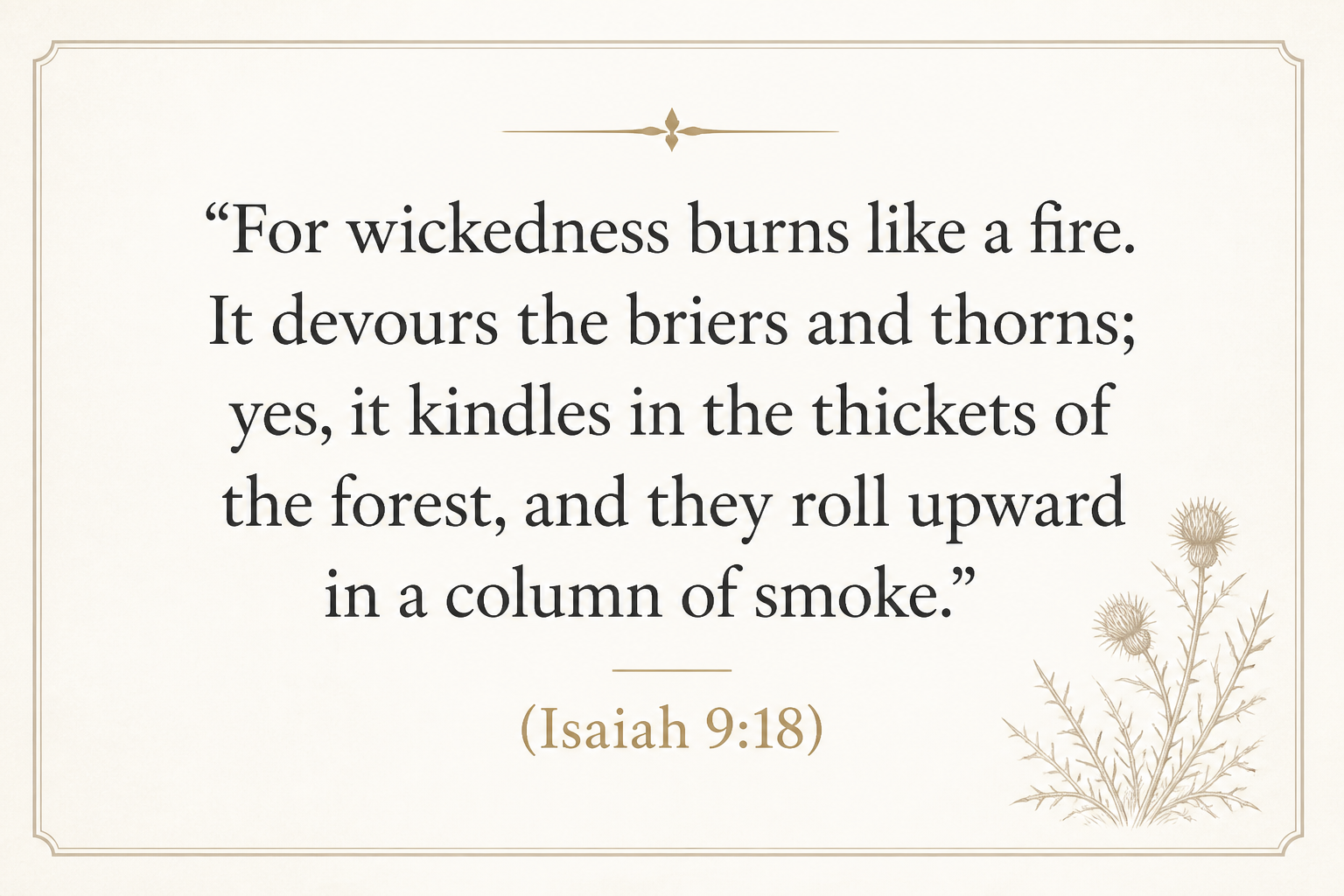
“For wickedness burns like a fire. It devours the briers and thorns; yes, it kindles in the thickets of the forest, and they roll upward in a column of smoke.” (Isaiah 9:18)
Here the prophet presents wickedness as an active, consuming force, compared directly to fire. The sequence of clauses builds intensity: it “burns,” it “devours,” it “kindles,” and then the aftermath becomes visible in the landscape. Within that cascade, אָבַךְ contributes the specific upward movement expressed in the final line: what results from the burning “roll[s] upward in a column of smoke.” The verb belongs to the concluding image where the fire’s work is no longer described in terms of what it eats (briers, thorns, thickets), but in terms of what it sends up—smoke gathered and moving skyward.
The immediate setting is thick vegetation: “briers and thorns” and “the thickets of the forest.” Such fuel suggests a fire that does not merely flicker but catches and spreads. The upward coiling is therefore not an isolated motion; it is the natural continuation of a blaze already described as devouring and kindling. The smoke is pictured as organized—“a column”—and the verb gives that column its animated behavior, like something twisting or curling as it rises. In this verse, the coiling upward is not merely a detail of weather or wind; it is the visual sign that the fire has taken hold and is producing a sustained, towering result.

Sense and Usage
The definition “probably to coil upward” fits the verse’s focus on the motion and shape of what rises after ignition. The context does not describe a calm, straight ascent; it portrays a rolling motion (“roll upward”) and a defined shape (“a column of smoke”). The idea of coiling upward therefore functions as an image of continuous, forceful rising—an ascent marked by curling or rolling movement rather than a simple vertical lift.
In Isaiah 9:18, the upward coiling belongs to the smoke itself, which gathers into a column. A “column” implies height and cohesion: the smoke does not disperse immediately but forms a visible shaft rising above the burning thickets. The coiling upward expresses the dynamic of that shaft as it climbs. This is important for the verse’s rhetoric: the fire is not hidden; its effect is public and unmistakable. The verb helps portray the aftermath of wickedness in terms that can be seen from a distance—smoke that rises in an organized, climbing mass.
The placement of the verb at the end of a progression also matters. The first clauses describe the action of burning in vivid verbs: wickedness “burns,” “devours,” and “kindles.” These describe what the fire does to what is on the ground. The final clause turns from consumption to ascent: the smoke goes upward. In other words, the verb marks a transition from destruction within the forest to a sign above it. The coiling upward becomes the climax of the picture, the last and highest movement—burning below, rising above.
The coiling motion is paired with the noun phrase “a column of smoke,” which adds a structural element to the image. A column has a recognizable form and suggests a sustained updraft produced by heat. The verb’s sense complements this by describing how such a column behaves in motion—rolling and curling as it ascends. The effect is to make the smoke feel almost tangible: not a mere haze, but something with body, movement, and direction.
Because the verse frames wickedness as the fire’s analogue (“For wickedness burns like a fire”), the upward-coiling smoke participates in the comparison. The fire’s devouring is the destructive side of wickedness; the smoke’s rising is the consequential side, what follows and signals that destruction. The coiling upward thus contributes to the moral-poetic logic of the line: wickedness does not stay contained at ground level. It flares, spreads, and produces an upsurge that gathers and rises, leaving an unmistakable plume in its wake.
Imagery
The word’s imagery is concrete and atmospheric: a forest under ignition, and above it a rising, rolling column of smoke. Isaiah 9:18 binds that physical picture to a moral reality by comparing wickedness to fire, so that the coiling upward of smoke becomes part of the verse’s warning. The motion upward, expressed with the vivid idea of coiling, makes the aftermath of burning feel immediate—something that climbs and towers, visible over “the thickets of the forest.”
Sources: Lexical data from Strong’s Exhaustive Concordance and the Open Scriptures Hebrew Lexicon. Occurrence data from the Westminster Leningrad Codex with STEPBible reference data (CC BY). Scripture quotations from the World English Bible (public domain).