Understanding the Meaning of Agathopiia in Greek
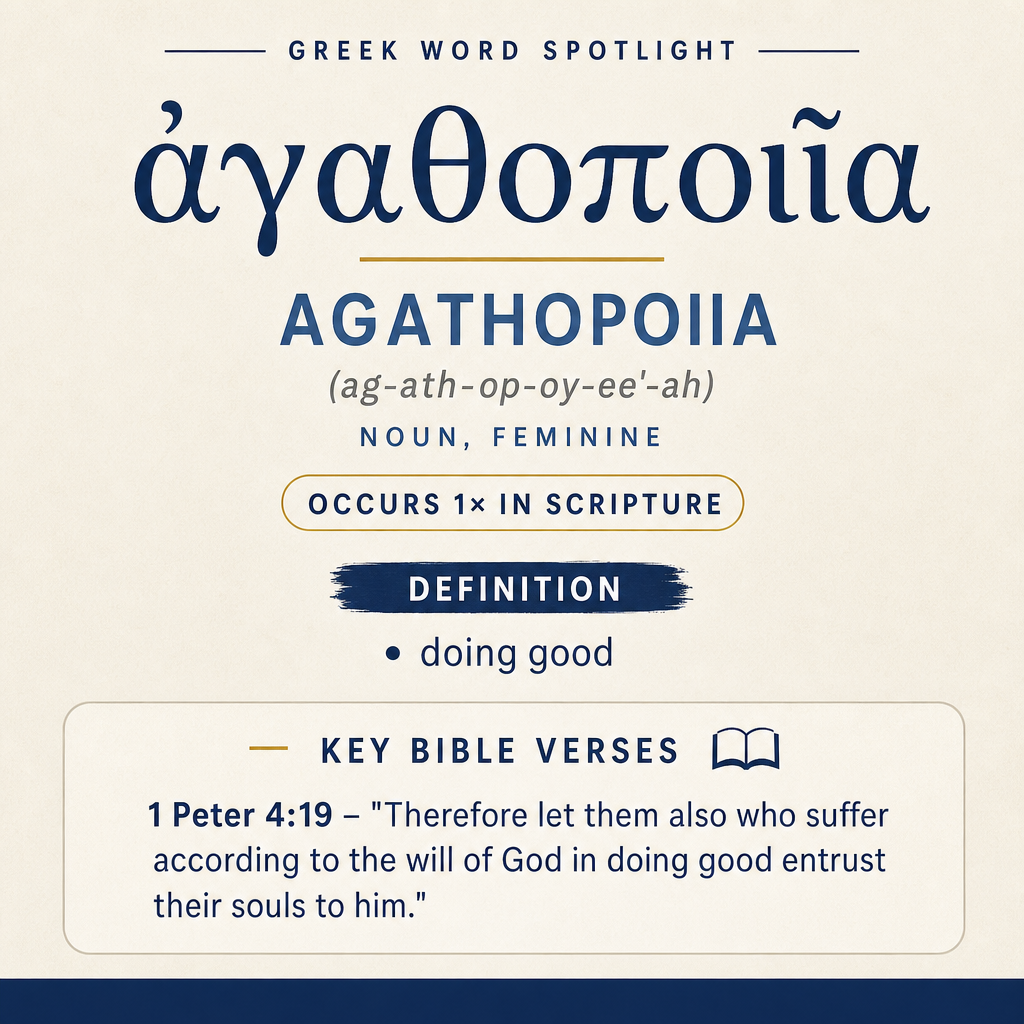
ἀγαθοποιΐα means “doing good” and appears once in Scripture at 1 Peter 4:19.
Scripture Occurrence
ἀγαθοποιΐα occurs 1 time in Scripture. It is found in 1 Peter 4:19.
Learn More →Verse Context
In 1 Peter 4:19 it appears in the phrase “in doing good.” The verse connects suffering according to God’s will with entrusting their souls to Him.
Learn More →ἀγαθοποιΐα means “doing good,” and it appears in the closing exhortation of 1 Peter 4:19. There it names the manner in which believers are to endure suffering under God’s will.
Root and Related Words
Agathopoiia (ἀγαθοποιΐα) derives from agathopoios (ἀγαθοποιός), meaning “doing good” (Strong’s G17). The relationship is visible in the shared formation, with the related term presenting the quality or characterization, and ἀγαθοποιΐα presenting the corresponding action or practice.

Occurrences
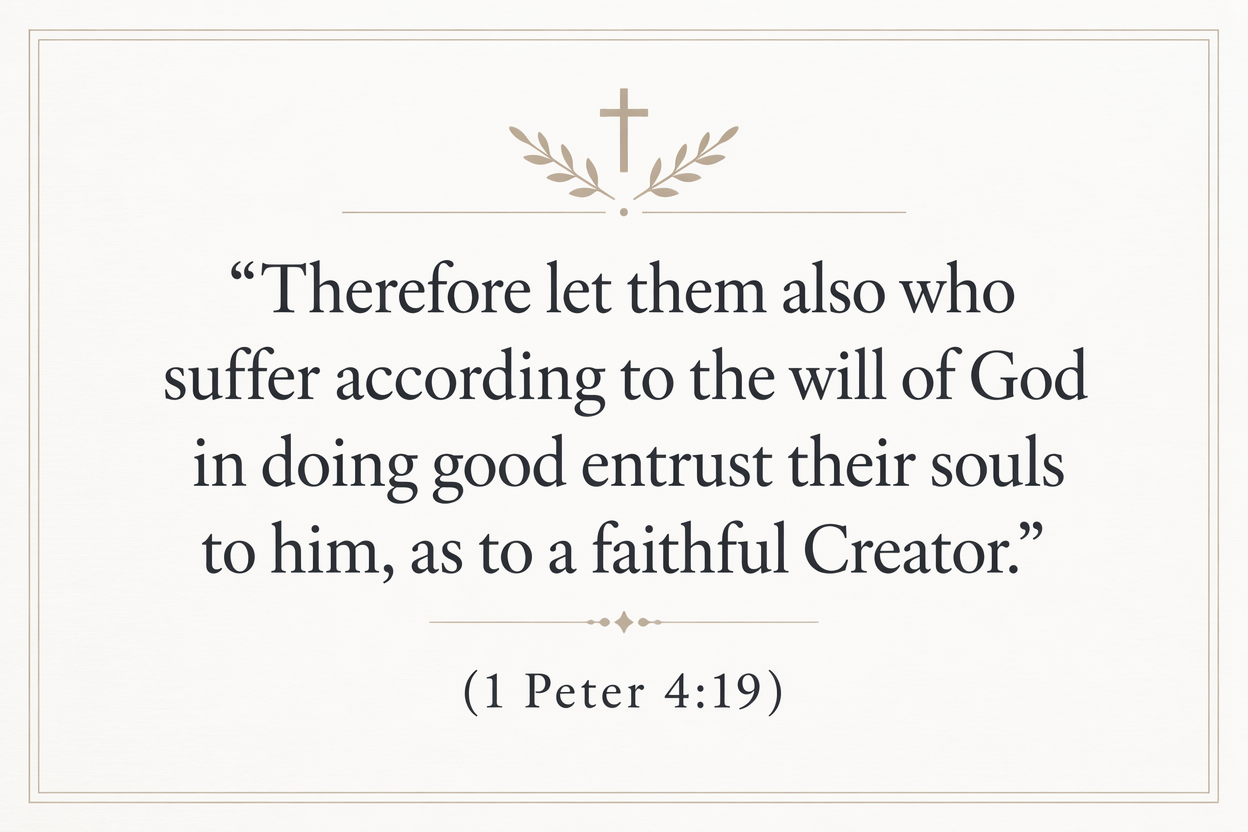
“Therefore let them also who suffer according to the will of God in doing good entrust their souls to him, as to a faithful Creator.” (1 Peter 4:19)
In this sentence, ἀγαθοποιΐα stands inside a tightly packed appeal shaped by three linked ideas: suffering, God’s will, and a deliberate response. The phrase “who suffer according to the will of God” sets the condition: the people addressed are not merely suffering in general, but suffering in a way explicitly placed within God’s will. The wording that follows—“in doing good”—places ἀγαθοποιΐα alongside that suffering as the posture or sphere in which it is endured. The verse does not present “doing good” as a separate topic from suffering; it frames faithful suffering as accompanied by, and characterized by, active good.
From the structure of the exhortation, ἀγαθοποιΐα functions as a practical marker of conduct at precisely the moment when suffering might invite withdrawal, retaliation, or despair. The word names a concrete moral course that runs in parallel with hardship: even as they “suffer according to the will of God,” they are to be found “in doing good.” In the logic of the verse, the same people who experience suffering are to maintain the practice of good as part of their endurance.
The exhortation then turns to a decisive action: “entrust their souls to him.” Here ἀγαθοποιΐα sits close to the verb “entrust,” shaping the setting in which this entrusting takes place. It is not a merely internal handing over, detached from outward conduct; it is paired with a life described as “doing good.” The verse’s syntax binds these together: suffering is met not with moral compromise but with continued good, and within that lived framework believers are told to place their lives (“their souls”) into God’s care.
The final clause, “as to a faithful Creator,” gives the ground for such entrusting. Within this single verse, ἀγαθοποιΐα is therefore not presented as a strategy to avoid suffering, nor as a bargaining chip to control outcomes. Instead, it belongs to a pattern of faithfulness: they continue doing good while suffering, and they entrust themselves to God because he is “faithful” and “Creator.” The word contributes to the verse by naming the kind of action that coheres with trust—good that persists when circumstances are adverse.
Sense and Usage
The definition “doing good” is enacted in 1 Peter 4:19 as a sustained practice rather than an isolated deed. The verse speaks of ongoing conditions (“who suffer”) and a continuing orientation (“entrust their souls”), and ἀγαθοποιΐα naturally fits this texture as a steady course of action. It is not described in detail by specific examples in the sentence; its content is carried by the general category “doing good.” Yet the placement of the word is itself instructive: it is embedded in a context where goodness is tested. The term therefore signals good that is maintained when it is costly.
Because the verse explicitly connects suffering with “the will of God,” ἀγαθοποιΐα is framed as compatible with that will, not as an attempt to escape it. The exhortation does not say that doing good prevents suffering; it assumes suffering and calls for doing good within it. In that way, the word functions as a moral stabilizer: suffering is real, but it does not redefine what counts as appropriate action. The practice of good remains the defined path, even under pressure.
The verse also aligns ἀγαθοποιΐα with an act of reliance: “entrust their souls to him.” “Doing good” and “entrusting” stand together as complementary responses. The good is outward and active; the entrusting is personal and comprehensive (“their souls”). Both are set in relation to God’s character, “a faithful Creator,” which reinforces that the doing of good in suffering is not portrayed as self-reliant heroism. The term thus participates in a larger sentence where ethical action and dependence on God are not alternatives but belong together.
Finally, ἀγαθοποιΐα helps define the moral identity of the sufferers addressed. The verse does not label them by their opponents, their social standing, or the details of their trial; it marks them by what they do: they are to be people who, while suffering, are found in “doing good.” In this way the term carries a quiet firmness: the circumstances do not get to name them more deeply than their chosen practice of good and their act of entrusting themselves to God.
Imagery
Although ἀγαθοποιΐα is an abstract noun, 1 Peter 4:19 places it in a vivid lived scene: sufferers continuing in “doing good” while placing their lives into the hands of “a faithful Creator.” The imagery is not of dramatic triumph but of steady conduct under strain—goodness practiced in the shadow of suffering, accompanied by a conscious handing over of the self to God.
Sources: Lexical data from Strong’s Exhaustive Concordance and the Translators Brief Lexicon of Extended Strongs for Greek (STEPBible, CC BY). Occurrence data from the Translators Amalgamated Greek New Testament (STEPBible, CC BY). Scripture quotations from the World English Bible (public domain).