Exploring the Meaning of Agathopoieo in Greek
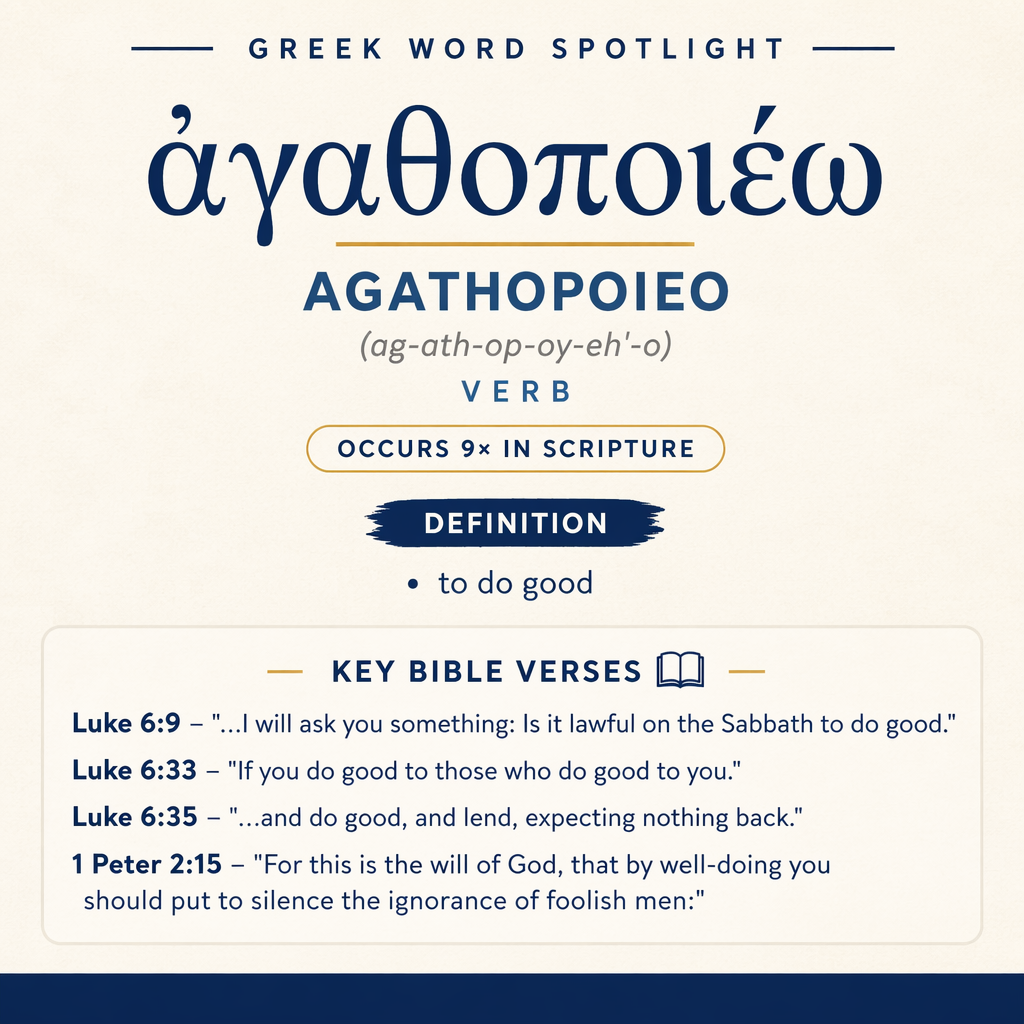
ἀγαθοποιέω means “to do good,” occurring 9 times in Scripture, including Luke 6 and several uses in 1 Peter, plus 3 John 1:11.
Core Meaning
ἀγαθοποιέω means “to do good.” In Luke 6 it is used in Jesus’ teaching about doing good, including on the Sabbath.
Learn More →Luke Contexts
Luke 6:33 asks about doing good to those who do good to you, and Luke 6:35 commands love for enemies and doing good. Luke 6:9 contrasts doing good with doing harm and saving life.
Learn More →1 Peter & John
1 Peter uses ἀγαθοποιέω for “well-doing,” linking it with God’s will, patient endurance, and suffering for doing well (1 Peter 2:15, 2:20, 3:17; also 3:6). 3 John 1:11 contrasts doing good with doing evil.
Learn More →ἀγαθοποιέω expresses the action “to do good,” appearing in Jesus’ teaching in Luke and in ethical exhortation in 1 Peter and 3 John. In these passages it is set in deliberate contrast with doing harm or doing evil, and it is repeatedly tied to public credibility, endurance under suffering, and a life that reflects God.
Occurrences
Luke 6:9: “Then Jesus said to them, “I will ask you something: Is it lawful on the Sabbath to do good, or to do harm? To save a life, or to kill?””
Here ἀγαθοποιέω stands in a stark, courtroom-like set of alternatives: “to do good” versus “to do harm,” and “to save a life” versus “to kill.” The framing treats doing good not as a vague attitude but as a morally weighty course of action that can be weighed against its opposite. In the immediate wording, doing good is aligned with saving life, so the term contributes the idea of concrete beneficent action that directly affects another person’s wellbeing.

Luke 6:33: “If you do good to those who do good to you, what credit is that to you? For even sinners do the same.”
In this saying, “do good” is placed within the logic of reciprocity: benefitting those who already benefit you. The question “what credit is that to you?” treats such good-doing as common currency in ordinary social exchange—so common that “even sinners do the same.” ἀγαθοποιέω thus contributes the sense of actively benefiting others, but the context presses beyond mere mutual kindness toward a good that is not limited to return on investment.
Luke 6:35: “But love your enemies, and do good, and lend, expecting nothing back; and your reward will be great, and you will be children of the Most High; for he is kind toward the unthankful and evil.”
This occurrence places ἀγαθοποιέω alongside two other outward actions: loving enemies and lending. The phrase “expecting nothing back” defines the manner of the good-doing—good that is freely given rather than calculated. The rationale is theological within the verse itself: God “is kind toward the unthankful and evil.” In this scene, doing good is a distinctive practice that mirrors divine kindness and is tied to the identity “children of the Most High,” showing that the verb can carry covenantal and familial implications in the way it is framed.
1 Peter 2:15: “For this is the will of God, that by well-doing you should put to silence the ignorance of foolish men:”
Here ἀγαθοποιέω is expressed as “well-doing” and is presented as a means of public vindication: it “put[s] to silence the ignorance of foolish men.” The term contributes the notion of observable conduct with a social effect; it is not private intention but a pattern of actions that can answer accusations. Within the verse’s logic, doing good functions almost like a rebuttal delivered through life rather than speech.
1 Peter 2:20: “For what glory is it if, when you sin, you patiently endure beating? But if, when you do well, you patiently endure suffering, this is commendable with God.”
This verse places doing good in a setting of endurance under mistreatment: “patiently endure beating” and “patiently endure suffering.” ἀγαθοποιέω contributes the moral baseline that distinguishes deserved pain (“when you sin”) from unjust suffering (“when you do well”). The commendation is explicitly “with God,” so the verb is part of an evaluative framework where the quality of one’s actions matters even when the immediate outcome is hardship rather than reward.
1 Peter 3:6: “So Sarah obeyed Abraham, calling him lord, whose children you now are, if you do well, and are not put in fear by any terror.”
In this conditional statement, “if you do well” sets a criterion within an appeal to identity: “whose children you now are.” The good-doing is paired with courage—“and are not put in fear by any terror.” ἀγαθοποιέω thus contributes a picture of steadfast, upright action that is sustained even when intimidation is present. The verse’s grammar connects doing good with a settled fearlessness, implying that good-doing is not merely occasional benevolence but faithful conduct under pressure.
1 Peter 3:17: “For it is better, if it is God’s will, that you suffer for doing well than for doing evil.”
This sentence builds a direct comparative: suffering “for doing well” versus suffering “for doing evil.” The verb’s contribution is to name the kind of behavior that may still lead to suffering, yet remains the preferable path. The clause “if it is God’s will” frames the possibility that hardship can accompany good-doing without negating its goodness. In this scene ἀγαθοποιέω is the moral counterpart to “doing evil,” and the contrast clarifies the ethical polarity in which the verb operates.
3 John 1:11: “Beloved, don’t imitate that which is evil, but that which is good. He who does good is of God. He who does evil hasn’t seen God.”
In 3 John, ἀγαθοποιέω is bound to imitation and identity. The instruction is framed as copying a model: “don’t imitate…evil, but…good.” The statement “He who does good is of God” makes doing good an outward marker of belonging, while the parallel “He who does evil hasn’t seen God” sets doing good against a life characterized by evil. Here the verb contributes a diagnostic function: repeated good-doing evidences a relationship to God as the verse defines it.

Sense and Usage
Across these passages ἀγαθοποιέω consistently names active, observable conduct that benefits others, and it is repeatedly defined by contrast. Luke 6:9 sets “to do good” against “to do harm,” aligning the former with saving life; the term is therefore not merely polite behavior but a choice with serious consequences. Luke 6:33 and 6:35 then situate good-doing within interpersonal economics: it can be done as ordinary reciprocity (“to those who do good to you”), or it can be done in a way that refuses repayment (“expecting nothing back”). The word itself remains stable, but the surrounding phrases show that good-doing can be either commonplace or radically generous depending on its target and expectations.
In 1 Peter, the verb becomes a headline for a whole manner of life that must endure scrutiny and mistreatment. “By well-doing you should put to silence the ignorance of foolish men” (1 Peter 2:15) treats good-doing as visible and persuasive: it answers slander not by argument but by the cumulative weight of a good life. The same letter also links good-doing to patient endurance: “when you do well, you patiently endure suffering” (1 Peter 2:20). This pairing shows that ἀγαθοποιέω is not defined by favorable outcomes; one can do good and still face “beating” and “suffering.” The moral value of the action is affirmed in God’s assessment: such endurance while doing good “is commendable with God.”
1 Peter 3:6 and 3:17 deepen that connection by tying good-doing to fearlessness and to the possibility of suffering within God’s will. “If you do well, and are not put in fear by any terror” (3:6) presents good-doing as steady conduct that refuses to be controlled by intimidation. “It is better…that you suffer for doing well than for doing evil” (3:17) makes explicit that good-doing and evil-doing are distinct paths, even when both can involve suffering; the distinction lies in the character of the deeds, not in whether hardship follows.
Finally, 3 John 1:11 places ἀγαθοποιέω in the realm of moral formation through imitation and offers a concise theological evaluation: doing good corresponds with being “of God.” In that setting, good-doing is not presented as a strategy for social approval but as an expression of spiritual affiliation. Taken together, these texts show that ἀγαθοποιέω can describe actions ranging from everyday benevolence to enemy-love, from generosity without repayment to steadfast conduct under threat, and from public vindication to evidence of belonging to God—all while maintaining its core focus on concrete deeds characterized as good.
Imagery in Context
The scenes surrounding ἀγαθοποιέω are strikingly physical: a life saved rather than killed (Luke 6:9), lending without expecting return (Luke 6:35), endurance under beating and suffering (1 Peter 2:20), and courage that refuses terror (1 Peter 3:6). Even where the word is summarized as “well-doing,” it is pictured as something others can observe and that can quiet hostile talk (1 Peter 2:15). In these passages, doing good is not an abstract ideal; it is a practiced course of action that can be tested by reciprocity, by enemies, by public accusation, and by pain.
Sources: Lexical data from Strong’s Exhaustive Concordance and the Translators Brief Lexicon of Extended Strongs for Greek (STEPBible, CC BY). Occurrence data from the Translators Amalgamated Greek New Testament (STEPBible, CC BY). Scripture quotations from the World English Bible (public domain).