Exploring the Meaning of Huperano in Greek
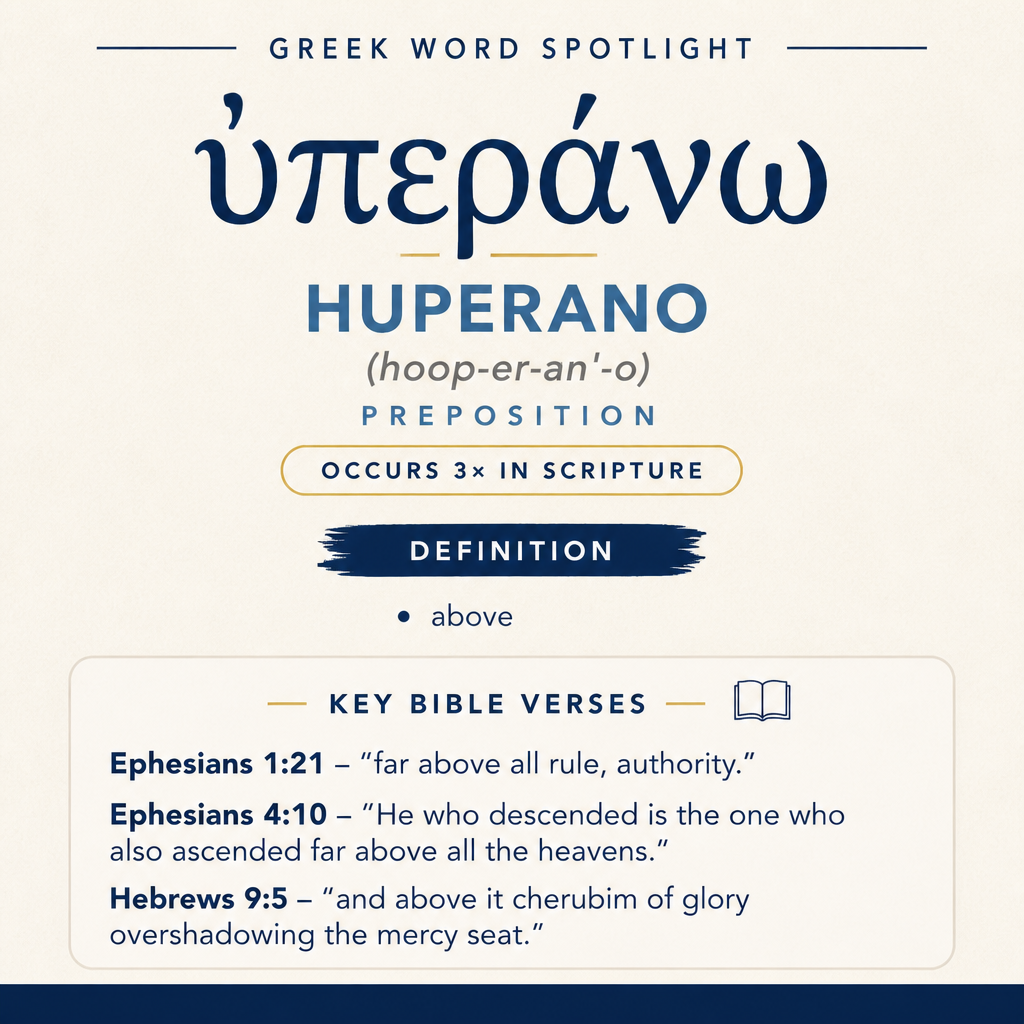
ὑπεράνω means “above” and occurs three times: Ephesians 1:21; Ephesians 4:10; Hebrews 9:5.
Core Meaning
ὑπεράνω is defined as “above.” It expresses a position of being over or higher than something else.
Learn More →Pauline Usage
In Ephesians 1:21, it describes Christ as far above all rule, authority, power, dominion, and every name. In Ephesians 4:10, it speaks of Christ ascending far above all the heavens to fill all things.
Learn More →Hebrews Context
In Hebrews 9:5, it describes cherubim of glory as being above the mercy seat. The verse notes these details are not spoken of in full at that point.
Learn More →ὑπεράνω expresses the idea of being “above,” and it appears in three New Testament contexts that speak of exaltation and spatial placement: two in Ephesians and one in Hebrews. In each setting, it marks an elevated position in relation to other realities named in the immediate sentence.
Root and Related Words
ὑπεράνω (Huperano) is related to ἄνω (ano), “above” (Strong’s G507), and to ὑπέρ (hyper), “above/for” (Strong’s G5228).

Occurrences
Ephesians 1:21: “far above all rule, authority, power, dominion, and every name that is named, not only in this age, but also in that which is to come.”
Here ὑπεράνω sets a vertical (and therefore ranking) contrast between the subject being described and a stacked list of powers: “rule, authority, power, dominion,” and even “every name that is named.” The phrasing does not merely place the subject slightly higher, but “far above,” emphasizing a separation of status from every category that could be invoked as a rival or competitor. The scope is also expanded by time: the superiority described reaches “not only in this age, but also in that which is to come,” so the “above” relation is pictured as holding across present and future horizons, not limited to one moment or one realm of influence.
Ephesians 4:10: “He who descended is the one who also ascended far above all the heavens, that he might fill all things.”
In this verse ὑπεράνω participates in a movement narrative: one who “descended” is also the one who “ascended far above all the heavens.” The word marks the endpoint of ascent as a position higher than “all the heavens,” a comprehensive phrase that gathers the entire expanse of “the heavens” into what is left beneath. Within the sentence, the elevation is not an isolated fact but is linked to purpose: “that he might fill all things.” ὑπεράνω thus helps frame “ascended” as an ascent to the highest conceivable location within the verse’s own terms, in service of an all-encompassing effect described by “fill all things.”
Hebrews 9:5: “and above it cherubim of glory overshadowing the mercy seat, of which things we can’t speak now in detail.”
Hebrews uses ὑπεράνω for a concrete spatial relationship: “above it” are “cherubim of glory overshadowing the mercy seat.” The word locates the cherubim in relation to the object in view (“it”), indicating placement overhead rather than beside or within. The sentence also adds an action shaped by that position—“overshadowing”—so that “above” is not a static coordinate alone; it supports an image of something positioned over the mercy seat in a way that covers or casts a presence downward. The final clause (“of which things we can’t speak now in detail”) shows the writer moving on quickly, but the brief description still relies on ὑπεράνω to orient the reader’s mental picture of the sacred arrangement.
Sense and Usage
Across these three occurrences, “above” functions in two closely connected ways: it expresses exalted superiority (Ephesians) and it expresses physical placement overhead (Hebrews). In Ephesians 1:21, the “above” relation is measured against named tiers of authority—“rule, authority, power, dominion”—and even against the breadth of “every name that is named,” so the word contributes to a portrayal of unmatched height relative to anything that can be labeled as power. In Ephesians 4:10, “above” is framed by verbs of motion (“descended… ascended”), so the term helps mark the culmination of ascent at a point beyond the full sweep of “all the heavens,” serving the verse’s claim of comprehensive reach (“fill all things”).
Hebrews 9:5 turns the same basic idea toward orientation and layout: “above it” is a plain spatial marker that tells the reader where the cherubim are situated with respect to the mercy seat. Even there, the spatial “above” naturally suggests a hierarchy of placement—what is above can be pictured as occupying a loftier position—yet the verse keeps the focus on the arrangement (“cherubim… overshadowing”) rather than on rank or authority. Taken together, these passages show ὑπεράνω as a word that can anchor either a theological claim of supreme elevation (“far above all rule…”) or a descriptive note that guides the reader’s eye to what stands overhead (“above it cherubim…”). In each case, the term depends on a stated reference point (powers and names; the heavens; “it” and the mercy seat) and gains its force from how comprehensive that reference point is within the sentence.
Imagery
The imagery carried by ὑπεράνω in these verses alternates between cosmic height and sanctuary arrangement. Ephesians paints “far above” as a summit beyond every enumerated power and beyond every “name,” extending the picture through “this age” and “that which is to come.” Hebrews compresses the idea into a single, vivid placement—“above it”—where the elevated position of the cherubim is immediately felt in the action “overshadowing the mercy seat.”
Sources: Lexical data from Strong’s Exhaustive Concordance and the Translators Brief Lexicon of Extended Strongs for Greek (STEPBible, CC BY). Occurrence data from the Translators Amalgamated Greek New Testament (STEPBible, CC BY). Scripture quotations from the World English Bible (public domain).