Exploring the Meaning of Sapros in Greek
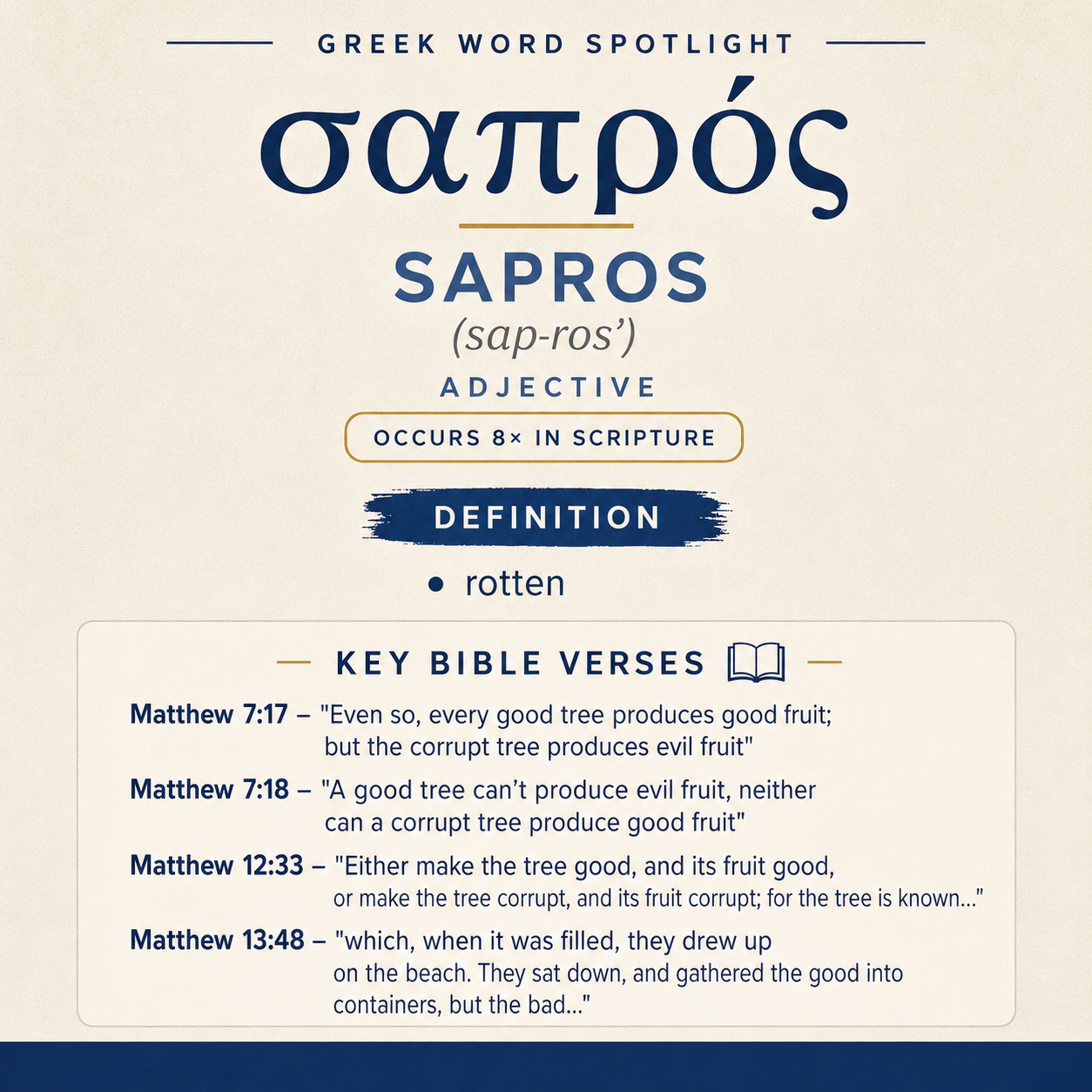
σαπρός means “rotten” and appears 8 times in Scripture, including in Matthew 7, Matthew 12, Matthew 13, Luke 6, and Ephesians 4:29.
Tree and Fruit
In Matthew 7:17–18, Matthew 12:33, and Luke 6:43, it describes rotten fruit from a corrupt tree. These passages contrast good and rotten fruit.
Learn More →Speech Warning
In Ephesians 4:29, it describes corrupt speech that must not proceed from the mouth. The verse contrasts this with speech that builds others up.
Learn More →σαπρός describes what is rotten. In the passages where it appears, it works as a concrete image (fruit or a tree) and as an evaluative adjective applied to what people produce—whether harvest or speech.
Occurrences
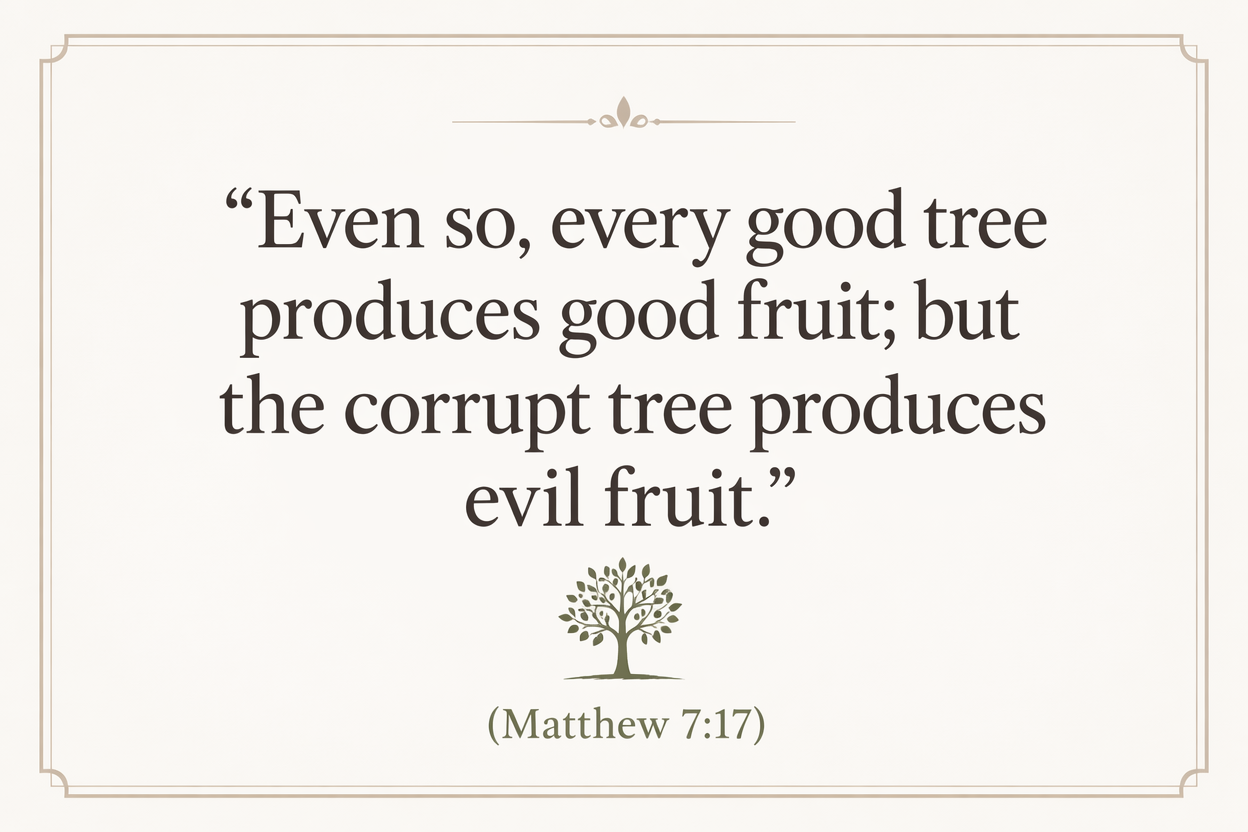
“Even so, every good tree produces good fruit; but the corrupt tree produces evil fruit.” (Matthew 7:17)
Here σαπρός qualifies the “tree” as “corrupt,” and the verse frames that corruption as productive: the kind of tree determines the kind of fruit. The word supplies a diagnosis of the tree’s condition—an internal rot—so that “evil fruit” is not an accident but a fitting outcome of what the tree is.
“A good tree can’t produce evil fruit, neither can a corrupt tree produce good fruit.” (Matthew 7:18)
In this parallel statement, σαπρός again marks the “tree” as “corrupt,” and the focus shifts to impossibility: certain combinations do not happen. The adjective strengthens the contrast by making the tree’s state decisive; just as “good” and “evil” fruit are not interchangeable, so a rotten condition cannot yield “good fruit.”
“Either make the tree good, and its fruit good, or make the tree corrupt, and its fruit corrupt; for the tree is known by its fruit.” (Matthew 12:33)
σαπρός functions as a mirror term to “good”: “good” tree/good fruit versus “corrupt” tree/“corrupt” fruit. The saying presses for consistency, pairing the adjective with both “tree” and “fruit” so that the rot is not only an internal state but something that becomes visible and recognizable. The closing line, “the tree is known by its fruit,” shows the adjective’s role in public discernment: corruption is identified by what it yields.
“which, when it was filled, they drew up on the beach. They sat down, and gathered the good into containers, but the bad they threw away.” (Matthew 13:48)
In this scene of sorting a catch, σαπρός appears as “the bad” in contrast with “the good.” The verse does not describe why some are “bad”; the adjective simply establishes an evaluative division that determines the outcome: one set is “gathered… into containers,” the other is “threw away.” Within the imagery, σαπρός marks what is unsuitable to keep, so the word contributes to the logic of separation and disposal.
“For there is no good tree that produces rotten fruit; nor again a rotten tree that produces good fruit.” (Luke 6:43)
Luke places σαπρός on the “fruit” rather than on the tree: “rotten fruit” and a “rotten tree.” This doubles the image—rot can characterize both what is produced and what produces it—while keeping the same categorical boundary: “no good tree” yields “rotten fruit,” and no “rotten tree” yields “good fruit.” The adjective makes the evaluation tangible: fruit that is rotten is the obvious, sensory evidence that matches a rotten source.
“Let no corrupt speech proceed out of your mouth, but only what is good for building others up as the need may be, that it may give grace to those who hear.” (Ephesians 4:29)
In Ephesians, σαπρός is transferred from agricultural and harvest imagery to communication: “corrupt speech.” The phrase treats speech as something that comes forth (“proceed out of your mouth”) and can therefore be judged by its quality and effects. Set against “what is good for building others up,” corrupt speech is speech that belongs to the rotten category rather than the constructive one; the verse’s contrast ties the adjective to outcomes in hearers—either damage implied by “corrupt,” or benefit described as “building others up” and “give grace.”

Sense and Usage
Across these passages, σαπρός consistently labels something as rotten in a way that invites a verdict based on what is produced. In the tree sayings (Matthew 7:17–18; Matthew 12:33; Luke 6:43), the adjective works within a simple moral logic expressed through natural imagery: the condition of a tree governs the kind of fruit it yields, and therefore fruit becomes a reliable indicator of the tree’s state. Because the sayings speak in terms of what a tree “produces,” σαπρός does not function as a mere insult; it is an assessment with explanatory power. The “corrupt tree” produces “evil fruit,” and the “rotten tree” does not produce “good fruit.” The adjective thus marks a condition that is steady enough to define what can and cannot come from a given source (“can’t,” “no… that”).
Matthew 12:33 intensifies this by pairing the adjective with both tree and fruit (“make the tree corrupt, and its fruit corrupt”). This coupling makes rot a quality that can be predicated of an origin and its outcome, connecting inner state and visible product. The final clause—“the tree is known by its fruit”—shows how σαπρός participates in recognition: it is not hidden. Rottenness, in this metaphor, becomes manifest in what is produced and can be named as such.
Matthew 13:48 places σαπρός in a different picture, not of growth but of gathering and sorting. Here the adjective does not explain production but suitability: the good are kept, the bad are discarded. The word therefore contributes to the practical judgment that follows from evaluation—containers for the good, rejection for the rotten. Even without describing the characteristics of “the bad,” the verse depends on the clarity of the distinction: σαπρός signals a category that warrants disposal.
Ephesians 4:29 shows that σαπρός can also qualify an intangible product—speech—while keeping the same evaluative force. The verse treats words as something that “proceed” and so can be appraised like fruit: they issue from a source (the mouth), they reach hearers, and they have effects. The contrast is not between two kinds of speech in the abstract, but between corrupt speech and speech that is “good for building others up.” In that setting, σαπρός signals speech that belongs to the rotten category in opposition to what benefits others. The word’s imagery remains concrete: rotten speech is speech that should not be allowed to come out, just as rotten fruit would not be gathered as good.
Imagery
The dominant imagery is organic and observable: trees and fruit, a net’s catch, and words that come out of a mouth. In each case, σαπρός marks what is unfit—either because it corresponds to a rotten source (the tree), because it shows its own rottenness (the fruit), or because it belongs to the discard pile (“the bad they threw away”). When applied to speech in Ephesians 4:29, the same adjective carries those concrete associations into daily life: spoken words are treated like produce that either nourishes and builds up, or rots and must be refused.
Sources: Lexical data from Strong’s Exhaustive Concordance and the Translators Brief Lexicon of Extended Strongs for Greek (STEPBible, CC BY). Occurrence data from the Translators Amalgamated Greek New Testament (STEPBible, CC BY). Scripture quotations from the World English Bible (public domain).