
Exploring the Meaning of Sappheire in Greek
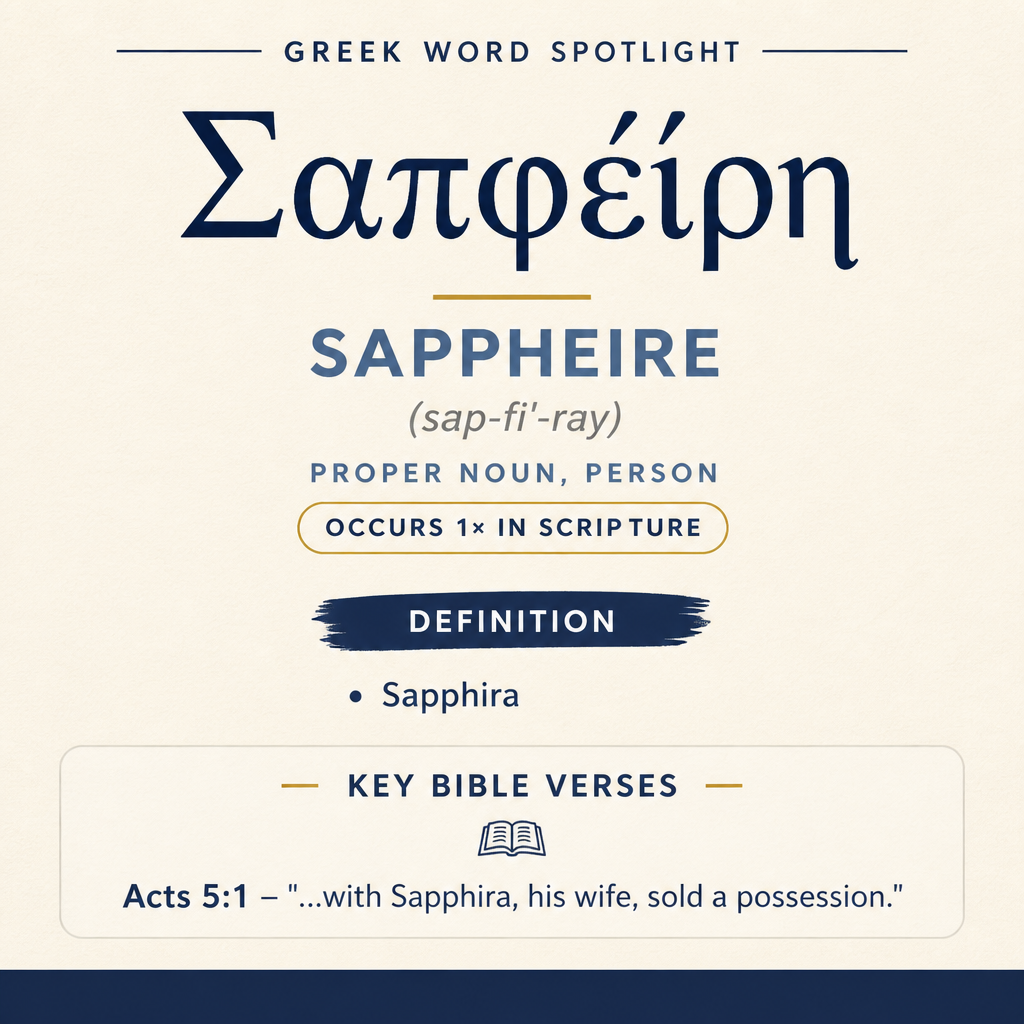
Σαπφείρη means “Sapphira” and appears once in Scripture, in Acts 5:1.
Verse Context
In Acts 5:1, Sapphira is named as the wife of Ananias in the sale of a possession.
Learn More →Σαπφείρη means “Sapphira” and appears in the account of a married couple’s sale of property in Acts. In its single attestation, the name functions to identify a specific woman in relation to her husband and to the transaction described.
Root and Related Words
Σαπφείρη (Sappheire) derives from the noun σάπφειρος (sappheiros), “sapphire” (Strong’s G4552). The relationship indicated by this derivation connects the personal name with an existing Greek word for a gemstone.

Occurrences
“But a certain man named Ananias, with Sapphira, his wife, sold a possession,” (Acts 5:1)
Here Σαπφείρη is introduced within a tightly framed identification: “Ananias” is named first, and Sapphira is named immediately alongside him and then specified as “his wife.” The wording presents the couple as a unit acting in concert—“with Sapphira, his wife”—before the shared action is narrated: they “sold a possession.” The name therefore does more than add a second character; it anchors the narrative’s depiction of joint participation in a concrete economic act, the sale of property. In this verse, Sapphira is not described by occupation, lineage, or location; her role is established by personal name and marital relationship, placing her within the household structure that frames the transaction.
The syntax also gives Σαπφείρη a distinct narrative weight: the sale of the possession is not attributed to Ananias alone but to Ananias “with” Sapphira. The name marks the presence of a second accountable party at the very moment the story’s central action is set in motion. By naming her at the outset, the verse prepares the reader to understand the ensuing events (introduced here by the sale) as involving both husband and wife, even before any further details are supplied in this line.
Sense and Usage
As a personal name, Σαπφείρη functions as a direct identifier rather than a descriptive title. In Acts 5:1, it is embedded in a relational phrase (“with Sapphira, his wife”) that clarifies which Sapphira is meant and how she is connected to the man already named. This use shows how a proper name in narrative can carry more than bare identification: it establishes social relation (wife to husband) and participation (included in the act of selling) without adding explanatory clauses. The definition “Sapphira” thus plays out in a typical narrative way—introducing a character—yet the placement of the name makes it integral to the depiction of a shared decision and shared action.
The verse’s economy of detail highlights what the name accomplishes. The line does not pause to explain motives or outcomes; instead, it focuses on the fact of a sale and on the parties involved. Σαπφείρη, therefore, is used to bind the action to a particular household pair: Ananias is not acting in isolation, and Sapphira is not an incidental bystander. Her naming at this point is the narrative’s way of making her involvement explicit at the moment the possession is sold.
The related term σάπφειρος (“sapphire”) indicates that Σαπφείρη is formed from a word used for a gemstone. Within Acts 5:1 itself, however, the name operates straightforwardly as a person’s name; the verse gives no figurative explanation or overt imagery drawn from the gemstone term. Any effect of the derivation remains indirect, residing in the sound and form of the name rather than in an explicit comparison in the sentence.
Imagery
The scene in which Σαπφείρη appears is concrete and domestic: a husband and wife are linked together in the sale of “a possession.” The name sits at the intersection of family identity (“his wife”) and property action (“sold”), so the imagery attached to its lone occurrence is the everyday world of land or goods being transferred—an ordinary transaction made narratively significant by the deliberate naming of both participants.
Sources: Lexical data from Strong’s Exhaustive Concordance and the Translators Brief Lexicon of Extended Strongs for Greek (STEPBible, CC BY). Occurrence data from the Translators Amalgamated Greek New Testament (STEPBible, CC BY). Scripture quotations from the World English Bible (public domain).





