
Exploring the Meaning of Sappheiros in Greek
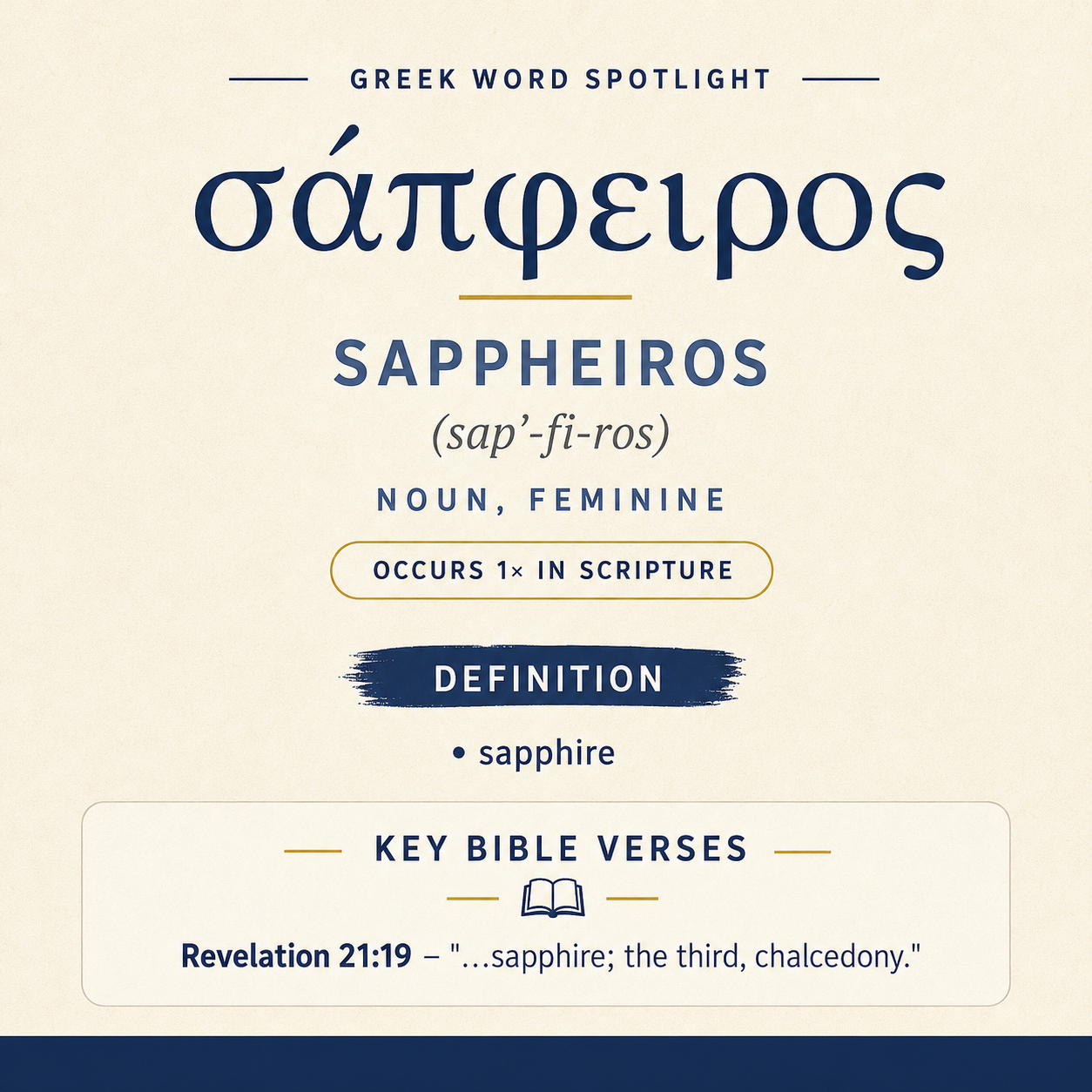
σάπφειρος (Sappheiros) means “sapphire” and appears once in Scripture in Revelation 21:19.
Context in Verse
Revelation 21:19 lists precious stones adorning the city’s wall foundations, where σάπφειρος is mentioned.
Learn More →σάπφειρος refers to “sapphire,” appearing in the description of the adorned foundations of the city’s wall in Revelation 21:19. In that setting it names one specific precious stone within a deliberate, ordered list of foundation materials.
Occurrences
“The foundations of the city’s wall were adorned with all kinds of precious stones. The first foundation was jasper; the second, sapphire; the third, chalcedony; the fourth, emerald;” (Revelation 21:19)
Here σάπφειρος is set within a carefully structured portrayal of the city’s architecture: “The foundations of the city’s wall were adorned with all kinds of precious stones.” The word contributes by naming the material of “the second” foundation. In other words, it is not presented as a loose decorative accent but as a foundational element—one of the stones that constitute the base courses supporting the wall.
The verse frames the foundations as intentionally embellished (“adorned”), and σάπφειρος functions as a concrete example of the “precious stones” used for that adornment. The surrounding list (“jasper… sapphire… chalcedony… emerald”) places sapphire among other named stones, so its force comes partly from its role as a distinct item in a catalog: it marks variety (“all kinds”) while also participating in a unified design (each foundation corresponds to a named stone, in sequence).
Because the word appears with an ordinal (“the second”), it helps carry the text’s emphasis on order and arrangement. The reader is invited to envision separate foundation layers, each identifiable by its gemstone. σάπφειρος therefore serves not only as a label for a gem but also as a building-material term within an architectural inventory: it is what the second foundation “was.”

Sense and Usage
In Revelation 21:19, “sapphire” is used in the plain, material sense: it names a precious stone applied to the city’s foundations as adornment. The verse does not treat sapphire as metaphor or as a general class of ornamentation; it is one member of a specified set of stones, selected to differentiate the foundation layers and to fill out the description’s “all kinds of precious stones.”
The syntax gives σάπφειρος a predicative role within a repeated pattern: “The first foundation was…; the second, sapphire; the third…; the fourth….” Even where the verb is not restated with each item, the construction keeps the sense clear—each foundation’s identity is expressed through the gemstone attached to it. Within that pattern, “sapphire” operates as a precise designation, contributing specificity to the visual and architectural imagery.
Because the term appears in a list of “precious stones,” its usage also participates in an overall emphasis on splendor that is presented as intrinsic to the city’s construction. The foundations are not merely functional supports; they are described as “adorned,” and the stone names supply the content of that adornment. “Sapphire” thus helps fill out the passage’s portrayal of richness and crafted beauty while remaining grounded in the straightforward sense of a gemstone used in building decoration.
Finally, the placement as “the second” stone underscores that sapphire is part of a larger, multi-layered design. The text does not present a single foundation of mixed stones, but multiple foundations, each associated with one named gemstone. In that context, “sapphire” carries the nuance of distinction within unity: one identifiable layer among others, contributing to the overall adorned structure of the city’s wall.
Imagery
The imagery of Revelation 21:19 is deliberately concrete: foundations, wall, adornment, precious stones, and a counted sequence. Within that concrete picture, σάπφειρος places “sapphire” at the level of what supports and frames the city—embedded in the architecture rather than held or worn. The word therefore evokes a city whose beauty is structural as well as decorative: the splendor described is built into the foundations themselves.
Sources: Lexical data from Strong’s Exhaustive Concordance and the Translators Brief Lexicon of Extended Strongs for Greek (STEPBible, CC BY). Occurrence data from the Translators Amalgamated Greek New Testament (STEPBible, CC BY). Scripture quotations from the World English Bible (public domain).





