
Exploring the Meaning of Proskarteresis in Greek
προσκαρτέρησις means perseverance and appears once in Scripture, in Ephesians 6:18.
Scripture Occurrence
This word occurs 1 time in Scripture. Its single occurrence is in Ephesians 6:18.
Learn More →Context in Ephesians
In Ephesians 6:18 it appears in an exhortation to pray at all times in the Spirit. The verse includes being watchful with all perseverance.
Learn More →προσκαρτέρησις means “perseverance” and appears in the context of sustained prayer. It occurs in a single New Testament exhortation that pairs prayer, watchfulness, and intercession for the saints.

Root and Related Words
προσκαρτέρησις is related to the verb proskartereō (προσκαρτερέω), “to continue in/with.” The noun expresses, in a condensed form, the kind of continuing action the verb names, portraying perseverance as something exercised and carried through.

Occurrences
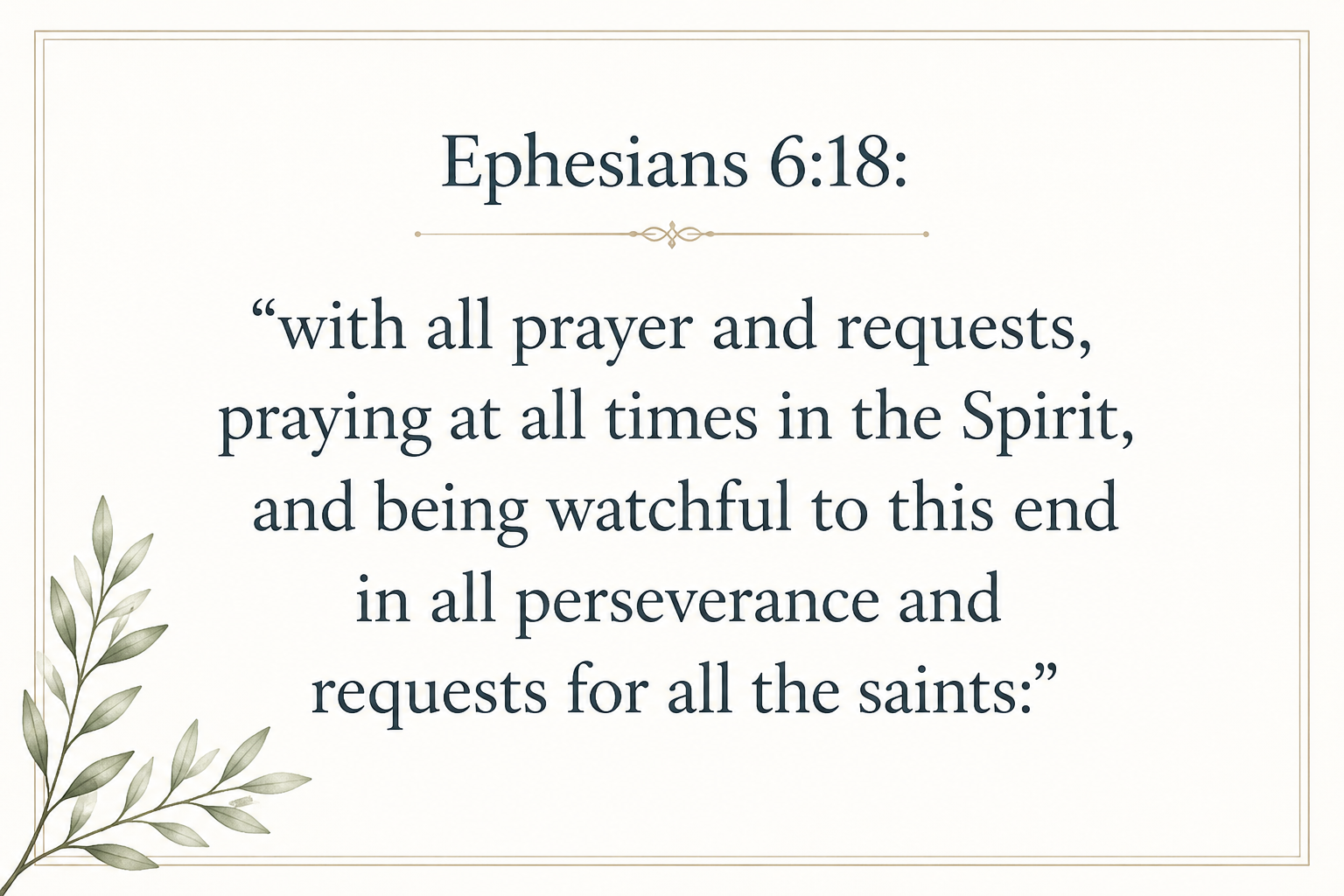
Ephesians 6:18: “with all prayer and requests, praying at all times in the Spirit, and being watchful to this end in all perseverance and requests for all the saints:”
Here προσκαρτέρησις stands inside a tightly packed series of phrases that describe the manner and posture of prayer. The line begins broadly (“with all prayer and requests”) and immediately widens the scope of prayer’s timing (“praying at all times in the Spirit”). It then adds alertness (“being watchful to this end”), and that watchfulness is specified further: it is carried out “in all perseverance and requests for all the saints.” In this sentence, perseverance is not presented as an abstract quality detached from practice; it is the atmosphere in which watchful prayer continues.
The grammar of the verse links perseverance to ongoing, repeated action. “Praying at all times” frames prayer as something that does not merely happen once. “Being watchful” adds the idea of sustained attentiveness. Then “in all perseverance” reinforces that the watchfulness envisioned is not momentary vigilance but a steadfast staying-with the work of praying and requesting. The verse also places perseverance next to “requests,” so that perseverance is pictured as accompanying petition: watchful prayer is not only broad and Spirit-directed, but also persistent and continuing in its requests.
The closing phrase, “for all the saints,” shows the direction perseverance takes in this setting. The perseverance is not simply for one’s own concerns; it is exercised in intercession. The verse’s repeated “all” language (“all prayer,” “at all times,” “all perseverance,” “for all the saints”) paints a comprehensive field in which perseverance operates: prayer in its many forms, across all times, with ongoing watchfulness, and with a continuing concern that extends to the whole community of saints. In that network of phrases, προσκαρτέρησις gives a name to the staying power required for the kind of prayer being commanded.
Sense and Usage
In Ephesians 6:18, “perseverance” functions as a practical description of how prayer is to be carried out. The verse does not treat prayer as a single act completed and set aside; it speaks of praying “at all times” and of remaining “watchful.” Within that flow, προσκαρτέρησις marks the quality of continuing in the activity without dropping it, the steady holding-on that keeps prayer and requests engaged over time.
The immediate co-text helps define the kind of perseverance intended. First, it is perseverance in a spiritual posture: the prayer is “in the Spirit,” and perseverance fits within that mode rather than replacing it. Second, it is perseverance expressed through alertness: “being watchful to this end” suggests an attentiveness that persists, a readiness that stays awake rather than drifting into neglect. Third, it is perseverance joined to concrete praying: the word sits beside “requests,” keeping perseverance tethered to actual petitions rather than allowing it to become a vague moral trait. Perseverance, as used here, is endurance in the work of prayer—continuing in petition with sustained watchfulness.
The verse also suggests perseverance’s breadth by the way it is modified and surrounded. “In all perseverance” indicates an unbounded perseverance, not limited to certain moments or certain topics. The adjoining phrase “requests for all the saints” gives perseverance a communal horizon: it is not merely persistence for private needs but tenacity in intercession on behalf of others. Thus the sense of προσκαρτέρησις in this passage is shaped by duration (“at all times”), posture (“in the Spirit”), attentiveness (“being watchful”), and scope (“for all the saints”).
Because the word appears within a chain of coordinated expressions, it also contributes to the rhythm and emphasis of the exhortation. The verse layers descriptors so that the reader hears prayer surrounded by adverbs and qualifiers: all kinds of prayer, all times, watchfulness, all perseverance, and the reach to all the saints. Within that rhetorical accumulation, προσκαρτέρησις supplies the concept of sustained continuance, reinforcing that the prayer envisioned is not sporadic but steady. The result is an instruction that prayer is to be marked by continuity and persistence, held in place by perseverance as one continues making requests.
Imagery
The imagery carried by προσκαρτέρησις in Ephesians 6:18 is the image of staying at one’s post in prayer: praying “at all times,” keeping watch, and continuing to bring “requests for all the saints.” Perseverance, in this scene, looks like ongoing alert intercession—prayer that keeps going and keeps looking out for the needs of the saints.
Sources: Lexical data from Strong’s Exhaustive Concordance and the Translators Brief Lexicon of Extended Strongs for Greek (STEPBible, CC BY). Occurrence data from the Translators Amalgamated Greek New Testament (STEPBible, CC BY). Scripture quotations from the World English Bible (public domain).





