
Exploring the Meaning of Paramutheomai in Greek
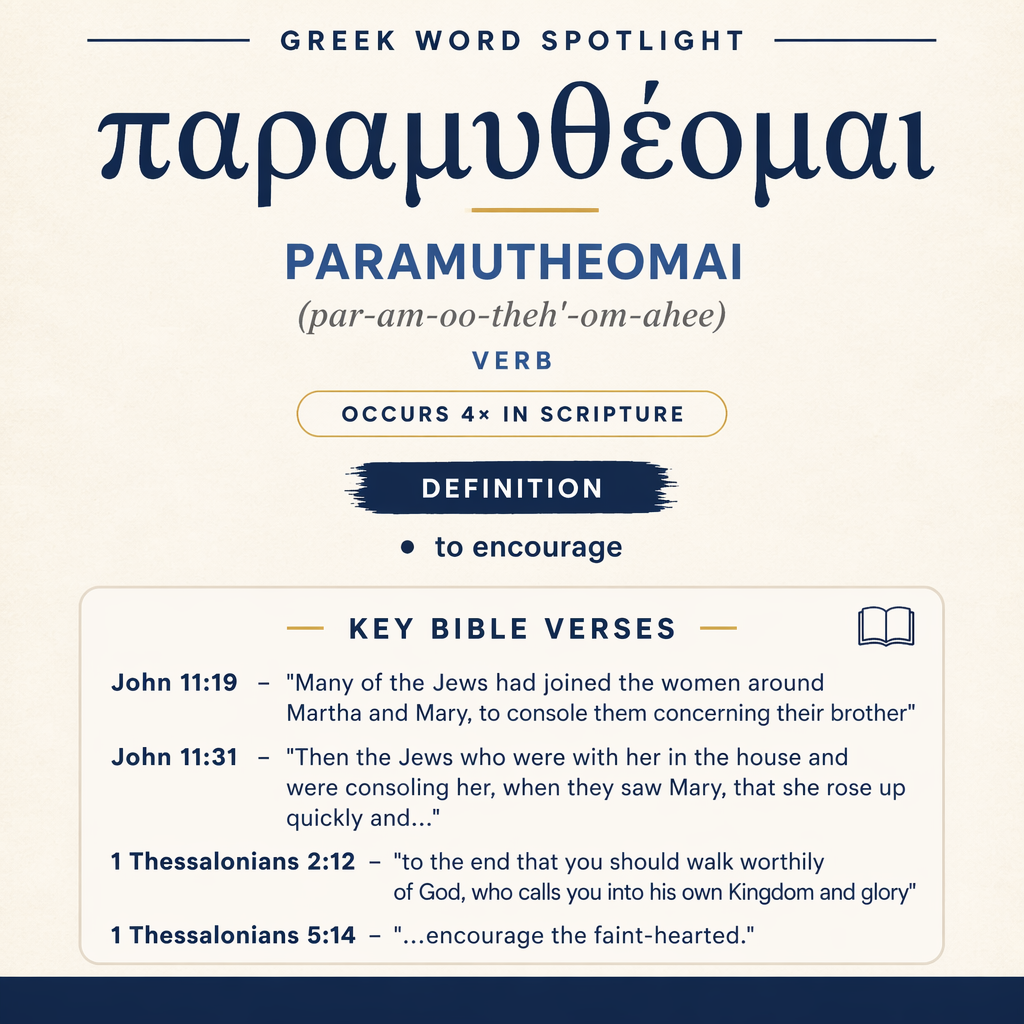
παραμυθέομαι means “to encourage,” appearing four times in Scripture: John 11:19, John 11:31, 1 Thessalonians 2:12, and 1 Thessalonians 5:14.
Core Meaning
παραμυθέομαι is defined as “to encourage.” In John 11 it describes consoling those grieving.
Learn More →Gospel Context
In John 11:19 and 11:31, Jews are pictured consoling Martha and Mary concerning their brother. The verb frames compassion expressed in mourning.
Learn More →Church Exhortation
In 1 Thessalonians 5:14 it appears in the instruction to “encourage the faint-hearted.” It also occurs in 1 Thessalonians 2:12 within a call to walk worthily of God.
Learn More →παραμυθέομαι means “to encourage” and appears in scenes of grief and pastoral instruction: Martha and Mary’s mourning in John 11, and exhortation within a Christian community in 1 Thessalonians.
Root and Related Words
παραμυθέομαι is associated with para (παρά), “from/with/beside” (Strong’s G3844), and mythos (μῦθος), “myth” (Strong’s G3454).

Occurrences
“Many of the Jews had joined the women around Martha and Mary, to console them concerning their brother.” (John 11:19)
Here the word functions within an identifiable social practice: people gather “around Martha and Mary” and their action is directed “concerning their brother.” The encouragement is not abstract; it is situated beside mourners, expressed as presence and speech among “many of the Jews” who have “joined” the women. The line frames encouragement as a communal response to bereavement—something done to people in pain, in close proximity to them, and with a specific grief in view.
“Then the Jews who were with her in the house and were consoling her, when they saw Mary, that she rose up quickly and went out, followed her, saying, “She is going to the tomb to weep there.”” (John 11:31)
This second Johannine use tightens the setting: the encouragers are “with her in the house,” engaged in consoling as an ongoing activity. The moment Mary “rose up quickly and went out,” the same group shifts from consolation to accompaniment, “followed her,” and interprets her movement as grief-driven—“to the tomb to weep there.” The word thus sits inside a sequence of embodied care: being with someone indoors, attending to their sorrow, noticing their sudden departure, and staying near them as they move toward the focal place of mourning. Encouragement here does not erase tears; it coexists with weeping and follows grief to its most concrete location, “the tomb.”
“to the end that you should walk worthily of God, who calls you into his own Kingdom and glory.” (1 Thessalonians 2:12)
In this sentence the word is tied to purpose and moral direction: “to the end that” introduces a goal, namely that the readers “should walk worthily of God.” Encouragement, in this context, is oriented toward shaping conduct (“walk”) in a way that matches the character and call of God, described as the One “who calls you into his own Kingdom and glory.” The scene is not a household around mourners but a community being formed by exhortation that aims at a worthy pattern of life. The content of the encouragement is therefore teleological: it is meant to move people toward a sustained manner of living that fits the divine calling named in the verse.
“We exhort you, brothers: Admonish the disorderly; encourage the faint-hearted; support the weak; be patient toward all.” (1 Thessalonians 5:14)
Here the word appears as one imperative among several, all addressed to “brothers” within a community that needs different kinds of care. The line distinguishes groups by condition—“the disorderly,” “the faint-hearted,” and “the weak”—and matches each with a fitting response: admonition for one, encouragement for another, support for another. The placement of “encourage the faint-hearted” clarifies the particular pastoral aim: encouragement is directed toward those whose inner strength is diminished, and it stands alongside “be patient toward all,” suggesting that this kind of strengthening care often requires time and forbearance within the whole community.
Sense and Usage
Across these four uses, παραμυθέομαι consistently operates as a relational act—something one person or group does for another in a defined situation. In John 11 it is woven into the language of presence (“around,” “with her in the house”) and shared movement (“followed her”), showing encouragement as close companionship in the thick of grief. The mourners are not corrected or redirected away from sorrow; rather, they are accompanied, and the action is explicitly “concerning their brother,” keeping the comfort tethered to the specific loss.
In 1 Thessalonians the word moves into the sphere of communal instruction and care. In 2:12 it is linked to an intended outcome—walking “worthily of God”—so encouragement is framed as morally and spiritually formative, aimed at shaping a worthy life in view of God’s call “into his own Kingdom and glory.” In 5:14 it becomes part of a differentiated pastoral toolkit: encouragement is not the only response, but it is the fitting response for “the faint-hearted,” set beside “support the weak” and “be patient toward all.” Taken together, these passages portray encouragement as both tender and directive: tender in its nearness to sorrow, directive in its capacity to orient people toward worthy conduct, and discerning in its matching of care to need.
Imagery
The passages in John 11 give the word especially concrete imagery: a house filled with mourners, friends gathered close, and a path from home to “the tomb to weep there.” In 1 Thessalonians the imagery shifts from location to conduct—“walk worthily”—and from a mourning household to a community where different struggles (“disorderly,” “faint-hearted,” “weak”) call for different forms of help.
Sources: Lexical data from Strong’s Exhaustive Concordance and the Translators Brief Lexicon of Extended Strongs for Greek (STEPBible, CC BY). Occurrence data from the Translators Amalgamated Greek New Testament (STEPBible, CC BY). Scripture quotations from the World English Bible (public domain).





