
Exploring the Meaning of Muthos in Greek
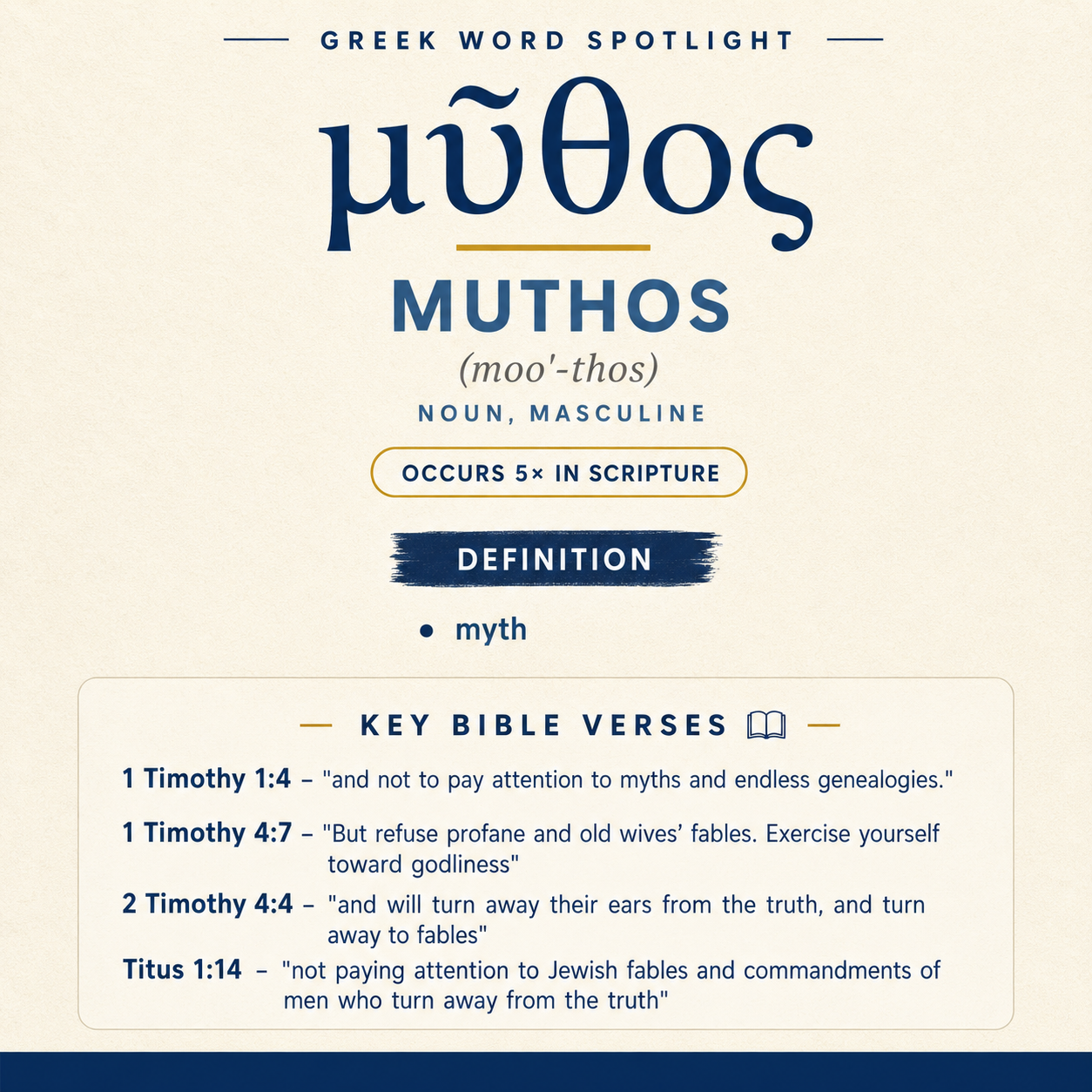
μῦθος (Muthos) means “myth” and occurs 5 times in Scripture: 1 Timothy 1:4; 1 Timothy 4:7; 2 Timothy 4:4; Titus 1:14; 2 Peter 1:16.
Core Meaning
μῦθος is defined as “myth.” In these passages it is rendered with terms like “myths” and “fables.”
Learn More →Pastoral Warnings
1 Timothy 1:4 and Titus 1:14 warn against paying attention to myths and fables that turn from the truth. 1 Timothy 4:7 calls such fables “profane and old wives’.”
Learn More →Apostolic Contrast
2 Timothy 4:4 describes people turning from truth to fables. 2 Peter 1:16 denies following “cunningly devised fables” in proclaiming Christ’s power and coming.
Learn More →μῦθος refers to a “myth” and appears in a cluster of pastoral warnings about what people choose to attend to, repeat, and believe, and in one apostolic denial that the message proclaimed was invented. Across its uses, the word is set in sharp contrast to truth, faith, godliness, and eyewitness testimony.
Root and Related Words
μῦθος is linked with the verb μυέω (myeō), “to initiate” (Strong’s G3453).

Occurrences
1 Timothy 1:4: “and not to pay attention to myths and endless genealogies, which cause disputes, rather than God’s stewardship, which is in faith—”
Here μῦθος is something one can “pay attention to,” and it is paired with “endless genealogies.” The verse frames these as a kind of preoccupation: they draw attention, invite ongoing engagement, and yet their effect is social and practical—“cause disputes.” In the same sentence, the alternative is “God’s stewardship, which is in faith,” so μῦθος functions as a rival focus, diverting energy from the ordered, faith-shaped care implied by stewardship.
1 Timothy 4:7: “But refuse profane and old wives’ fables. Exercise yourself toward godliness.”
In this command, μῦθος is presented as material to be rejected: “refuse” gives the word an interpersonal setting, as though such talk may be offered, circulated, or pressed upon the hearer. The modifiers “profane” and “old wives’” depict the tone and social character of these narratives—speech that is treated as unfit for the sacred direction of life. The imperative that follows, “Exercise yourself toward godliness,” sets μῦθος in opposition to a disciplined pursuit: the refusal is not an end in itself but clears space for sustained formation in godliness.
2 Timothy 4:4: “and will turn away their ears from the truth, and turn away to fables.”
μῦθος here marks the destination of a deliberate turning. The verse describes a shift in listening: people “turn away their ears from the truth,” which makes truth the immediate counterpart. μῦθος is not merely an alternative topic; it is the object toward which one “turn[s] away,” portraying myths as a substitute for truth that attracts the ear once truth is rejected. The repetition of “turn away” stresses a double movement—departure from one loyalty and arrival at another.
Titus 1:14: “not paying attention to Jewish fables and commandments of men who turn away from the truth.”
As in 1 Timothy 1:4, μῦθος is something one can “pay attention to,” and again it is placed alongside another category—in this case, “commandments of men.” The phrase “Jewish fables” situates these myths within a particular religious setting, and the verse adds a moral trajectory: they are associated with people “who turn away from the truth.” μῦθος thus participates in a larger pattern of diversion, where narratives and human commands compete with truth and lead listeners into the orbit of those who have already departed from it.
2 Peter 1:16: “For we didn’t follow cunningly devised fables when we made known to you the power and coming of our Lord Jesus Christ, but we were eyewitnesses of his majesty.”
In this passage μῦθος is denied as the source or model of apostolic proclamation. The speakers reject the charge that they “follow[ed] cunningly devised fables,” which characterizes myths as something constructed with craft—“devised”—and aimed at persuasion—“cunningly.” Against that, they describe what they “made known”: “the power and coming of our Lord Jesus Christ,” grounding their message not in invention but in encounter, “we were eyewitnesses of his majesty.” μῦθος therefore stands for a mode of speech that can be designed and followed like a storyline, over against testimony anchored in what was seen.
Sense and Usage
The five occurrences show μῦθος operating as a contested object of attention, trust, and listening. In multiple places, the word is linked to the act of focusing the mind: “pay attention” (1 Timothy 1:4; Titus 1:14) and “turn away…to” (2 Timothy 4:4) picture myths as narratives that solicit commitment and shape the direction of one’s hearing. The repeated emphasis on hearing and attention implies that myths spread and take root through what communities repeatedly entertain—what is listened to, discussed, and allowed to steer priorities.
μῦθος also appears as an obstacle to constructive spiritual aims. In 1 Timothy 1:4, myths stand where “God’s stewardship…in faith” should stand; the problem is not only that they are false narratives, but that they generate “disputes,” fracturing communal life rather than strengthening faithful stewardship. In 1 Timothy 4:7, myths oppose training: refusing them is paired with exercising toward godliness, presenting a choice between consuming certain kinds of talk and pursuing a disciplined life. In Titus 1:14, myths are yoked with “commandments of men,” suggesting that myths can function within systems of humanly generated authority, and the result is a turning away “from the truth.” Across these passages, μῦθος is consistently set against truth, faith, and godliness—not merely as a neutral story, but as a narrative that draws allegiance and redirects moral and communal energy.
The most detailed contrast comes in 2 Peter 1:16, where μῦθος is described as “cunningly devised,” highlighting a quality of being crafted. The apostolic message, by contrast, is presented as public disclosure (“we made known to you”) rooted in witness (“eyewitnesses of his majesty”). This does not expand μῦθος beyond “myth,” but it does show how the word functions rhetorically: myths can be portrayed as produced narratives that are followed, whereas proclamation grounded in eyewitness experience claims a different kind of authority. Thus, within these passages, μῦθος names a form of discourse that competes with truth-based testimony and faith-shaped stewardship by offering an attention-capturing alternative.
Imagery
The scenes attached to μῦθος are auditory and communal: ears that “turn away” (2 Timothy 4:4), attention that is paid or refused (1 Timothy 1:4; 1 Timothy 4:7; Titus 1:14), and a public message “made known” that appeals to eyewitnesses (2 Peter 1:16). The word carries the picture of competing voices—some producing disputes and distractions, others calling hearers toward truth, faith, and godliness.
Sources: Lexical data from Strong’s Exhaustive Concordance and the Translators Brief Lexicon of Extended Strongs for Greek (STEPBible, CC BY). Occurrence data from the Translators Amalgamated Greek New Testament (STEPBible, CC BY). Scripture quotations from the World English Bible (public domain).




