Exploring the Meaning of Paramuthion in Greek
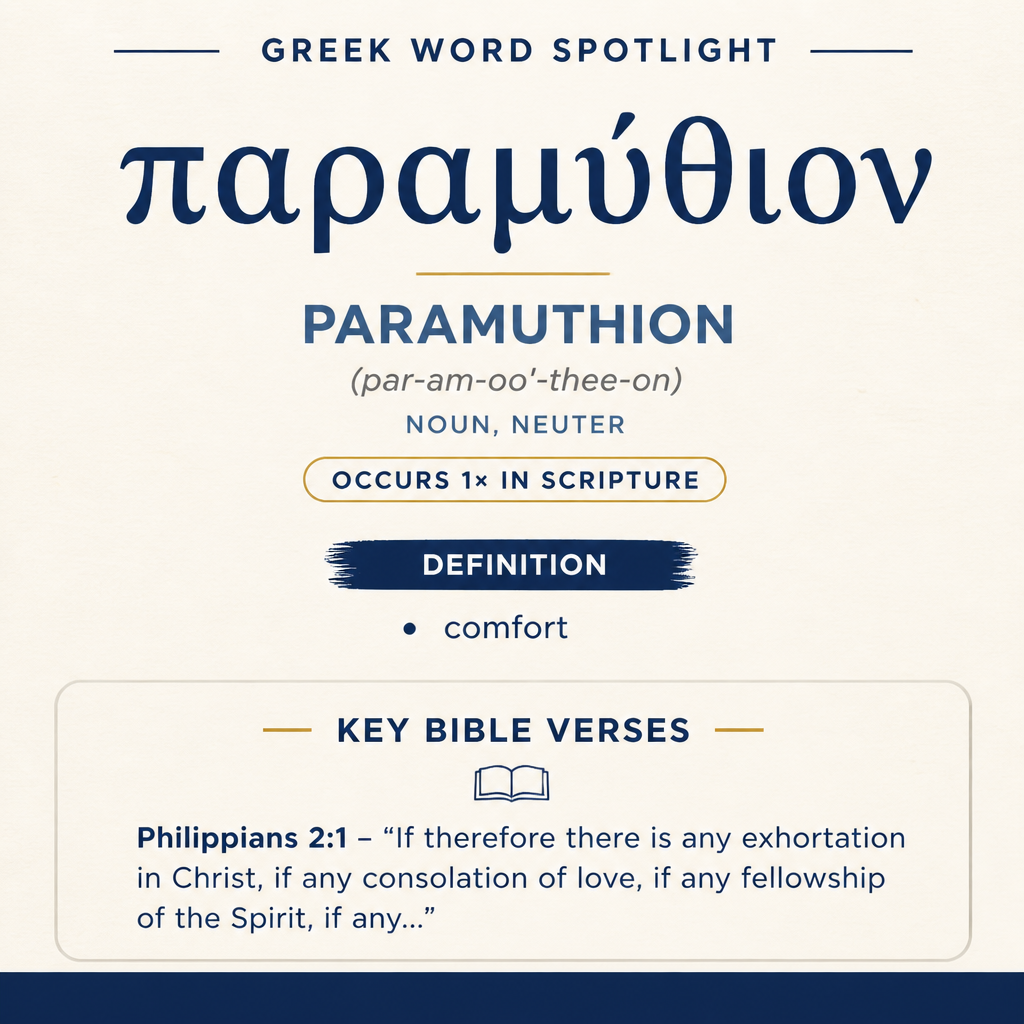
παραμύθιον means “comfort” and appears once in Scripture, in Philippians 2:1.
Biblical Occurrence
This word occurs 1 time in Scripture. Its single occurrence is in Philippians 2:1.
Learn More →Verse Context
In Philippians 2:1, παραμύθιον appears in the phrase “any consolation of love.”
Learn More →παραμύθιον denotes “comfort” and appears once in the New Testament, within Paul’s appeal to unity in Philippians 2:1. In that verse it is set among several relational and spiritual realities that are presented as shared grounds for a single-minded life together.
Root and Related Words
παραμύθιον is related to παραμυθία (paramythia), “comfort” (Strong’s G3889), from which it derives.

Occurrences
“If therefore there is any exhortation in Christ, if any consolation of love, if any fellowship of the Spirit, if any tender mercies and compassion,” (Philippians 2:1)
In Philippians 2:1 παραμύθιον stands in a series of “if any …” clauses that gather up what the community already knows and experiences: “exhortation in Christ,” “consolation of love,” “fellowship of the Spirit,” and “tender mercies and compassion.” Within that list, “comfort” functions as a named benefit of love—something love supplies and makes tangible inside the relationships of believers. The verse does not present comfort as an isolated inner feeling but places it in the same frame as shared participation (“fellowship of the Spirit”) and active, responsive care (“tender mercies and compassion”).
The rhetorical form of the sentence also shapes the word’s force. The repeated “if any” does not read like uncertainty so much as a piling up of recognized realities, each introduced as a premise for what follows. In that setting, “comfort” is one of the agreed-upon supports that undergird Paul’s call to a particular kind of communal life. The word therefore contributes a note of reassurance and steadying help: love does not merely demand; it strengthens and consoles. The clause “consolation of love” makes comfort a relational gift, tied to love’s presence among them rather than to external circumstances.
Finally, the placement of “comfort” between “exhortation in Christ” and “fellowship of the Spirit” is suggestive within the verse’s own flow. “Exhortation” implies urging or encouragement; “fellowship” implies shared participation. “Comfort” bridges these by naming something that both supports exhortation (encouragement that does not crush) and nourishes fellowship (a climate in which people can remain together). Even without extending beyond the verse, the clustering shows that comfort is treated as one of the spiritual and relational goods that belong to life “in Christ” and in the Spirit’s shared work.
Sense and Usage
The single New Testament use of παραμύθιον in Philippians 2:1 places “comfort” in a carefully balanced set of motivations that are simultaneously Christ-centered (“in Christ”), love-shaped (“of love”), Spirit-shared (“of the Spirit”), and compassion-formed (“tender mercies and compassion”). Within this arrangement, comfort is not framed as a private remedy for individual distress but as part of the communal fabric that makes unity and mutual regard possible. It belongs to the realm of what believers can point to together as already present realities: consolation is something they have tasted in love and therefore something that can rightly be appealed to as a common ground.
The phrase “consolation of love” is especially important for understanding how the definition “comfort” functions here. Love is treated as the source or sphere in which comfort is experienced. That linkage keeps the idea from becoming merely sentimental: comfort is anchored to love’s active stance toward others. In a sentence that includes “tender mercies and compassion,” comfort takes its place among terms that describe sympathetic responsiveness. The verse’s language evokes a community in which there is room for hearts to be steadied, wounds to be attended, and burdens to be carried with patience—without needing to specify any particular crisis. Comfort in this usage is therefore a real, relational support that love provides inside shared life.
Because the word occurs inside a list of premises, its role is also argumentative. Paul stacks motivations that are meant to carry weight precisely because they are mutually recognized: Christ’s encouragement, love’s consolation, the Spirit’s fellowship, and compassion’s tenderness. Comfort, in that argument, is a moral and relational resource. It is one of the givens that should move the readers toward the kind of unity and humble regard that the surrounding passage is designed to produce. In other words, “comfort” is not simply something received; it is part of what qualifies the appeal itself—an appeal that assumes the community knows what it is to be consoled by love and therefore can be summoned to live consistently with that experience.
The relationship to παραμυθία (paramythia), likewise glossed “comfort,” reinforces the word’s place within a family of terms that name consolation. In Philippians 2:1 the emphasis falls less on describing the mechanism of comfort and more on locating it: comfort is bound up with love in the same way fellowship is bound up with the Spirit. That parallel structure highlights comfort as something that characterizes Christian relationships and spiritual life together. It is a reality that can be appealed to without elaboration because it is assumed to be known: the community recognizes the consoling quality of love as part of its shared identity.
Imagery
Though Philippians 2:1 is abstract and does not paint a physical scene, the phrasing “consolation of love” carries a gentle relational texture alongside “tender mercies and compassion.” Comfort here suggests the felt support that comes when love meets need with warmth and steadiness, creating space for a community to remain joined in spirit and purpose.
Sources: Lexical data from Strong’s Exhaustive Concordance and the Translators Brief Lexicon of Extended Strongs for Greek (STEPBible, CC BY). Occurrence data from the Translators Amalgamated Greek New Testament (STEPBible, CC BY). Scripture quotations from the World English Bible (public domain).