
Exploring the Meaning of Homoiotes in Greek
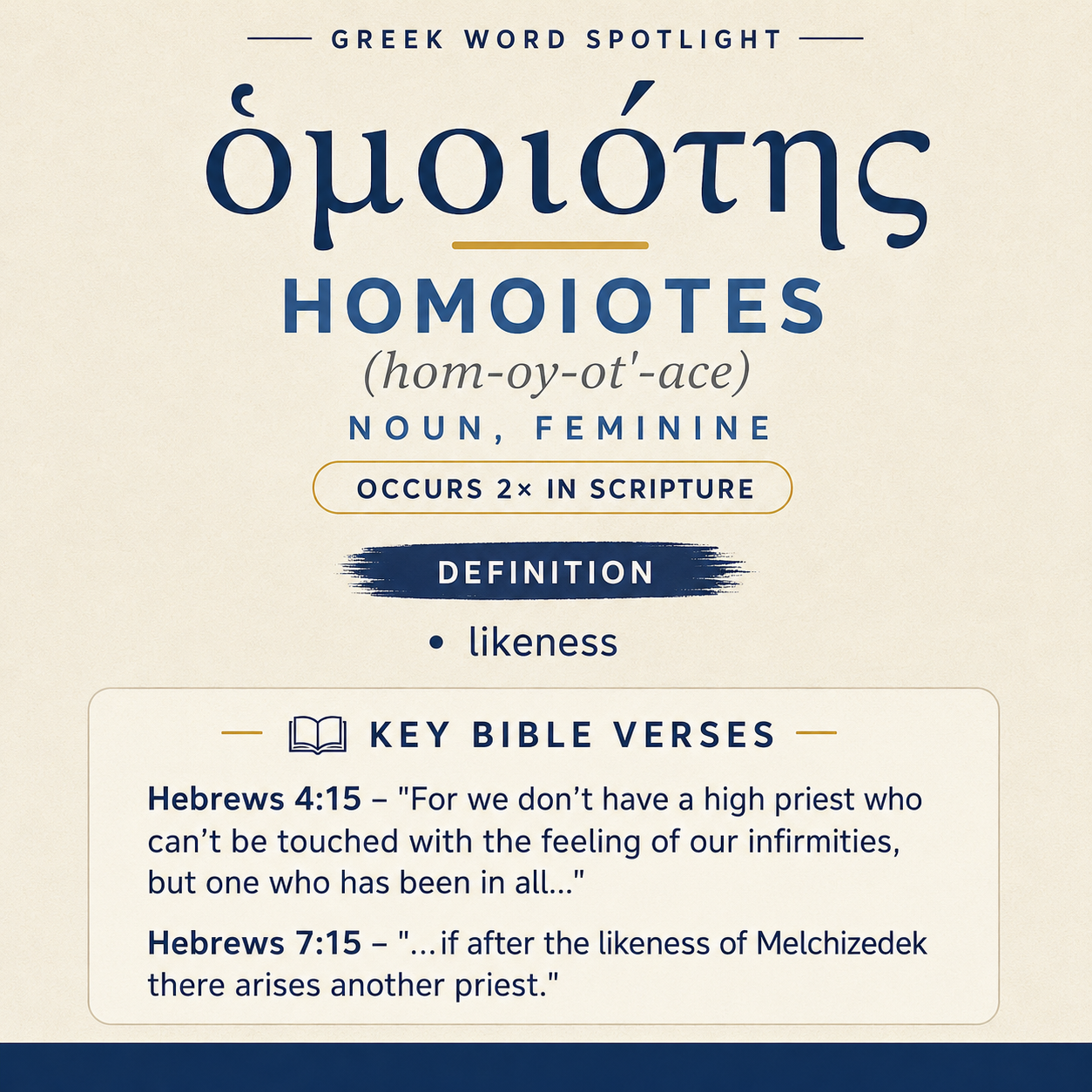
ὁμοιότης means “likeness” and occurs twice in Scripture, in Hebrews 4:15 and Hebrews 7:15.
Scripture Occurrences
This word occurs 2 times in Scripture: Hebrews 4:15 and Hebrews 7:15.
Learn More →Context Snapshot
Hebrews 7:15 uses ὁμοιότης in the phrase “after the likeness of Melchizedek.” Hebrews 4:15 includes the term within its verse context.
Learn More →ὁμοιότης means “likeness.” In the New Testament it appears in Hebrews 4:15 and Hebrews 7:15, where it helps the writer express resemblance as a way of explaining priestly ministry.
Root and Related Words
ὁμοιότης relates to homoios (ὅμοιος), “like” (Strong’s G3664). The relationship links the noun’s idea of resemblance to the broader language of being “like,” which in Hebrews becomes a precise way of comparing persons and roles without collapsing them into sameness.

Occurrences
“For we don’t have a high priest who can’t be touched with the feeling of our infirmities, but one who has been in all points tempted like we are, yet without sin.” (Hebrews 4:15)
In this statement about the high priest, likeness functions as a bridge between two affirmations held together in the same sentence. The high priest is described as one who can be “touched with the feeling of our infirmities,” and the reason given is that he “has been in all points tempted like we are.” Likeness here operates within lived experience: temptation is presented as the shared arena in which resemblance is established. The phrase “in all points” pushes the comparison toward breadth—temptation is not treated as a narrow or occasional overlap, but as something encompassing. At the same time, the sentence ends with a limiting clause, “yet without sin,” which sets a boundary around the comparison. The likeness supports the claim of genuine fellow-feeling—he is not distant from “our infirmities”—while the closing clause prevents the comparison from being read as an identity in every respect. In the flow of the verse, likeness is the means by which empathy and priestly fitness are made intelligible: the high priest’s ability to be “touched” is tied to an experience that resembles the readers’ own.
“This is yet more abundantly evident, if after the likeness of Melchizedek there arises another priest,” (Hebrews 7:15)
Here likeness is tied to a named figure, Melchizedek, and it is used to frame an argument about priesthood. The writer says something becomes “more abundantly evident” under a stated condition: “if after the likeness of Melchizedek there arises another priest.” Likeness in this context is not about inward feeling, but about the pattern by which a priest “arises.” It functions as a category for comparison: the new priest is presented as corresponding to Melchizedek in a way that makes a point “evident.” The verse does not spell out the specific points of resemblance, but the structure makes clear what likeness accomplishes rhetorically: it establishes a recognizable model, and that model is strong enough to carry an inference. The emphasis falls on the explanatory power of resemblance—likeness provides the shape that makes the emergence of “another priest” meaningful within the writer’s reasoning.
Sense and Usage
Across these two occurrences, “likeness” serves as a controlled way of speaking about resemblance that is significant but not flattening. In Hebrews 4:15, the comparison is experiential: temptation is the shared point of reference, and likeness supports the claim that the high priest truly connects with human weakness. Yet the verse itself places a guardrail on the comparison—“yet without sin”—so likeness does not erase distinction. The result is a resemblance that grounds compassion while preserving moral difference, all within a single tightly balanced sentence.
In Hebrews 7:15, likeness is structural and argumentative. Instead of linking two sets of experiences, it links a present reality (“there arises another priest”) to a recognized pattern (“after the likeness of Melchizedek”). Likeness here is the hinge of an inference: it is offered as the condition under which something becomes “more abundantly evident.” In other words, the noun points to a resemblance that can be reasoned from. The verse’s wording shows that likeness can work not only in personal identification (as in 4:15), but also in formal comparison—one priestly figure is presented as comparable to another in a way that clarifies what kind of priest has come on the scene.
Together these passages show likeness operating in two complementary registers. One register is relational and pastoral in tone: likeness makes it possible to speak of being “touched with the feeling of our infirmities.” The other is analytical: likeness makes an argument “evident” by appealing to a known reference point. In both, likeness is neither a vague similarity nor an accidental overlap; it is brought forward because it does explanatory work. It grounds empathy in Hebrews 4:15 and grounds clarity in Hebrews 7:15.
Imagery
The imagery suggested by these uses of likeness is concrete even when the comparisons are conceptual. Hebrews 4:15 evokes the picture of testing—temptation occurring “in all points”—and places the high priest alongside those who face infirmity, close enough to be “touched” by their condition. Hebrews 7:15 evokes the image of a recognizable pattern being traced: a new priest “arises” in a way that matches an earlier model, so the resemblance itself becomes a kind of visible outline that makes the writer’s point stand out as “more abundantly evident.”
Sources: Lexical data from Strong’s Exhaustive Concordance and the Translators Brief Lexicon of Extended Strongs for Greek (STEPBible, CC BY). Occurrence data from the Translators Amalgamated Greek New Testament (STEPBible, CC BY). Scripture quotations from the World English Bible (public domain).





