Exploring the Meaning of Nephos in Greek
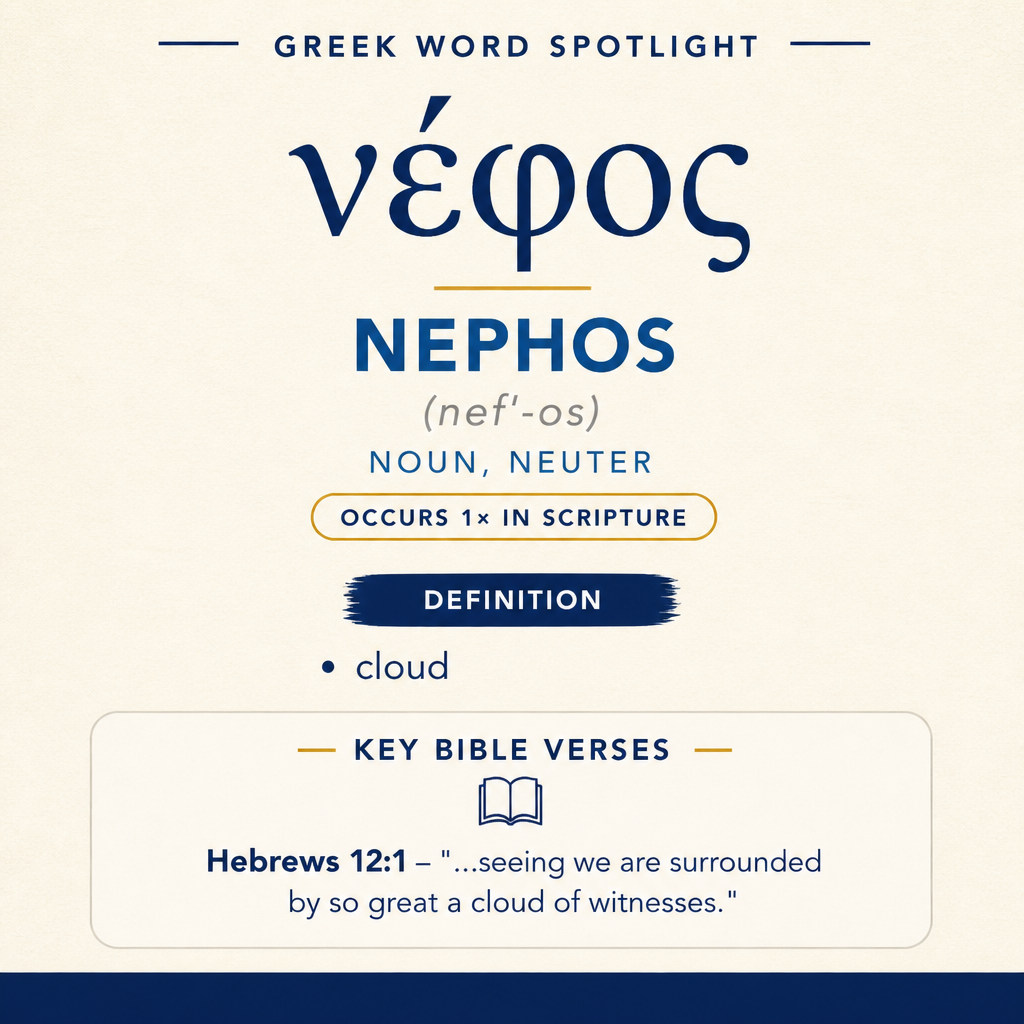
νέφος (Nephos) means “cloud” and appears once in Scripture, in Hebrews 12:1.
Scripture Occurrence
It occurs 1 time in Scripture. The occurrence is in Hebrews 12:1.
Learn More →Verse Usage
In Hebrews 12:1, νέφος describes “so great a cloud of witnesses” surrounding believers.
Learn More →νέφος means “cloud” and appears in Hebrews 12:1. In this single use, it provides a vivid picture that frames how the surrounding context is to be understood.
Occurrences
“Therefore let’s also, seeing we are surrounded by so great a cloud of witnesses, lay aside every weight and the sin which so easily entangles us, and let’s run with perseverance the race that is set before us,” (Hebrews 12:1)
Here νέφος names what the writer says the audience is “surrounded” by: “so great a cloud of witnesses.” The word “cloud” functions as a collective image. Rather than pointing to a single witness, it gathers “witnesses” into one encompassing mass, large enough to be spoken of as encircling those who are running. The surrounding is not described as partial or distant; the phrase “seeing we are surrounded” makes the cloud an immediate feature of the setting, shaping how the exhortations that follow are heard.
Within the verse, the cloud imagery supports the practical calls to action: “lay aside every weight,” reject “the sin which so easily entangles us,” and “run with perseverance the race that is set before us.” A cloud is not a list; it is a single, thick presence. In the same way, “so great a cloud of witnesses” conveys a sense of magnitude and nearness that presses upon the runner’s moment. The cloud is not itself the race, nor the runner’s burden, but the enveloping context in which the runner is urged to strip off hindrances and keep going. The term νέφος therefore contributes a spatial and atmospheric frame: the runner does not run alone or unnoticed, but within an environment crowded by testimony.

Sense and Usage
Because νέφος is used with “witnesses,” “cloud” is applied metaphorically to people, while still drawing on the ordinary physical character of a cloud as something extensive and surrounding. The verse does not treat the cloud as a sign to interpret or a weather event to observe; it uses the common, concrete image of a cloud to express the scale and density of the witnesses as a group. The cloud’s “great” size (expressed in “so great a cloud”) suggests not merely that witnesses exist, but that they are numerous enough to be pictured as a mass filling the runner’s horizon.
The immediate grammatical environment also clarifies what the “cloud” does in the argument. It is linked to perception: “seeing we are surrounded.” The cloud is something the audience is to consider as a settled reality, a circumstance already true, not something to be achieved. That perception then becomes a basis for the imperatives that follow. The logic moves from awareness of the surrounding cloud, to decisive removal of burdens (“every weight” and “the sin which so easily entangles us”), to sustained effort (“run with perseverance”). In this way, νέφος is not decorative; it is part of the motivational structure of the sentence, helping the reader feel the pressure and encouragement of being encircled by a multitude described in a single, enveloping image.
The phrase “cloud of witnesses” also keeps the focus on the character of the surrounding group: they are not described as opponents, judges, or spectators by these words, but as “witnesses.” The cloud image therefore does not blur their identity; it intensifies it. The witnesses remain individuals in their role, yet they are spoken of as one surrounding reality. νέφος allows the author to speak about a plurality as a unified presence—many witnesses, one cloud—without shifting to a different subject. The result is an image that matches the verse’s athletic language: a runner in a race, urged to endurance, set within an atmosphere thick with witness.
In terms of imagery, “cloud” naturally evokes something that can fill the space around a person. Hebrews 12:1 uses that spatial potential to depict the witnesses as encompassing the runner’s course. The runner’s task is then described in terms of freedom of movement (“lay aside every weight” and what “entangles us”) and steady forward motion (“run with perseverance”). The cloud image complements those ideas: since the runner is surrounded, the call is to live and run as one whose whole environment is defined by that surrounding testimony, and therefore to take seriously whatever slows, trips, or binds.
Imagery in Context
In Hebrews 12:1, νέφος supplies a single dominant picture: an encircling “cloud” that makes the “witnesses” feel numerous, near, and present to the race. The verse’s movement—from being surrounded, to laying aside hindrances, to running with perseverance—lets the cloud stand as the atmospheric backdrop against which endurance is urged.
Sources: Lexical data from Strong’s Exhaustive Concordance and the Translators Brief Lexicon of Extended Strongs for Greek (STEPBible, CC BY). Occurrence data from the Translators Amalgamated Greek New Testament (STEPBible, CC BY). Scripture quotations from the World English Bible (public domain).