Exploring the Meaning of Meteorizo in Greek
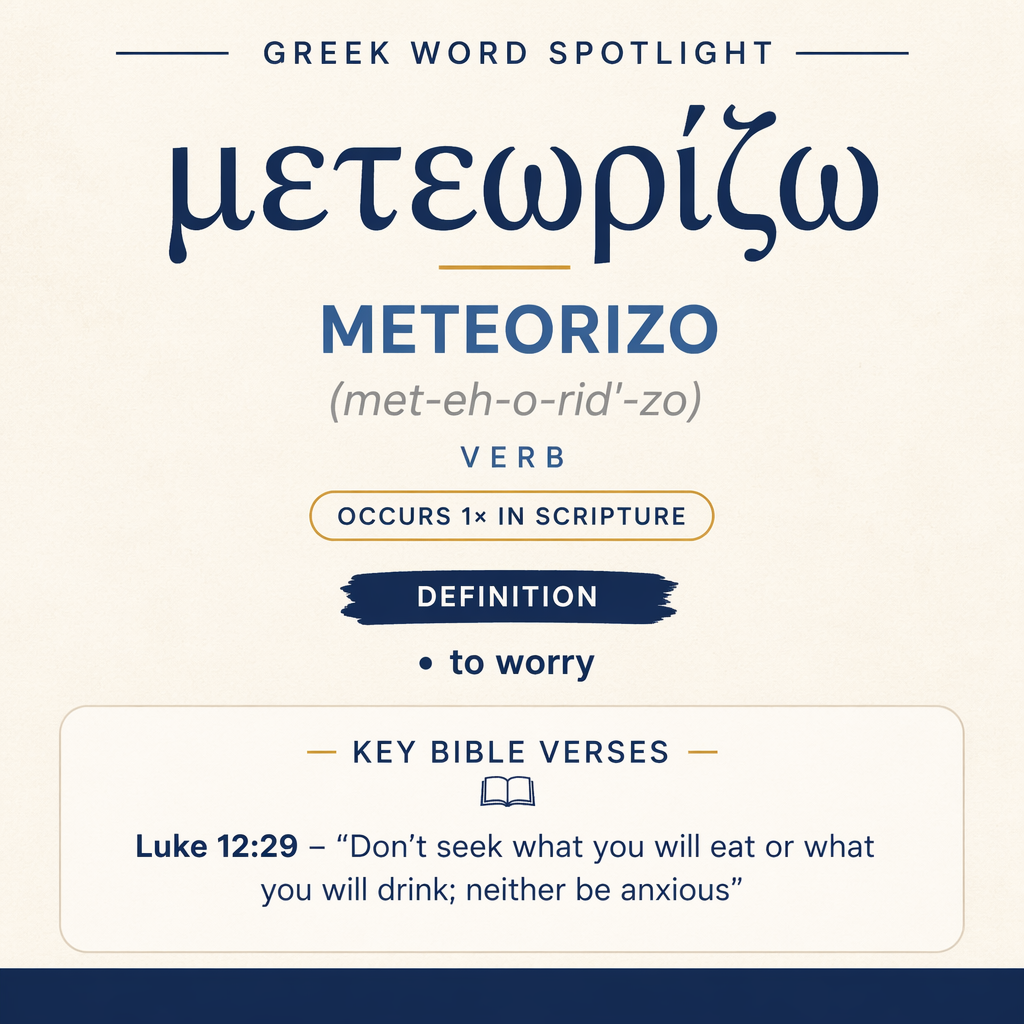
μετεωρίζω means “to worry” and appears once in Scripture, in Luke 12:29.
Biblical Occurrence
μετεωρίζω occurs one time in Scripture. Its single reference is Luke 12:29.
Learn More →μετεωρίζω means “to worry” and appears in Jesus’ instruction about daily needs in Luke 12:29. In that setting it is paired with commands about what people seek and what they allow to occupy their thoughts.
Root and Related Words
μετεωρίζω (Meteorizo) is connected with several Greek words named in its derivation: ἀήρ (aer), “air” (Strong’s G109); αἴρω (airo), “to take up” (Strong’s G142); and μετά (meta), “with/after” (Strong’s G3326). These relationships place the verb within a family of terms that speak of “air,” “taking up,” and association or sequence (“with/after”), providing a linguistic backdrop for how the verb functions in Greek expression.

Occurrences
“Don’t seek what you will eat or what you will drink; neither be anxious.” (Luke 12:29)
In Luke 12:29, μετεωρίζω is rendered “be anxious,” placed alongside two explicit prohibitions: “Don’t seek what you will eat or what you will drink.” The verse frames worry as an inward posture that runs parallel to an outward pursuit. First, the hearer is told not to “seek” food and drink as controlling aims; then, with “neither,” the instruction tightens to the internal response that can accompany such seeking. The verb therefore marks the mental and emotional unrest that tracks with fixation on necessities, and it is treated as something to be refused in the same way that misguided seeking is refused. The brief clause “neither be anxious” makes the command pointed: worry is not merely a feeling that happens but a stance addressed directly by Jesus’ imperative.
Sense and Usage
The single New Testament attestation of μετεωρίζω shows “to worry” operating as a practical, everyday concern tied to eating and drinking. The verb is not used here for a general unease without content; it is attached to specific, ordinary questions (“what you will eat… what you will drink”), which keeps the sense concrete and situational. At the same time, the structure of the sentence distinguishes worry from the act of searching or pursuing: “Don’t seek…; neither be anxious.” This pairing treats worry as the inner counterpart to an outward agenda. One can picture two related movements—what a person runs after and what a person carries inside—both addressed as matters of obedience.
Because the command is phrased as a negative imperative, the usage highlights worry as something that can be resisted rather than indulged. The brevity of the clause also suggests how quickly worry can attach itself to basic needs: the verse does not elaborate on the mechanics of anxious thought, but it names the posture plainly and forbids it. In this way, μετεωρίζω serves as a compact term for the unsettled, preoccupied state that arises when provision becomes the central object of seeking.
The verse also places worry within a moral and spiritual framework: it stands under the authority of Jesus’ instruction. Without introducing additional vocabulary, Luke 12:29 itself is enough to show that μετεωρίζω is not presented as a harmless reflex but as a disposition that competes with the kind of life Jesus calls for. The command assumes that worry exerts a pull on attention and desire; the hearer is redirected away from that pull by being told, directly, not to enter or remain in it.
Imagery
Even though Luke 12:29 speaks in ordinary terms—eating and drinking—the placement of “neither be anxious” after “Don’t seek” gives the line a vivid human scene: people scanning the horizon of daily life for what will satisfy immediate needs, and then feeling the inward churn that such scanning can produce. μετεωρίζω names that churn in a single word, set starkly against the calmness implied by the command to refuse it.
Sources: Lexical data from Strong’s Exhaustive Concordance and the Translators Brief Lexicon of Extended Strongs for Greek (STEPBible, CC BY). Occurrence data from the Translators Amalgamated Greek New Testament (STEPBible, CC BY). Scripture quotations from the World English Bible (public domain).