Exploring the Meaning of Aer in Greek
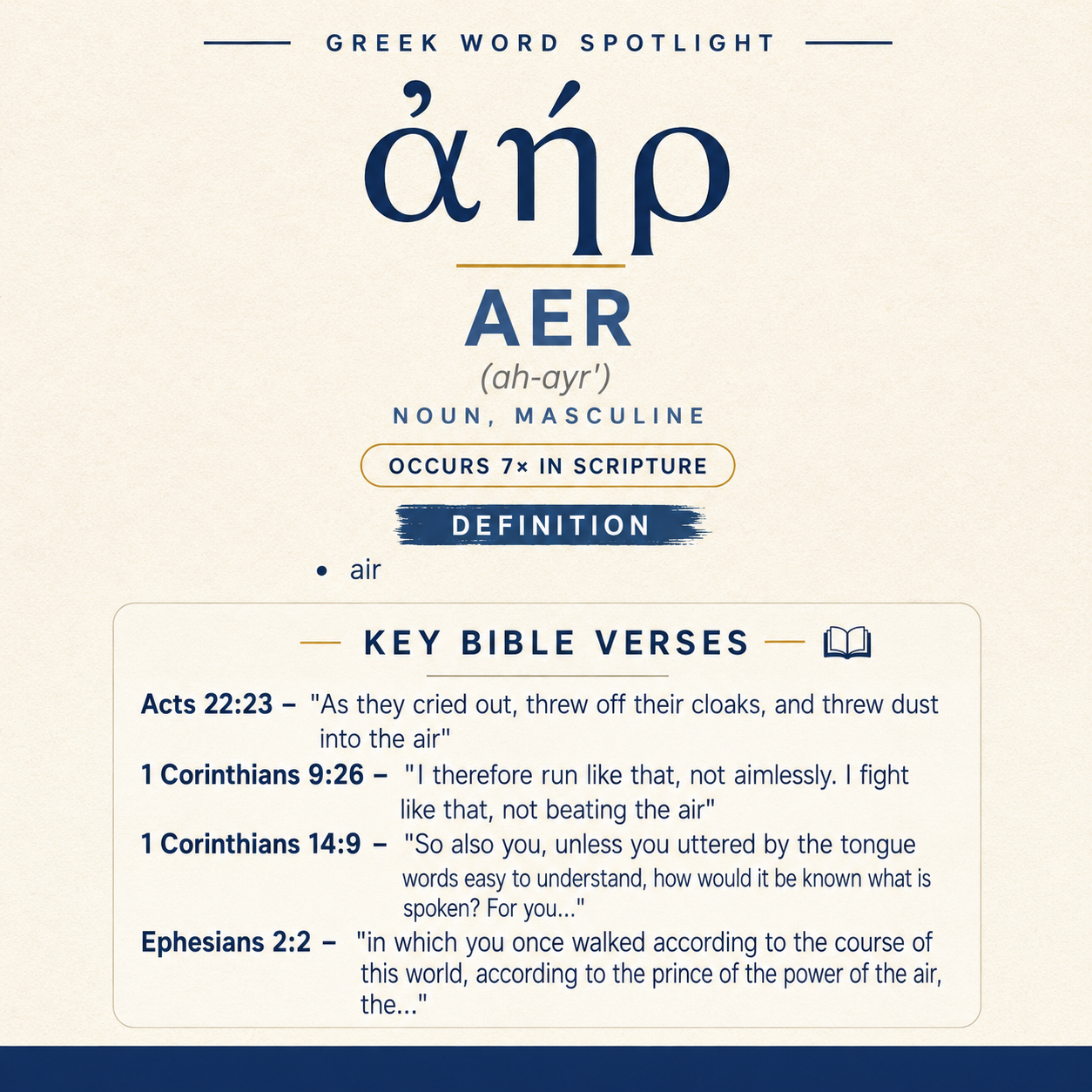
ἀήρ means “air” in Greek and appears 7 times in Scripture, including Acts 22:23; 1 Corinthians 9:26; and Ephesians 2:2.
Core Meaning
ἀήρ is the Greek word for “air.” It denotes the air in which actions occur, such as dust being thrown into it (Acts 22:23).
Learn More →Everyday Usage
Paul uses ἀήρ figuratively for ineffective action: “not beating the air” (1 Corinthians 9:26). It also appears in contexts of speech and understanding (1 Corinthians 14:9).
Learn More →Key Contexts
Ephesians 2:2 speaks of “the prince of the power of the air.” 1 Thessalonians 4:17 describes meeting the Lord “in the air.”
Learn More →ἀήρ means “air,” the space above the ground that can be filled, darkened, or spoken into. In the New Testament it appears in narrative description, metaphor, and apocalyptic scene-setting, including Acts, Paul’s letters, and Revelation.
Occurrences
Acts 22:23 — “As they cried out, threw off their cloaks, and threw dust into the air,”
Here ἀήρ names the immediate environment above the crowd as the destination of what they hurl. Dust “into the air” portrays agitation that becomes visible: the air is not a neutral emptiness but the place where the crowd’s outrage is displayed, so that their shouting is matched by a clouding, upward motion.
1 Corinthians 9:26 — “I therefore run like that, not aimlessly. I fight like that, not beating the air,”
In this athletic and combative imagery, ἀήρ is the space a person can strike without contact. “Beating the air” contrasts with purposeful fighting: the air is what receives wasted motion, blows that land nowhere. The word marks the difference between action that connects with a real opponent and action dissipated into empty space.
1 Corinthians 14:9 — “So also you, unless you uttered by the tongue words easy to understand, how would it be known what is spoken? For you would be speaking into the air.”
In a discussion of intelligible speech, ἀήρ denotes the realm where sound can go without reaching understanding. “Speaking into the air” pictures words leaving the mouth and entering the shared atmosphere, yet failing to become recognized communication. The air becomes the place where speech can vanish—audible, perhaps, but not grasped as meaning by others.
Ephesians 2:2 — “in which you once walked according to the course of this world, according to the prince of the power of the air, the spirit who now works in the children of disobedience.”
Here ἀήρ appears within the title “the prince of the power of the air.” The phrase uses the air as a sphere associated with “power,” and thus as a way of locating the influence described: it is portrayed as ruling within a domain characterized by ἀήρ. The verse links that domain to a “spirit who now works,” so the word contributes to a picture of an active realm of influence that stands over against the former way of life being described (“you once walked”).
1 Thessalonians 4:17 — “then we who are alive, who are left, will be caught up together with them in the clouds, to meet the Lord in the air. So we will be with the Lord forever.”
In this scene, ἀήρ marks the location of meeting: not on the ground but in the open atmosphere, in proximity to “the clouds.” The air functions as the setting where the upward movement (“caught up”) reaches its appointed point (“to meet the Lord”). The term gives spatial concreteness to the event: the meeting is described as occurring in the air itself.
Revelation 9:2 — “He opened the pit of the abyss, and smoke went up out of the pit, like the smoke from a burning furnace. The sun and the air were darkened because of the smoke from the pit.”
Here ἀήρ is something that can be altered—specifically, “darkened” by smoke. The verse presents a chain of effects: the abyss is opened, smoke rises, and the result is that even the “sun and the air” are darkened. Air, normally transparent, becomes visibly impaired; it is treated as part of the created environment that can be overwhelmed by what rises from below.
Revelation 16:17 — “The seventh poured out his bowl into the air. A loud voice came out of the temple of heaven, from the throne, saying, “It is done!””
In this bowl-judgment scene, ἀήρ is the target receiving what is poured out. The action “into the air” indicates scope: the air is not a localized object but a pervasive realm, so pouring into it suggests an effect that reaches broadly. The immediate sequel—“A loud voice came out of the temple of heaven, from the throne”—adds a sense of decisive finality to the moment, with the air serving as the medium into which the climactic bowl is discharged.

Sense and Usage
Across these passages, ἀήρ consistently refers to air as a real, surrounding space—one that can be filled (with dust, with smoke), can receive action (a bowl poured into it), and can function as the setting for movement and encounter. In Acts 22:23 it is the place where dust is thrown, making the crowd’s hostility tangible; the air is the immediate public space that becomes visibly disturbed. Revelation 9:2 likewise treats air as capable of being affected: it can be darkened, as smoke transforms what is ordinarily clear and life-supporting into something oppressive.
In Paul’s metaphors, air becomes the emblem of what is not effectively engaged. “Beating the air” (1 Corinthians 9:26) uses air as what absorbs effort without result: the fighter’s movement is real, but it is unproductive because it strikes only air. “Speaking into the air” (1 Corinthians 14:9) similarly presents air as the place where words can go when they fail to be understood; the sound disperses into the shared atmosphere but does not land as known speech. In both, air is not the enemy, but it marks the boundary of futility—activity that does not reach its intended object.
Two texts attach ἀήρ to heightened theological and eschatological scenes by treating it as a domain. Ephesians 2:2 speaks of “the power of the air,” using air to name a sphere in which a “prince” rules and in which a “spirit…works.” The word thus participates in a portrayal of an overarching realm of influence aligned with disobedience. By contrast, 1 Thessalonians 4:17 places ἀήρ at the center of hope-filled meeting: the air is where those “caught up…in the clouds” meet “the Lord.” The same term that can be associated with oppressive power (Ephesians) and with darkening smoke (Revelation 9) also names the open space where reunion and abiding presence are described (“So we will be with the Lord forever”).
Revelation 16:17 extends the sense of air as an all-encompassing environment: to pour a bowl “into the air” depicts an act that reaches beyond a single land, sea, or river into the very atmosphere that touches everything beneath it. The air here is not merely background; it is the recipient of a decisive act followed by the pronouncement, “It is done!” That pairing gives the air a role in the staging of finality: the realm into which the bowl is poured becomes the immediate setting for the concluding declaration from the throne.
Imagery
These passages use ἀήρ to make invisible space speak: dust suspended above a shouting crowd (Acts 22:23), blows that land on nothing (1 Corinthians 9:26), speech that disperses without comprehension (1 Corinthians 14:9), a realm associated with governing power (Ephesians 2:2), a meeting place in the clouds (1 Thessalonians 4:17), air turned dim by rising smoke (Revelation 9:2), and air itself receiving the final poured bowl (Revelation 16:17). In each case, “air” is more than empty distance—it is the shared medium where actions register and scenes take shape.
Sources: Lexical data from Strong’s Exhaustive Concordance and the Translators Brief Lexicon of Extended Strongs for Greek (STEPBible, CC BY). Occurrence data from the Translators Amalgamated Greek New Testament (STEPBible, CC BY). Scripture quotations from the World English Bible (public domain).