Exploring the Meaning of Matthaios in Greek
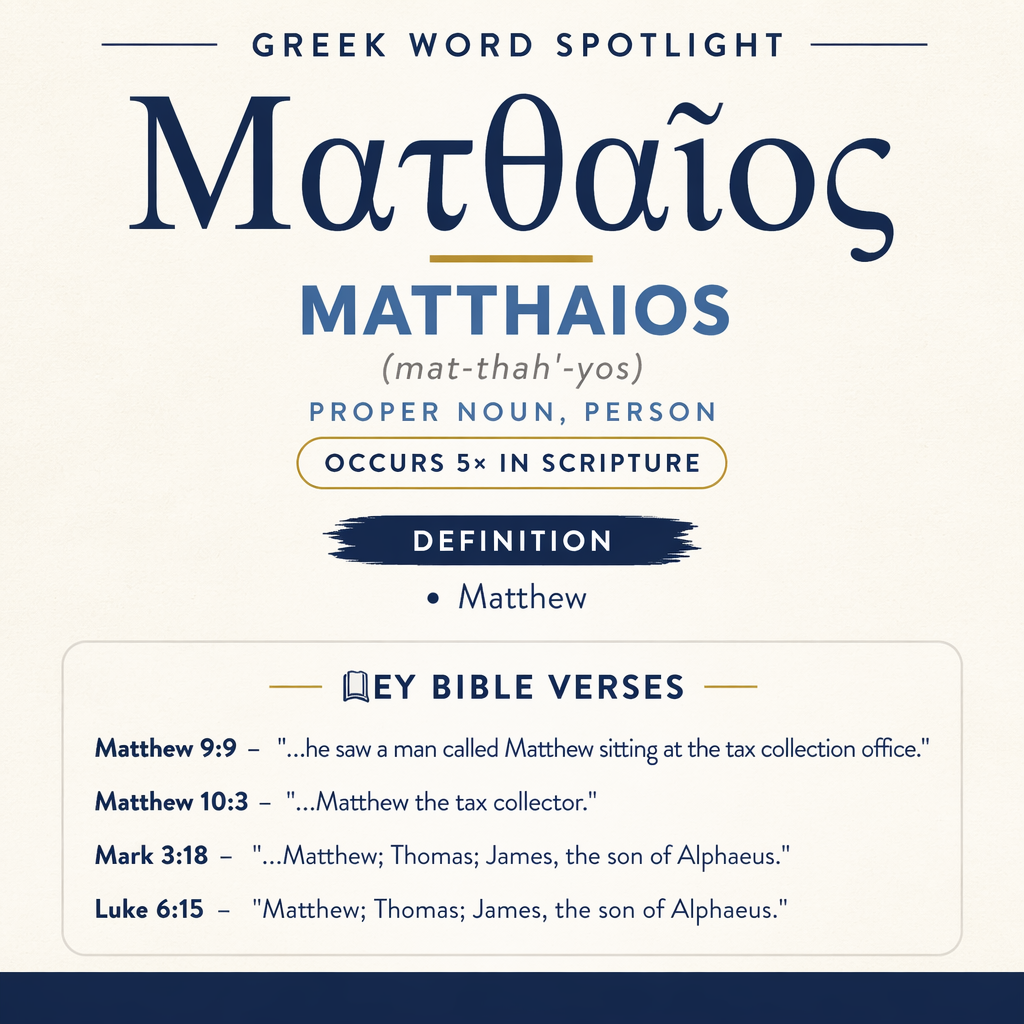
Ματθαῖος means “Matthew” and appears in Matthew 9:9; 10:3, Mark 3:18, Luke 6:15, and Acts 1:13.
Meaning
Ματθαῖος is the Greek name translated “Matthew.” It identifies a specific person in the New Testament.
Learn More →Gospel Mentions
In Matthew 9:9, Jesus sees a man called Matthew at the tax collection office and says, “Follow.” In Matthew 10:3 he is listed as “Matthew the tax collector.”
Learn More →Apostle Lists
Ματθαῖος appears in lists of the apostles in Mark 3:18 and Luke 6:15. It also appears in Acts 1:13 among those gathered in the upper room.
Learn More →Ματθαῖος names Matthew, appearing in Gospel and Acts contexts as the person called by Jesus and listed among the Twelve. The passages present him in narrative action once and in several roster-style enumerations that locate him within the apostolic circle.
Root and Related Words
Strong’s connects Ματθαῖος with machomai (μάχομαι), “to quarrel” (Strong’s G3164).

Occurrences
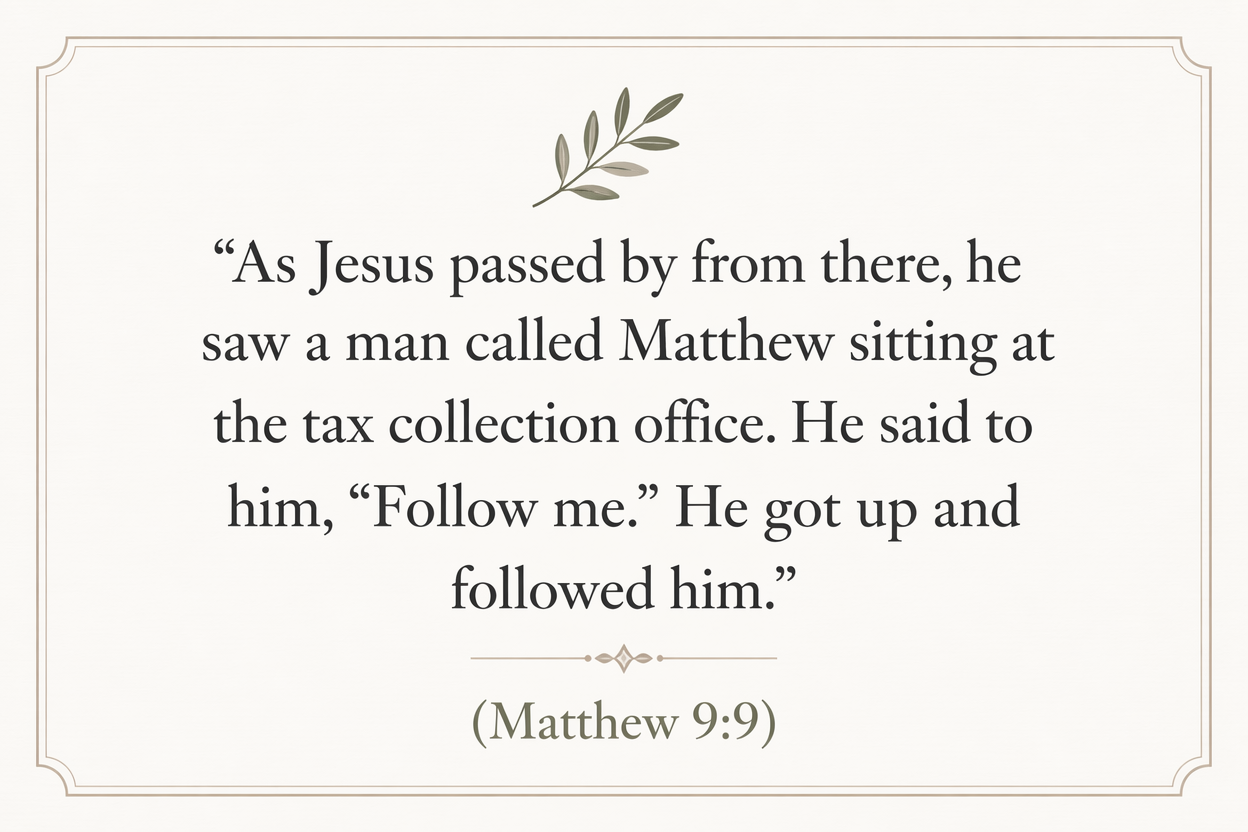
“As Jesus passed by from there, he saw a man called Matthew sitting at the tax collection office. He said to him, “Follow me.” He got up and followed him.” (Matthew 9:9)
Here Ματθαῖος functions as an identifying name within a direct call scene. The narrative places Matthew in a specific setting—“sitting at the tax collection office”—and the name anchors the encounter as personal and concrete rather than generic. The command “Follow me.” is addressed to him as an individual, and the immediate response (“He got up and followed him.”) ties the name to a decisive change of posture and direction inside the story. In this verse, “Matthew” is not merely a label in a list; it is the named subject of an action sequence: seen, addressed, and responding.
“Philip; Bartholomew; Thomas; Matthew the tax collector; James the son of Alphaeus; Lebbaeus, who was also called Thaddaeus;” (Matthew 10:3)
In this list, Ματθαῖος marks a specific member among a group presented in a fixed sequence. The wording “Matthew the tax collector” attaches an occupational descriptor to the name, distinguishing him from the other names and connecting him to the earlier scene where he is found “at the tax collection office.” Within the roster’s rhythm of names and brief identifiers (“James the son of Alphaeus,” “Lebbaeus, who was also called Thaddaeus”), Ματθαῖος carries the weight of recognition: it points to a particular person within a set and, by the added descriptor, highlights the kind of background associated with him in this Gospel’s presentation.
“Andrew; Philip; Bartholomew; Matthew; Thomas; James, the son of Alphaeus; Thaddaeus; Simon the Zealot;” (Mark 3:18)
Mark places Ματθαῖος within another enumeration of disciples. Here the name appears without an occupational tag, so its contribution is primarily relational and structural: it helps define the membership of a known inner circle by naming individuals in turn. The list format itself foregrounds the collective identity of those named, and “Matthew” functions as one coordinate in that group portrait—present, counted, and positioned among other recognized figures.
“Matthew; Thomas; James, the son of Alphaeus; Simon, who was called the Zealot;” (Luke 6:15)
Luke’s ordering again includes Ματθαῖος, this time adjacent to “Thomas,” and followed by two names with clarifying descriptions. The name’s force in this verse lies in its stability across traditions of listing: “Matthew” appears as a settled part of the apostolic roll. The verse’s concise style makes each name a discrete unit; Ματθαῖος contributes by marking one distinct person who stands alongside others who are likewise individually identified within the same communal office.
“When they had come in, they went up into the upper room where they were staying; that is Peter, John, James, Andrew, Philip, Thomas, Bartholomew, Matthew, James the son of Alphaeus, Simon the Zealot, and Judas the son of James.” (Acts 1:13)
Acts situates Ματθαῖος after the resurrection context implied by the gathering of these named individuals in a specific location: “the upper room where they were staying.” The name is embedded in a longer roll call that defines who “they” are by explicit identification (“that is Peter… and Judas the son of James”). Here “Matthew” contributes to the scene by confirming his presence among those who assemble and remain together, and by helping the narrative move from an undefined group to a clearly delimited community. In contrast to Matthew 9:9, the name is not tied to a personal dialogue; instead it serves the historiographic function of naming witnesses/participants in the early community’s shared action of gathering.
Sense and Usage
Across these five passages, Ματθαῖος operates as a personal name that does two main kinds of work: it identifies an individual in a moment of direct encounter, and it identifies a member of a defined group through lists. Matthew 9:9 gives the name its most vivid narrative contour by placing Matthew in a workplace setting and making him the direct recipient of Jesus’ imperative. That single scene supplies a concrete snapshot—where he is, what he is doing, and how he responds—so that later appearances of the name can function with more compressed reference. When Matthew 10:3 says “Matthew the tax collector,” it reintroduces a detail attached to the name that differentiates him within the roster, the way other names are differentiated by paternal relation or an alternate name.
In Mark 3:18 and Luke 6:15, the name appears without additional comment, and the focus shifts toward the collective shape of the discipleship group: the list itself becomes the frame, and “Matthew” is one fixed element within it. Acts 1:13 extends that list function into a setting—an “upper room”—so that the name now indicates not only membership but presence in a shared place of staying. The repeated appearance of Ματθαῖος in these group contexts also shows how the name can carry identity with minimal narrative support; once established, it can be spoken as a sufficient reference point among other well-known names.
Because Ματθαῖος is used in both a call narrative and formal enumerations, the name bridges personal story and corporate identity. It can point to one man singled out—seen, summoned, and following—and it can also point to a recognized participant in a circle that is named and counted. The usage thus moves from particularity (a named man at a tax collection office) to continuity (the same named person embedded in lists that define the Twelve and their ongoing gathering).
Imagery
The passages attach Ματθαῖος to two simple, memorable images: a man “sitting at the tax collection office” who rises to follow, and a group of named disciples who “went up into the upper room where they were staying.” Together they place Matthew within ordinary locations—workplace and lodging—where naming establishes who is present and what is happening, whether the moment is a personal summons or the steady cohesion of a community.
Sources: Lexical data from Strong’s Exhaustive Concordance and the Translators Brief Lexicon of Extended Strongs for Greek (STEPBible, CC BY). Occurrence data from the Translators Amalgamated Greek New Testament (STEPBible, CC BY). Scripture quotations from the World English Bible (public domain).