
Exploring the Meaning of Matthat in Greek
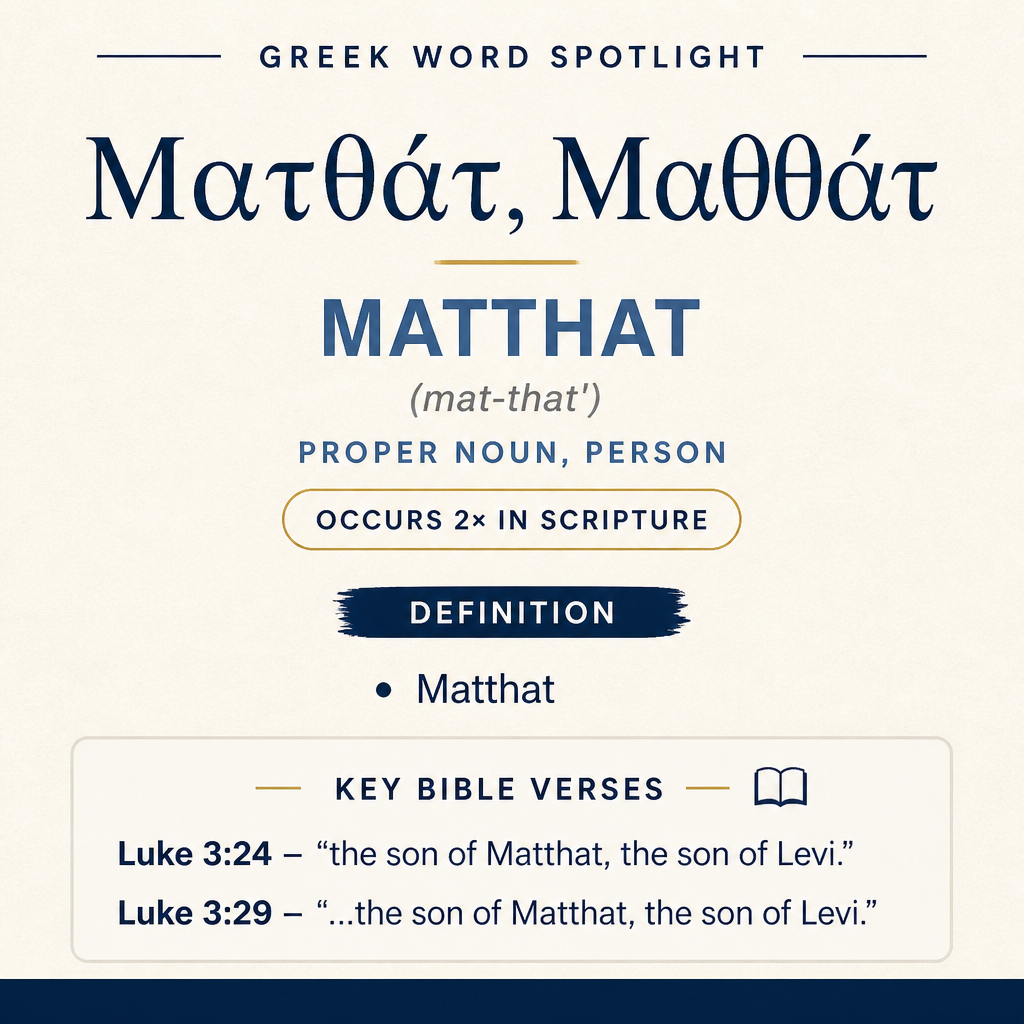
Matthat is a personal name appearing twice in Luke’s genealogy of Jesus (Luke 3:24; 3:29).
Name and Form
The Greek proper name is written Ματθάτ or Μαθθάτ and transliterated Matthat.
Learn More →Biblical Occurrences
Matthat occurs 2 times in Scripture, both in the Gospel of Luke.
Learn More →Genealogy Context
In Luke 3:24, Matthat is named in a line including Levi, Melchi, Jannai, and Joseph; in Luke 3:29, Matthat appears between Jorim and Levi.
Learn More →Matthat is a personal name appearing in Luke’s genealogy of Jesus. In this list of “son of …” relationships, Matthat functions as one link within a chain of descent.
Root and Related Words
Matthat is related to the name Mattathias (transliteration: Mattathias; Greek: Ματταθίας), “Mattathias” (Strong’s G3161).

Occurrences
Luke 3:24 — “the son of Matthat, the son of Levi, the son of Melchi, the son of Jannai, the son of Joseph,”
Here Matthat appears inside a tightly patterned sequence of paternal links. The repeated phrasing (“the son of …, the son of …”) places Matthat in the middle of a generational chain: one person is identified as “the son of Matthat,” and Matthat himself is immediately tied onward as “the son of Levi.” In this setting, the name carries its force not by a narrated episode or an individual action, but by its role in specifying identity within an ordered lineage. Matthat is therefore not a stand-alone figure in the verse’s surface presentation; he is a connector that anchors the genealogy at a particular point, allowing the next names (“Levi … Melchi … Jannai … Joseph”) to be attached in a continuous line.
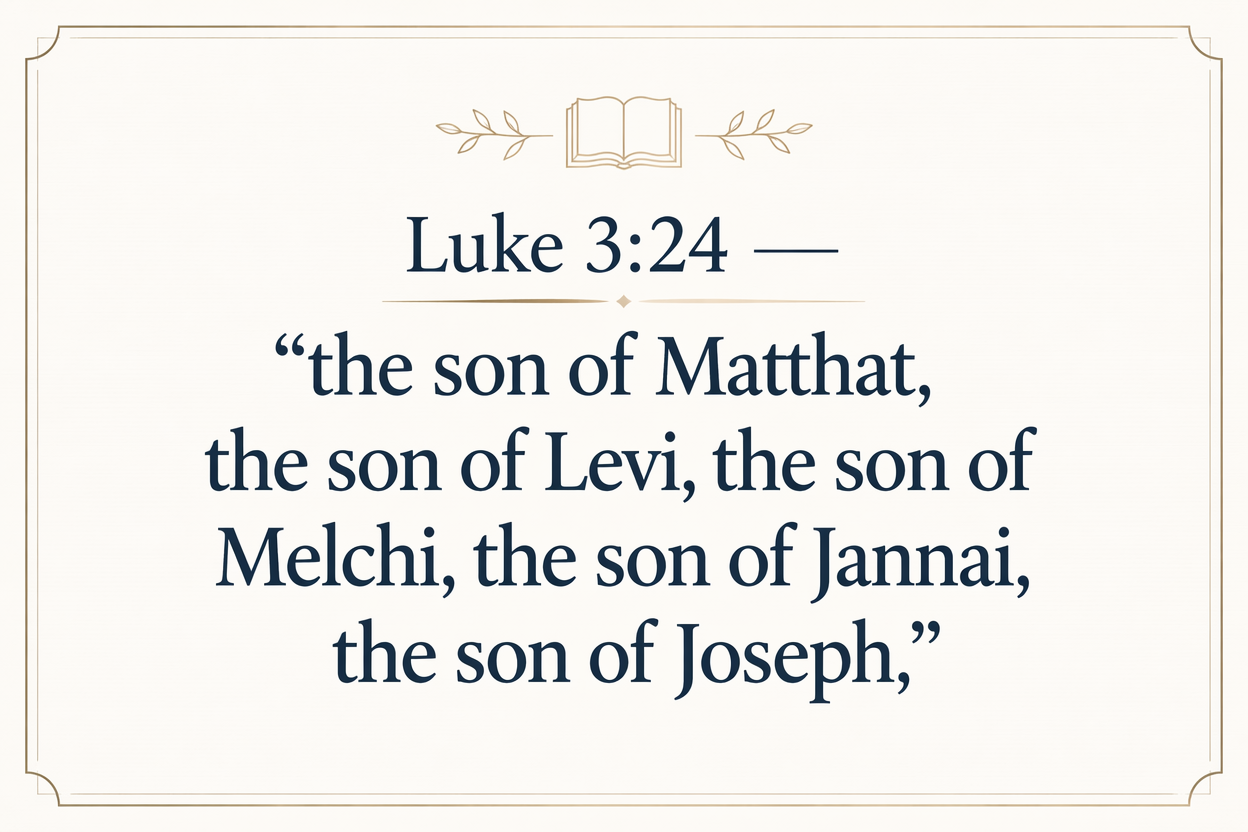
The placement also shows how the genealogy works as a series of nested identifications. Each clause both completes and opens a relationship: “the son of Matthat” identifies the immediately preceding person, and “the son of Levi” identifies Matthat in turn. Matthat’s contribution, then, is to secure the continuity of the list at a juncture where two successive father–son links meet.
Luke 3:29 — “the son of Jose, the son of Eliezer, the son of Jorim, the son of Matthat, the son of Levi,”
This second occurrence places Matthat within another segment of the same genealogy, again expressed through the same repeated formula. Matthat is the father of Jorim (“the son of Jorim, the son of Matthat”) and is linked to Levi as his own father (“the son of Levi”). In this verse, the chain is extended backward through several names—“Jose … Eliezer … Jorim … Matthat … Levi”—so Matthat serves as a pivotal intermediate ancestor between Jorim and Levi.
The immediate literary effect is cumulative: each name adds one more generational step, and Matthat is one of those steps. The name carries no descriptive modifiers, titles, or narrative details in this verse; its value is entirely genealogical. Matthat’s presence ensures that the transition from Jorim to Levi is made explicit rather than implied, preserving the consistent rhythm of the list and keeping the ancestry sequence unbroken.
Sense and Usage
Across these occurrences, Matthat functions as a fixed personal designation within a genealogical register. The definition is realized in a straightforward way: it is the name by which an individual ancestor is identified, and it appears only in the formulaic structure that marks descent (“the son of Matthat”). Because the same surrounding pattern recurs in both verses, Matthat’s usage is stable and uniform: it is neither a title nor a descriptor, but a proper name used to locate a person precisely within a lineage.
At the level of discourse, a name in a genealogy does more than label an individual; it also serves as an organizing marker. Each named person functions like a joint in the chain where two relationships meet: someone is described as that person’s son, and that person is in turn described as the son of someone else. Matthat appears exactly in that joint position in both verses, which highlights how genealogies depend on names to carry relational information. In Luke 3:24, Matthat stands between an unnamed “son” (identified by being Matthat’s son) and Levi (identified as Matthat’s father). In Luke 3:29, the same structural role is present, but the surrounding names differ (“Jorim” above him and “Levi” below him), situating Matthat at a different point in the list while keeping the same kind of function.
The repetition of “the son of Levi” immediately after Matthat in both verses also shows Matthat’s consistent linkage to Levi within Luke’s sequence. That repeated pairing does not turn the name into a descriptive term; it reinforces the list’s method of identifying each individual by paternal connection. In this way, Matthat contributes to the genealogy’s aim of establishing a continuous line by providing one necessary named step in the succession.
Genealogical Imagery
In these verses, Matthat carries the imagery of ancestry expressed through a chain of names. The wording presents lineage as a succession of links, each joined to the next by the recurring phrase “the son of.” Matthat is one of those links: a single name that, in context, represents a generational connection between the surrounding fathers and sons named in Luke’s list.
Sources: Lexical data from Strong’s Exhaustive Concordance and the Translators Brief Lexicon of Extended Strongs for Greek (STEPBible, CC BY). Occurrence data from the Translators Amalgamated Greek New Testament (STEPBible, CC BY). Scripture quotations from the World English Bible (public domain).





