Exploring the Meaning of Machomai in Greek
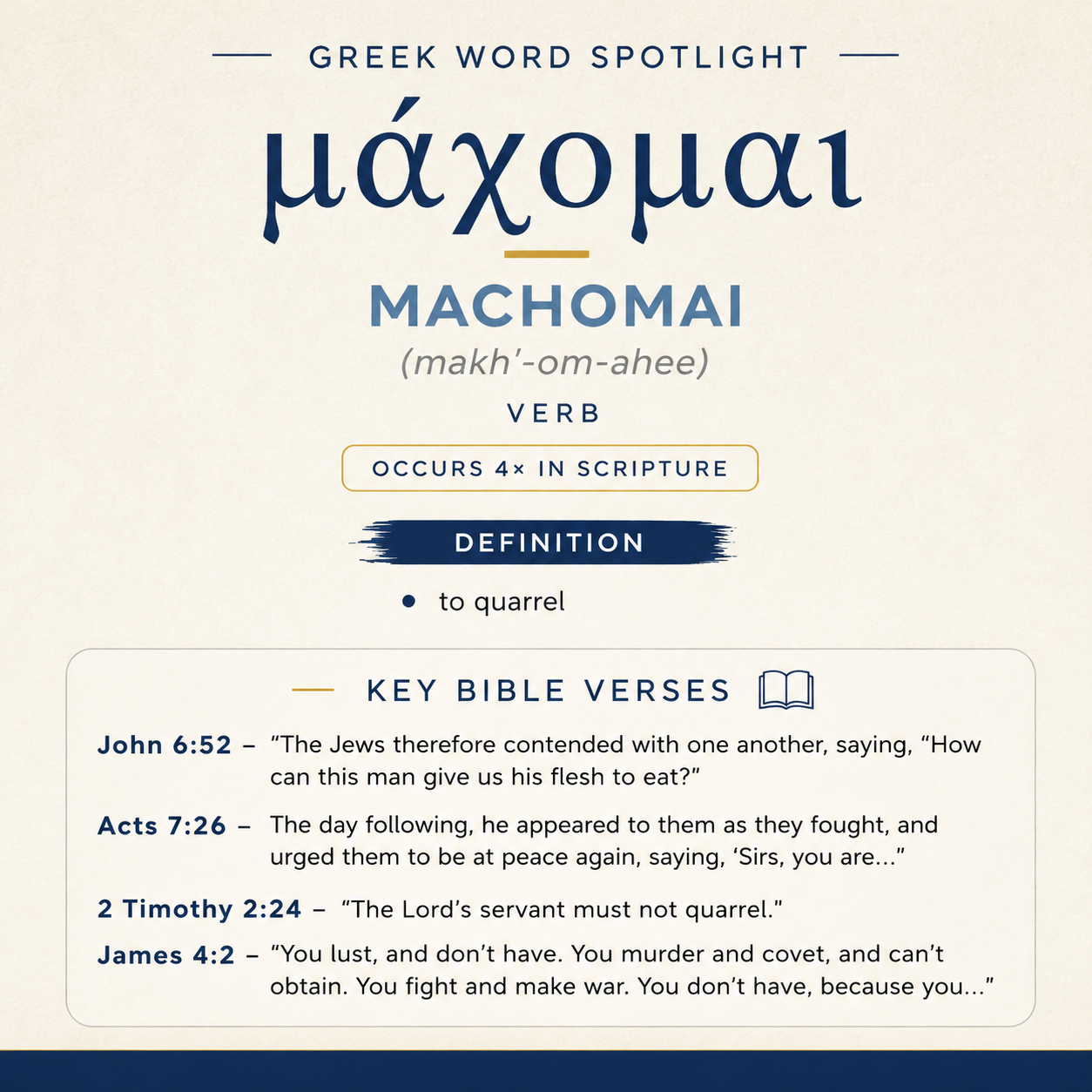
μάχομαι means “to quarrel” and appears four times in Scripture: John 6:52, Acts 7:26, 2 Timothy 2:24, and James 4:2.
Core Meaning
μάχομαι is defined as “to quarrel.” It describes contention and fighting in the cited passages.
Learn More →Scripture Occurrences
This verb occurs four times in Scripture: John 6:52; Acts 7:26; 2 Timothy 2:24; James 4:2.
Learn More →Context Snapshots
In John 6:52, the Jews contended with one another over Jesus’ words. In 2 Timothy 2:24, the Lord’s servant must not quarrel.
Learn More →μάχομαι means “to quarrel,” describing open contention that ranges from disputes in speech to active fighting. It appears in scenes of argument, interpersonal violence, and instruction about how the Lord’s servant is to behave when conflict arises.
Occurrences
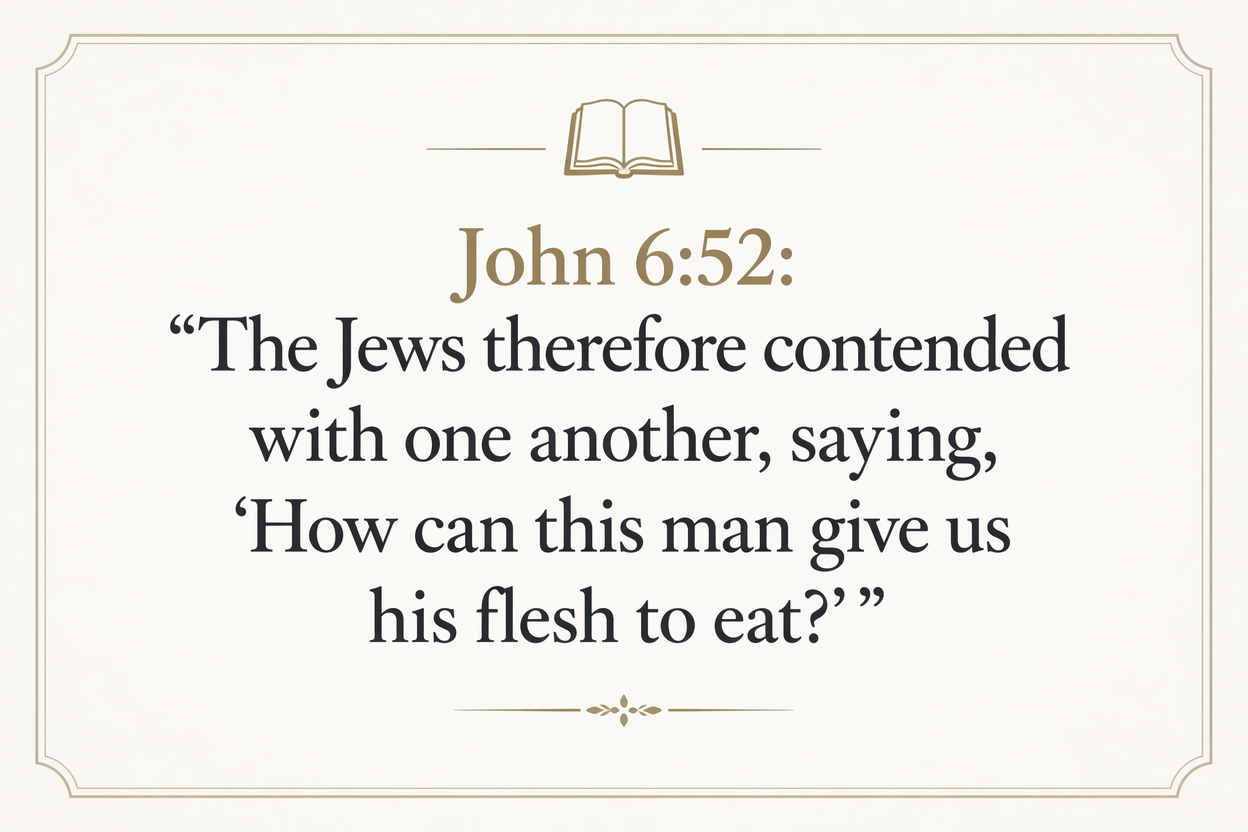
John 6:52: “The Jews therefore contended with one another, saying, ‘How can this man give us his flesh to eat?’”
Here μάχομαι names a dispute that breaks out within a crowd: they “contended with one another,” and the immediate sound of the quarrel is captured in their question. The conflict is not described as a private difference of opinion but as contention that turns people against each other (“with one another”), and it is propelled by a concrete point of disagreement (“How can this man…”). In this setting, the verb frames the response as argumentative friction inside the group, not merely puzzlement; their words become the arena where the quarrel is happening.
Acts 7:26: “The day following, he appeared to them as they fought, and urged them to be at peace again, saying, ‘Sirs, you are brothers. Why do you wrong one another?’”
In this narrative moment, μάχομαι occurs in a scene already characterized by wrongdoing and the need to restore peace. The action is described as “they fought,” and the attempt at intervention is an appeal to reconciliation: “urged them to be at peace again.” The verb thus marks more than verbal sparring; it fits a situation where the quarrel has become a physical clash between two parties. The speaker’s question, “Why do you wrong one another?” places the fighting within a moral frame: their quarrel is expressed as harm done between “brothers,” and the call to peace highlights the social rupture μάχομαι represents.
2 Timothy 2:24: “The Lord’s servant must not quarrel, but be gentle toward all, able to teach, patient,”
Here μάχομαι is set in direct contrast to the posture expected of “The Lord’s servant.” The instruction is not merely to avoid a certain topic but to avoid becoming the kind of person who enters conflicts in a quarrelsome way: “must not quarrel.” The alternatives that follow—“be gentle toward all, able to teach, patient”—show the relational setting in which quarrels commonly arise and the kind of conduct meant to replace them. μάχομαι, in this line, functions as a boundary marker: it names a mode of engagement that undermines gentleness, teaching, and patience, and so it is excluded from the servant’s conduct.
James 4:2: “You lust, and don’t have. You murder and covet, and can’t obtain. You fight and make war. You don’t have, because you don’t ask.”
In James, μάχομαι appears in a forceful chain of verbs that trace desire into conflict. The sequence moves from inward craving (“You lust”) and frustration (“don’t have,” “can’t obtain”) into outward harm (“You murder”) and then into wider hostility: “You fight and make war.” Within this progression, μάχομαι depicts conflict as one of the social outcomes of unchecked wanting. The pairing “fight and make war” intensifies the picture: quarrel is not an isolated episode but part of a pattern where people turn against others in order to grasp what they want. The final line, “You don’t have, because you don’t ask,” sets the fighting against an alternative response to lack, implying that quarrel is a misdirected attempt to resolve desire.

Sense and Usage
Across these passages, μάχομαι consistently marks conflict that is outward-facing and relational—something enacted “with one another,” visible as “they fought,” forbidden as a habit for the Lord’s servant, and listed as a symptom of disordered desire. The verb’s force is seen in how it shapes the surrounding language: it can be expressed through contentious speech (“contended… saying”), it can appear as an observable clash that calls for peacemaking (“urged them to be at peace again”), and it can sit alongside extreme actions that show how far quarrel can go when fed by coveting (“You murder… You fight and make war”).
The contexts also show that μάχομαι is not merely a label for disagreement but a rupture in community. John 6:52 locates the quarrel within a single group (“The Jews… with one another”), emphasizing internal fragmentation. Acts 7:26 sharpens that by naming the fighters as “brothers,” so the quarrel becomes a violation of kinship and a cause for urgent intervention. 2 Timothy 2:24 approaches the same reality from the opposite angle: instead of describing a quarrel, it describes the kind of character and conduct meant to prevent it. There, μάχομαι stands for a posture that would contradict gentleness and patience, suggesting that quarrels often involve a combative stance that spreads beyond one moment into a recognizable pattern of interaction.
James 4:2 adds an inner-to-outer movement that helps explain why quarrels arise. The line joins the social act (“You fight”) to frustrated desire (“lust… covet… can’t obtain”), portraying quarrel as an attempt to secure what one wants when one feels deprived. In that setting, μάχομαι is a social expression of inward disorder, and it is set within escalating language that shows how conflict can widen: from personal wanting to interpersonal harm to broader hostility (“make war”).
Imagery in Context
The imagery attached to μάχομαι in these verses moves from crowded contention to open conflict and then to the moral and pastoral handling of such conflict. In John 6:52, the quarrel is heard in competing voices pressing a sharp question. In Acts 7:26, it is seen as a fight that demands the restoring word, “be at peace again.” In 2 Timothy 2:24, it is the avoided path, replaced by gentleness and patience. In James 4:2, it is the outward flare of inward craving, part of a tragic cycle where people “fight and make war” rather than seek rightly for what they lack.
Sources: Lexical data from Strong’s Exhaustive Concordance and the Translators Brief Lexicon of Extended Strongs for Greek (STEPBible, CC BY). Occurrence data from the Translators Amalgamated Greek New Testament (STEPBible, CC BY). Scripture quotations from the World English Bible (public domain).