Exploring the Meaning of Matthias in Greek
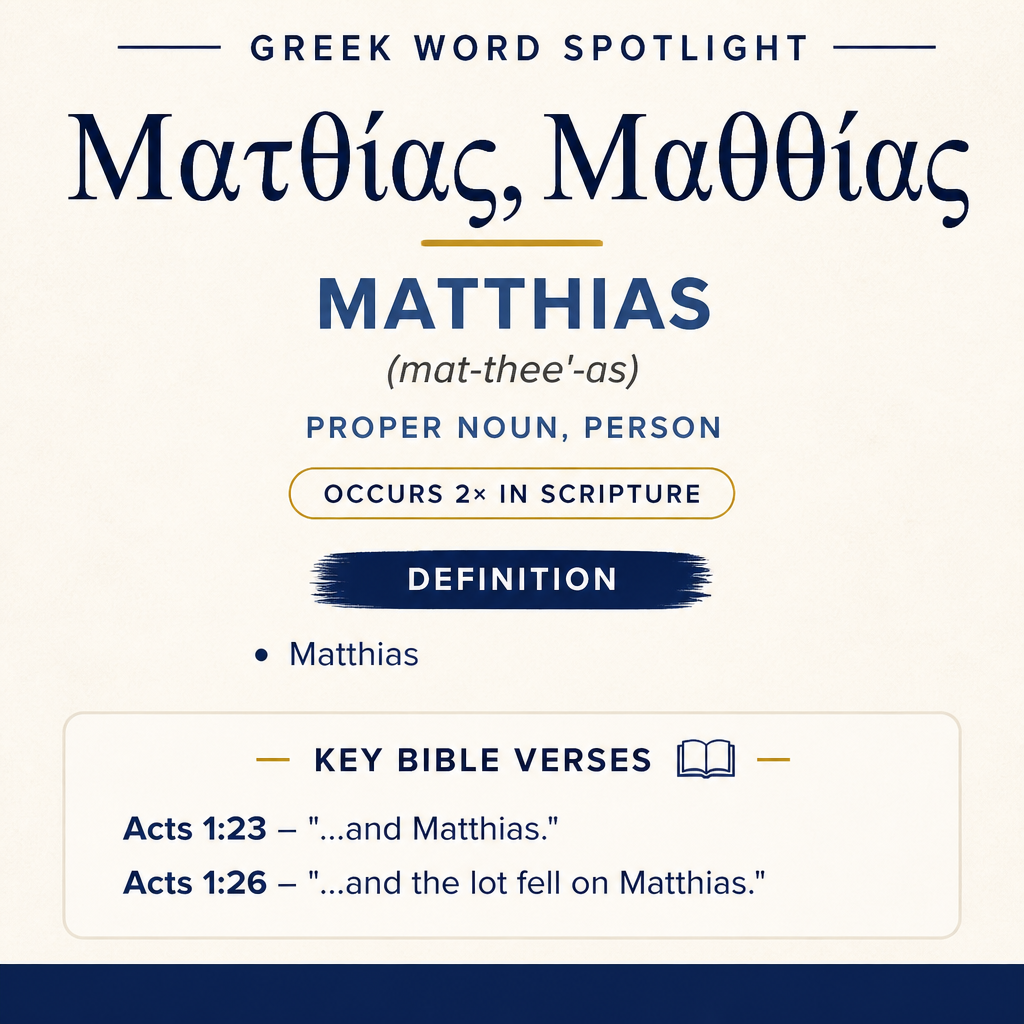
Ματθίας (also Μαθθίας) means “Matthias” and appears twice in Scripture, in Acts 1:23 and Acts 1:26.
Acts Context
In Acts 1:23, Matthias is put forward alongside Joseph called Barsabbas (Justus).
Learn More →Apostolic Number
In Acts 1:26, the lot falls on Matthias, and he is counted with the eleven apostles.
Learn More →Matthias is a personal name that appears in the account of selecting a replacement among the apostles in Acts 1. In both occurrences, it functions as the identifying name of the man who is proposed and then chosen.
Root and Related Words
Matthias is connected with the related name Mattathias (Greek Ματταθίας, transliteration Mattathias; Strong’s G3161), “Mattathias.”
Occurrences
“They put forward two, Joseph called Barsabbas, who was also called Justus, and Matthias.” (Acts 1:23)
Here Matthias is introduced in a setting where a group is deciding between candidates. The verse presents him as one of two individuals formally proposed (“They put forward two”), and the name serves to distinguish him from the other candidate, whose identification is expanded by multiple designations (“Joseph called Barsabbas, who was also called Justus”). Against that longer chain of identifiers, “Matthias” stands as a single, sufficient label, placing him on equal footing in the process as a clearly recognized person without further qualifiers in this sentence. The word’s contribution is therefore chiefly referential: it anchors one side of the two-person choice and allows the narrative to keep the candidates distinct as the selection proceeds.
The structure of the sentence also highlights the public, procedural character of the moment. The group does not act on an unnamed impulse; they propose named individuals. In that environment, “Matthias” is not merely a mention but part of an explicit nomination. The name marks him as someone considered eligible for a role significant enough to require a careful, two-option presentation. Even without additional descriptors attached to him here, the naming places him within a communal decision where personal identity matters and must be stated plainly.
“They drew lots for them, and the lot fell on Matthias, and he was counted with the eleven apostles.” (Acts 1:26)
In this verse, Matthias is the outcome of a selection action described in two coordinated steps: first the action (“They drew lots for them”), then the result (“the lot fell on Matthias”). The name functions as the point where the narrative resolves uncertainty into a specific person. “Matthias” is the one singled out by the lot’s falling, and the clause places his name at the focal point of the decision’s conclusion.
The verse then immediately interprets what that naming means for the group’s makeup: “and he was counted with the eleven apostles.” The shift from the proper name “Matthias” to the pronoun “he” binds the person named to a new status. The name does not stand alone as a mere record of who won; it becomes the identifier of the one incorporated into an already-defined body (“the eleven apostles”). The verb “was counted with” portrays inclusion by reckoning—an act of recognition that places Matthias within a numbered company. In this context the name carries narrative weight: it identifies the individual whose standing changes from candidate to counted member. The word thus supports the text’s movement from proposal to decision to recognized inclusion.
The parallelism within the verse also gives the name a formal tone. “They drew lots … the lot fell on Matthias” reads like a report of procedure and verdict. The name is the final term of that verdict, and its placement in the sentence keeps the focus on the individual selected rather than on the method itself. The method is described, but the narrative’s end point is personal: the decision results in “Matthias,” and then the community’s roster is stated in relation to him.
Sense and Usage
Across these passages, Matthias functions strictly as a personal name, and its use is shaped by the narrative’s need to identify one man among others in a decisive communal moment. In Acts 1:23 the name is used in a list of nominees, where identification is necessary simply to establish who is under consideration. In Acts 1:26 the same name becomes the marker of resolution, identifying the individual upon whom the lot falls and the one subsequently recognized within the apostolic group.
The two occurrences together show how a proper name can carry different kinds of narrative force without changing what it is. First, it serves to place a person into the field of possibilities (“They put forward two … and Matthias”). Second, it serves to state the person who emerges from those possibilities (“the lot fell on Matthias”). The movement from possibility to selection is built into the way the name appears: it is initially one of two, then it is the one chosen. Because the text pairs the naming with procedural verbs (“put forward,” “drew lots,” “fell on,” “was counted with”), the name is consistently tied to action and outcome rather than to descriptive portraiture. Matthias is not characterized by lineage, occupation, or title in these verses; he is characterized by his role in the decision and by the group’s recognition of him afterward.
Another feature of usage is the interplay between naming and counting. The final clause, “he was counted with the eleven apostles,” frames community membership as something that can be reckoned and stated. The proper name anchors that reckoning: it is Matthias who is counted with them. This is not presented as an informal association but as an acknowledged placement within a defined set. In that sense, the name functions like a hinge between two states of affairs—before the lot falls, he is among candidates; after it falls, he is among apostles.
Within the immediate context of the quoted lines, the name also contributes to clarity and accountability. A public action (“They put forward…,” “They drew lots…”) yields a public result that is expressed by naming the person. The text’s straightforward reporting depends on the name to make the result concrete. “Matthias” is therefore not ornamental; it is essential to the narrative’s precision, allowing the reader to follow who is being considered and who is ultimately recognized.
Imagery
The imagery surrounding Matthias in these verses is procedural and communal: two candidates are set forward, lots are drawn, and a person is counted into an existing group. The name stands at the center of that sequence, tied to the moment when a collective process narrows to a single individual—“the lot fell on Matthias”—and to the ensuing image of inclusion—“he was counted with the eleven apostles.”
Sources: Lexical data from Strong’s Exhaustive Concordance and the Translators Brief Lexicon of Extended Strongs for Greek (STEPBible, CC BY). Occurrence data from the Translators Amalgamated Greek New Testament (STEPBible, CC BY). Scripture quotations from the World English Bible (public domain).