Exploring the Meaning of Loipoy in Greek
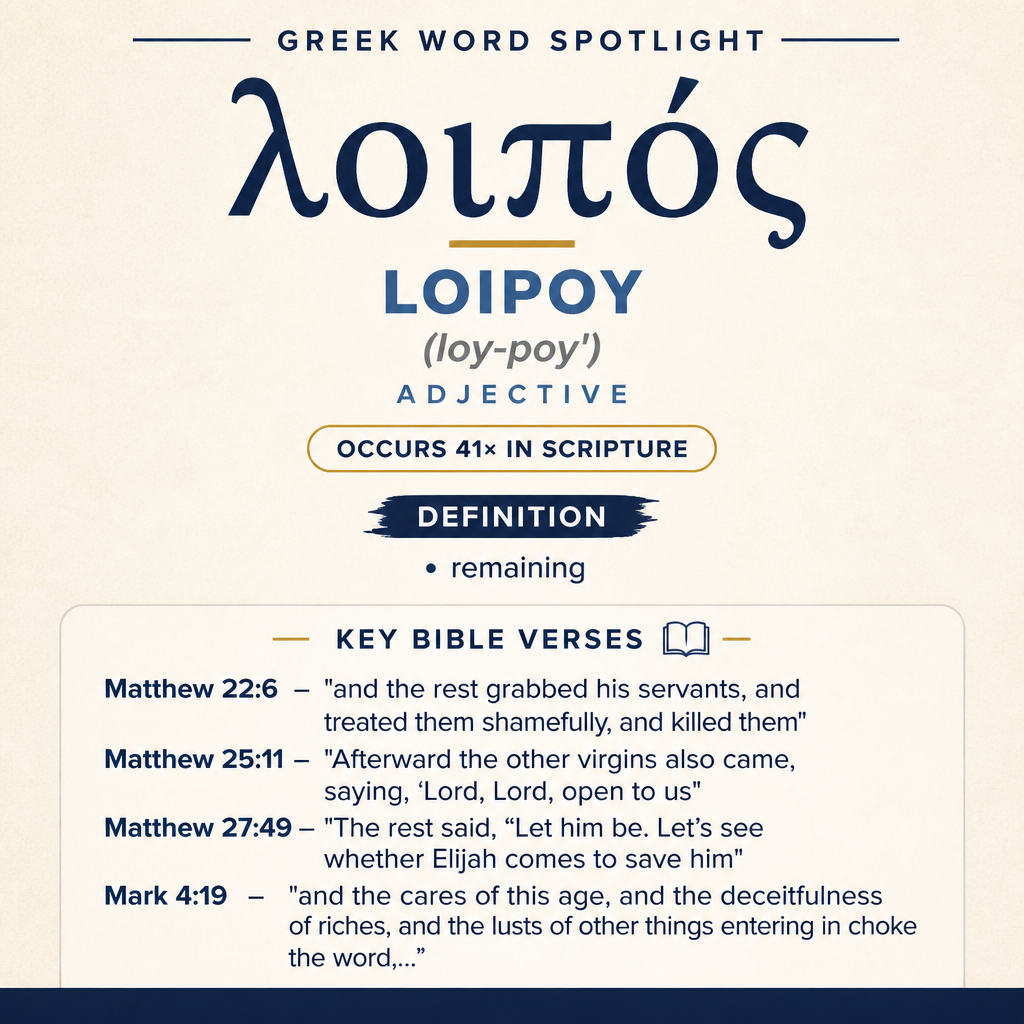
λοιπός means “remaining” and appears 41 times in Scripture, including Matthew 22:6; 25:11; 27:49 and Mark 16:13.
Core Meaning
λοιπός means “remaining.” In several passages it points to “the rest” or “the other” people in view.
Learn More →Gospel Examples
In Matthew 22:6 and 27:49 it refers to “the rest” who respond to the servants and to Jesus. In Matthew 25:11 it describes “the other virgins” who come afterward.
Learn More →Further Occurrences
Mark 16:13 uses it for “the rest” who are told but do not believe. Luke uses it for those outside the disciples (Luke 8:10) and for “the rest” of someone’s concerns (Luke 12:26).
Learn More →λοιπός expresses the idea of what is left or what remains, and in these passages it regularly marks the portion of a group or situation that stands over against what has just been mentioned. The word appears in narrative, teaching, and dialogue to separate an already-identified subset from those who are “the rest.”
Root and Related Words
λοιπός is connected with the verb leipo (λείπω), “to lack” (Strong’s G3007), a relationship that fits the word’s repeated use for what is left over after a portion has been singled out.

Occurrences
Matthew 22:6 — “and the rest grabbed his servants, and treated them shamefully, and killed them.”
Here λοιπός draws a line within the invited people: some have already been described as merely refusing or going their own way, but “the rest” are those who go further—seizing the servants and escalating to shameful treatment and murder. The word narrows attention to the remaining group as a distinct set whose actions define the next turn of the scene.

Matthew 25:11 — “Afterward the other virgins also came, saying, ‘Lord, Lord, open to us.’”
In this moment, λοιπός identifies the virgins who arrive later, after an earlier group has already been in view. The term frames them as those left outside the earlier movement of events, and their plea (“open to us”) is heard as the request of the ones who remain on the other side of the closed door.
Matthew 27:49 — “The rest said, “Let him be. Let’s see whether Elijah comes to save him.””
λοιπός distinguishes a set of speakers within a larger crowd at the crucifixion scene. “The rest” are the bystanders who respond with a wait-and-see stance, holding back action and calling for delay (“Let him be”) so that an expected rescue might be observed. The word functions to group their voices together as the remaining opinion in the moment.
Mark 4:19 — “and the cares of this age, and the deceitfulness of riches, and the lusts of other things entering in choke the word, and it becomes unfruitful.”
Within the list of competing pressures, λοιπός appears in the phrase “other things,” placing an open-ended remainder after the named items (“cares,” “deceitfulness of riches”). The word lets the saying sweep beyond the two specified concerns to whatever else remains capable of “entering in” and choking the word.
Mark 16:13 — “They went away and told it to the rest. They didn’t believe them, either.”
Here λοιπός marks the remaining disciples or associates beyond the two who bring the report. The word emphasizes that the message moves from a smaller witnessing pair to everyone else who remains, and the disbelief (“They didn’t believe them, either”) is attached to that larger remainder.
Luke 8:10 — “He said, “To you it is given to know the mysteries of God’s Kingdom, but to the rest in parables; that ‘seeing they may not see, and hearing they may not understand.’”
In Jesus’ explanation, λοιπός sets up a contrast between two audiences: “you” and “the rest.” The term gathers all who are outside the addressed circle into a single category, characterized by receiving the message “in parables,” with the result expressed in the quoted line about seeing and hearing without grasping.
Luke 12:26 — “If then you aren’t able to do even the least things, why are you anxious about the rest?”
λοιπός shifts from group membership to the remainder of concerns. After “even the least things” are mentioned, “the rest” names everything left that might provoke anxiety—whatever remains beyond the smallest matters. The word supports the argument’s logic: if the minimal is out of reach, anxiety over all remaining matters is exposed as misplaced.
Luke 18:9 — “He spoke also this parable to certain people who were convinced of their own righteousness, and who despised all others.”
In this introductory description, the idea signaled by λοιπός is heard in “all others,” the remainder beyond “certain people” who trust in themselves. The phrasing sets up a social and moral boundary: the targeted listeners view themselves as a defined circle and treat everyone else as what remains—objects of contempt.
Luke 18:11 — “The Pharisee stood and prayed to himself like this: ‘God, I thank you that I am not like the rest of men, extortionists, unrighteous, adulterers, or even like this tax collector.”
Here λοιπός is placed on the Pharisee’s lips as a dividing label: “the rest of men” are those outside his self-assessed category. The term carries the force of exclusion in his prayer, and his list of wrongdoers is presented as representative of the remaining humanity from which he claims separation, climaxing in “even like this tax collector.”
Luke 24:9 — “returned from the tomb, and told all these things to the eleven and to all the rest.”
λοιπός helps map the community receiving the women’s report. “The eleven” are named first, and then “all the rest” extends the audience to everyone remaining beyond that defined apostolic group. The word broadens the scope of testimony from the core leadership to the wider circle.
Luke 24:10 — “Now they were Mary Magdalene, Joanna, and Mary the mother of James. The other women with them told these things to the apostles.”
Here λοιπός appears as “the other women,” distinguishing unnamed companions from the three women just identified. The term signals that the reporting group is larger than the named individuals; there are remaining women present whose testimony joins the message delivered “to the apostles.”
Acts 2:37 — “Now when they heard this, they were cut to the heart, and said to Peter and the rest of the apostles, “Brothers, what shall we do?””
λοιπός functions within an address: the crowd speaks “to Peter and the rest of the apostles.” Peter is singled out, and the term gathers those apostles remaining beside him into a single collective. This use highlights both leadership and shared identity: Peter is prominent, yet the question is directed to the whole apostolic body beyond him.
Sense and Usage
Across these scenes, λοιπός regularly works as a boundary word—one that lets a speaker or narrator take a previously mentioned set and point to what remains outside it. Sometimes the division is within a crowd (Matthew 22:6; Matthew 27:49), sometimes within a defined group of followers (Mark 16:13; Luke 24:9; Acts 2:37), and sometimes within a smaller subgroup already identified by name (Luke 24:10). In each case, the word depends on a prior reference point: once a portion has been identified, λοιπός names the remainder as a meaningful category.
The word can also mark the remainder not of people but of things or concerns. In Mark 4:19, “other things” extends a list beyond its stated items, leaving the category open-ended yet still framed as what remains after particular pressures have been named. In Luke 12:26, “the rest” gathers the whole field of anxious concerns left after “even the least things,” turning the remainder into the target of a rhetorical question. Whether the remainder is a crowd, a circle of disciples, or an unspecified range of pressures, λοιπός serves to collect what is left and make it speakable as a unit.
Several occurrences show how easily the term can carry a social or evaluative edge without changing its basic force. In Luke 8:10, “the rest” are those outside the addressed disciples, characterized by receiving teaching “in parables.” In Luke 18:11, “the rest of men” becomes a self-exalting contrast category in the Pharisee’s prayer. In Matthew 22:6, “the rest” are not merely additional invitees but the remainder whose violent response defines them. In each passage, the word’s role is to sort the scene into an identified part and the remainder, leaving the narrative or the speaker to describe what that remainder does or represents.
Imagery
These passages often picture λοιπός as the group standing just beyond a threshold: outside the opened door (Matthew 25:11), outside the inner circle granted understanding (Luke 8:10), outside the named apostles yet still within the community that must hear the report (Luke 24:9), or outside the singled-out leader yet still part of the addressed body (Acts 2:37). Even where no physical boundary is mentioned, the word regularly creates a conceptual edge in the scene, so that the “remaining” people or matters are gathered and brought into focus.
Sources: Lexical data from Strong’s Exhaustive Concordance and the Translators Brief Lexicon of Extended Strongs for Greek (STEPBible, CC BY). Occurrence data from the Translators Amalgamated Greek New Testament (STEPBible, CC BY). Scripture quotations from the World English Bible (public domain).