Exploring the Meaning of Kopiao in Greek
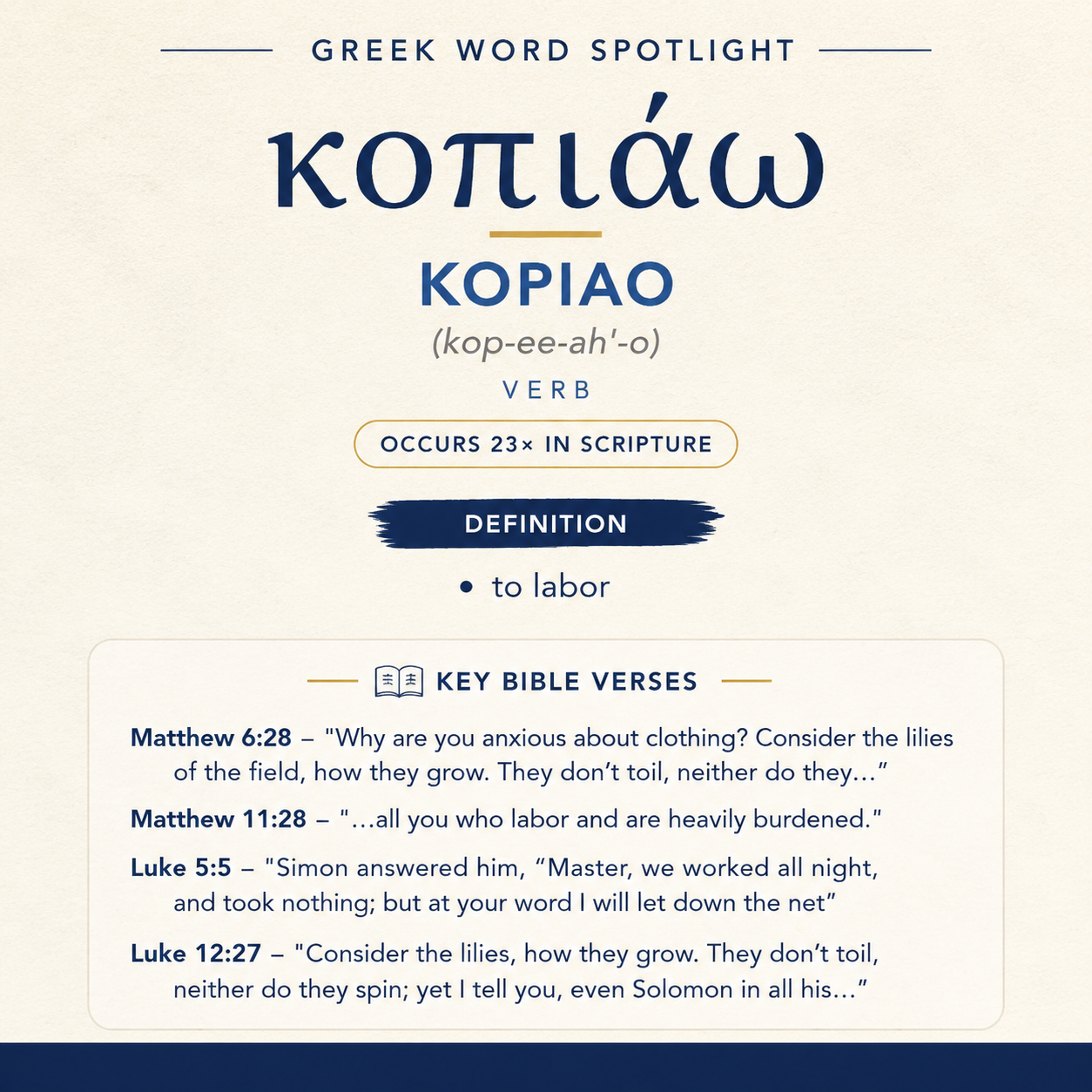
κοπιάω means “to labor” and occurs 23 times in Scripture, including Matthew 11:28, Luke 5:5, John 4:6, Acts 20:35, and Romans 16:6.
Core Meaning
κοπιάω means “to labor.” In Matthew 11:28 it describes those who labor and are heavily burdened.
Learn More →Gospel Examples
Matthew 6:28 and Luke 12:27 contrast human toil with lilies that “don’t toil.” John 4:6 notes Jesus was tired from his journey.
Learn More →Ministry Labor
John 4:38 speaks of labor connected with reaping and entering others’ labor. Acts 20:35 urges laboring to help the weak, and Romans 16:6 commends Mary’s much labor.
Learn More →κοπιάω speaks of labor—work that can be pictured as exertion over time. In the passages where it appears, it ranges from ordinary human work (fishing through the night, manual labor, making clothing) to sustained ministry and service done “in the Lord.”
Occurrences
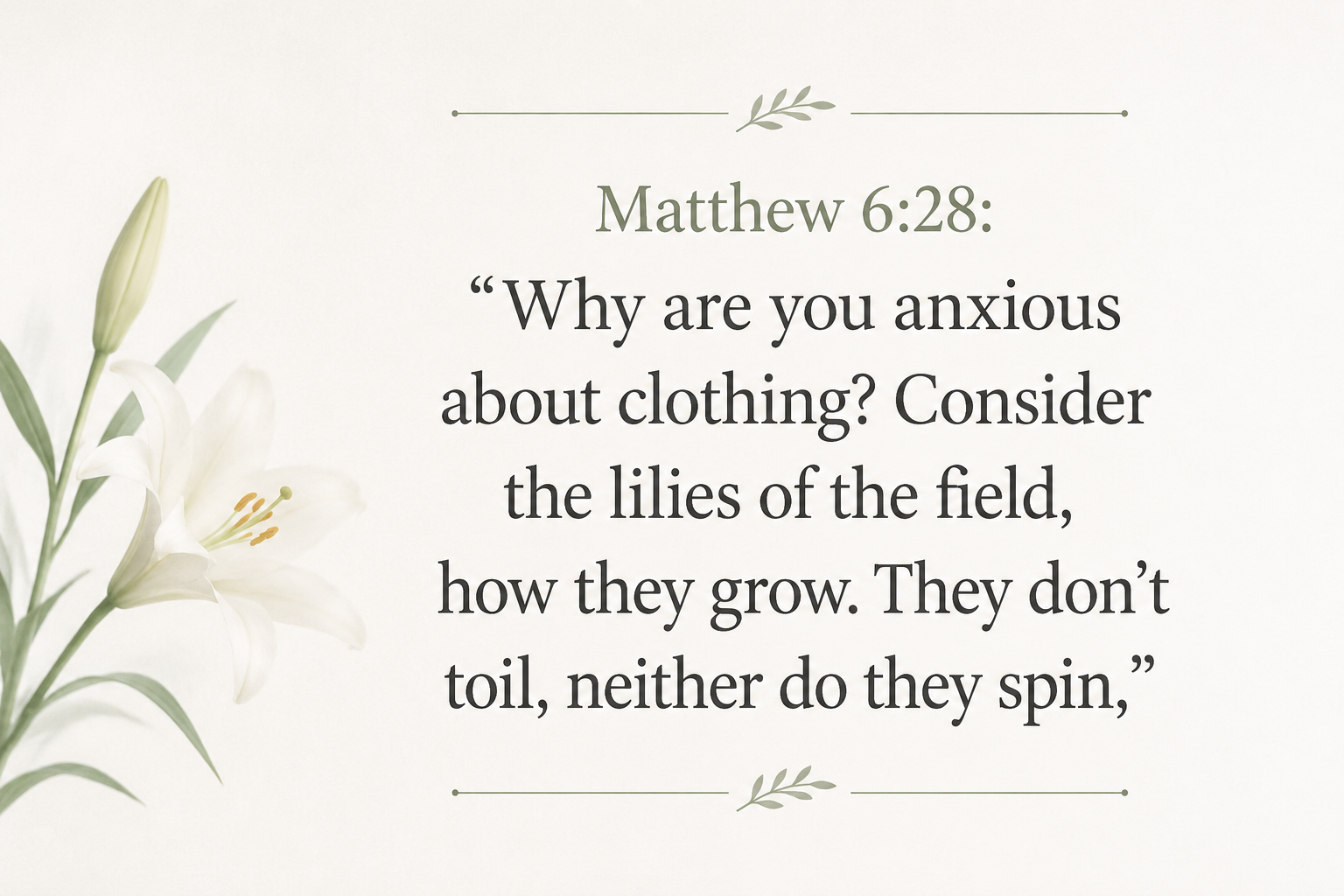
Matthew 6:28: “Why are you anxious about clothing? Consider the lilies of the field, how they grow. They don’t toil, neither do they spin,”
Here the verb is set in a contrast between human effort and the effortless growth of “the lilies of the field.” The scene names two kinds of work connected with clothing—“toil” and “spin”—and uses the lilies as a visible counterexample to anxious, clothing-focused labor. The point depends on the reader recognizing what toil for clothing normally entails, then observing that the lilies are clothed without engaging in such work.
Matthew 11:28: “Come to me, all you who labor and are heavily burdened, and I will give you rest.
Labor is paired with being “heavily burdened,” so the work in view is not merely activity but an experience of weight and weariness that calls for “rest.” The invitation assumes that those addressed are already engaged in labor that leaves them loaded down; the promise of rest answers that condition directly.
Luke 5:5: Simon answered him, “Master, we worked all night, and took nothing; but at your word I will let down the net.”
The labor is concrete and time-marked: “all night” of work with a disappointing result (“took nothing”). The word adds the feel of prolonged effort that yields no catch, intensifying the contrast with Simon’s decision to act again “at your word.” The labor is not abstract; it is embodied night work on the water with nets and fatigue implied by the duration.
Luke 12:27: “Consider the lilies, how they grow. They don’t toil, neither do they spin; yet I tell you, even Solomon in all his glory was not arrayed like one of these.”
As in Matthew 6:28, toil is linked to clothing production (“spin”) and set against the lilies’ growth. The comparison is sharpened by the mention of splendor (“Solomon in all his glory”): the lilies’ beauty exceeds the finest human array even though they do not perform the labor associated with making garments. The verb helps build the argument by naming the kind of work humans instinctively do to be “arrayed.”
John 4:6: “Jacob’s well was there. Jesus therefore, being tired from his journey, sat down by the well. It was about the sixth hour.”
In this narrative moment, labor is reflected through its effect: Jesus is “tired from his journey.” The verb contributes the idea of exertion that leads to weariness and the need to sit. The simple action—sitting down by the well at a specific time—roots the word in bodily fatigue rather than in a general idea of work.
John 4:38: “I sent you to reap that for which you haven’t labored. Others have labored, and you have entered into their labor.”
Labor is framed as the investment that precedes harvesting (“reap”). The statement distinguishes between those who did not labor and “others” who did, and then adds a second layer: entering into another’s labor, benefiting from work already done. The repetition—“labored… labored… labor”—makes the contrast explicit and presents labor as something that can be shared in its results, even if not shared in its effort.
Acts 20:35: “In all things I gave you an example, that so laboring you ought to help the weak, and to remember the words of the Lord Jesus, that he himself said, ‘It is more blessed to give than to receive.’”
Labor is presented as an “example” and is linked to a purpose: “help the weak.” The verb here is not an end in itself but the manner in which assistance is offered—“so laboring you ought to help.” The word supports an ethic of active, effortful support, connected with giving rather than receiving.
Romans 16:6: “Greet Mary, who labored much for us.”
Labor is used as a descriptor of a person’s contribution to a community: Mary “labored much.” The phrase “for us” locates the work as benefiting others, and “much” underlines its extent. The verb becomes a concise way to honor sustained effort without detailing the specific tasks.
Romans 16:12: “Greet Tryphaena and Tryphosa, who labor in the Lord. Greet Persis, the beloved, who labored much in the Lord.”
Here labor is explicitly situated “in the Lord,” marking it as work carried out within a devotional and communal frame. Two women are described in the present as those “who labor,” while Persis is marked by the extent of her past labor: “labored much.” The repeated phrasing ties labor to identity and reputation within the community, and the added qualifier signals that this labor is understood as belonging to the sphere of Christian service.
1 Corinthians 4:12: “We toil, working with our own hands. When people curse us, we bless. Being persecuted, we endure.”
The verb is immediately clarified by an accompanying phrase: “working with our own hands.” Labor is manual and self-sustaining, placed alongside verbal abuse (“curse us”) and hardship (“persecuted”). The juxtaposition shows toil as part of a larger pattern of endurance: they work, they bless in return, they endure under pressure. The word contributes the sense of effort that accompanies a life marked by opposition.
1 Corinthians 15:10: “But by the grace of God I am what I am. His grace which was given to me was not futile, but I worked more than all of them; yet not I, but the grace of God which was with me.”
Labor is presented as abundant (“more than all of them”) and yet interpreted through a theological lens: it is not credited as isolated personal achievement but as work bound up with “the grace of God.” The verb helps hold together two assertions in the same sentence: extraordinary exertion and the insistence that grace is active “with me” in that exertion.
1 Corinthians 16:16: “that you also be in subjection to such, and to everyone who helps in the work and labors.”
Labor is paired with “helps in the work,” portraying a collaborative setting where some both assist and labor. The instruction concerns recognizing and yielding to such people (“be in subjection to such”), so the verb functions as a marker of committed participation. Labor here is not solitary; it belongs to shared “work” in which helpers and laborers can be identified.

Sense and Usage
Across these passages, κοπιάω consistently marks work as something that costs effort. Sometimes the cost is registered by time and outcome: “we worked all night, and took nothing” (Luke 5:5) portrays labor that is extended and unrewarded. Sometimes the cost appears as bodily effect: Jesus is “tired from his journey” and sits (John 4:6), a narrative vignette where labor is felt as fatigue. Elsewhere the cost is embedded in contrast: lilies “don’t toil” (Matthew 6:28; Luke 12:27), so toil becomes the kind of human exertion that the anxious might assume is necessary for being clothed well.
The verb can also describe labor whose value is measured by whom it benefits. Mary “labored much for us” (Romans 16:6), and in Acts 20:35 laboring is urged as the active means by which one “help[s] the weak.” In John 4:38 labor is treated as an investment whose results can be enjoyed by others: some reap without having labored, yet they “enter into” another’s labor. That statement casts labor as transferable in its fruits—one person’s work becomes another person’s harvest—while still preserving the distinction between those who did the toil and those who benefited from it.
Several occurrences attach labor to Christian identity and communal order. Tryphaena, Tryphosa, and Persis are remembered as those who labor “in the Lord” (Romans 16:12), placing their effort within a recognizably religious sphere. In 1 Corinthians 16:16 the community is told to recognize those who “helps in the work and labors,” implying that labor is visible and acknowledged, and that it carries social weight within the group. In 1 Corinthians 15:10 labor is described as extensive, yet spoken of alongside “the grace of God,” showing that hard work and divine enabling are not treated as competing explanations in that context.
Finally, 1 Corinthians 4:12 anchors labor in ordinary, even gritty reality: “working with our own hands,” combined with cursing and persecution. In that setting κοπιάω names not only activity but the persistence of work under pressure, where labor is part of a larger pattern of endurance and response.
Imagery
The imagery associated with κοπιάω in these texts is practical and tactile: the quiet growth of lilies contrasted with human production of clothing (Matthew 6:28; Luke 12:27), the long night of fishing with empty results (Luke 5:5), and a traveler sitting down from weariness at a well (John 4:6). Alongside these scenes are community portraits where labor becomes a way of naming faithful service—work that supports the weak (Acts 20:35), builds up others “in the Lord” (Romans 16:12), and can even be “entered into” by those who reap what others have worked for (John 4:38).
Sources: Lexical data from Strong’s Exhaustive Concordance and the Translators Brief Lexicon of Extended Strongs for Greek (STEPBible, CC BY). Occurrence data from the Translators Amalgamated Greek New Testament (STEPBible, CC BY). Scripture quotations from the World English Bible (public domain).