
Exploring the Meaning of Koimesis in Greek
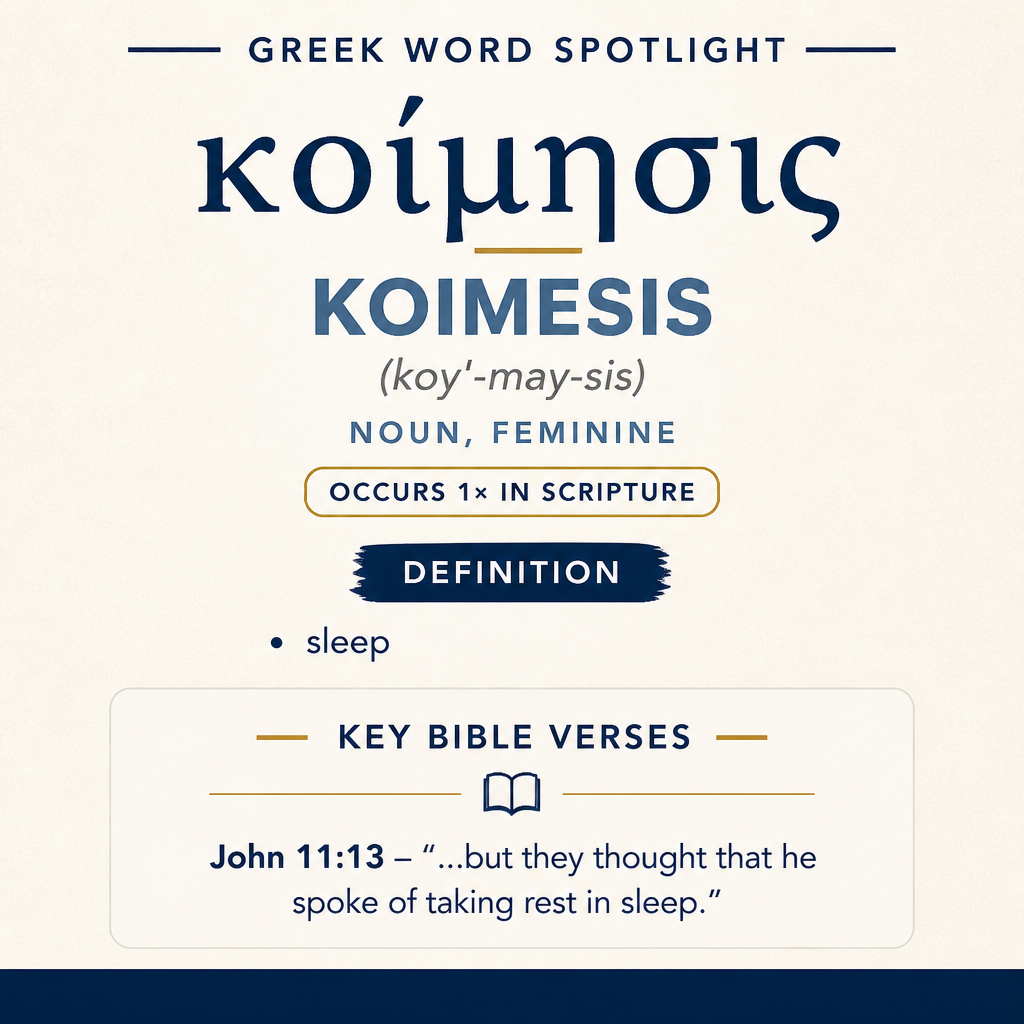
κοίμησις means “sleep” and appears once in Scripture in John 11:13.
Context in John
In John 11:13, Jesus spoke of his death, but they thought he meant rest in sleep.
Learn More →κοίμησις means “sleep” and appears in a single New Testament setting where Jesus’ words are heard one way by his disciples and intended another way by him. In that scene, the term becomes the hinge for a misunderstanding that must be corrected by context.
Root and Related Words
κοίμησις (Koimesis) derives from the verb koimao (κοιμάω), “to sleep” (Strong’s G2837). The noun form expresses the idea of sleep as a state or event, drawing on the same core concept carried by the verb.

Occurrences
“Now Jesus had spoken of his death, but they thought that he spoke of taking rest in sleep.” (John 11:13)
In John 11:13, κοίμησις functions inside a contrast between two interpretations of Jesus’ speech. The verse sets two understandings side by side: Jesus’ intended referent (“his death”) and the disciples’ conclusion (“taking rest in sleep”). Within the disciples’ hearing, κοίμησις is the plain, ordinary sense of sleep—resting—so that Jesus’ statement is taken as a reassuring report about physical recovery rather than as an announcement of loss. The wording “taking rest in sleep” frames κοίμησις as a natural, even hopeful, condition: someone is not in danger, but resting. That natural sense is exactly what makes the misunderstanding plausible in the narrative logic of the verse.
The verse itself highlights how the term can sit at the boundary between everyday experience and the way a speaker may use familiar language to refer to something heavier. The disciples are not confused because the word is obscure; they are confused because “sleep” is a common, concrete reality that easily fits their expectations. By stating both Jesus’ meaning and the disciples’ assumption in one sentence, the verse makes κοίμησις the pivot point: it is the concept that the disciples supply as an explanation, and it is the concept that must be distinguished from what Jesus “had spoken of.”
Sense and Usage
With the definition “sleep,” κοίμησις carries a straightforward idea: the condition of being asleep, understood as rest. John 11:13 shows this sense at work in a moment of interpretation, where “sleep” is not merely described but inferred. The disciples hear Jesus and, rather than taking his words as a statement about death, they map his saying onto the ordinary category of rest. In this way, κοίμησις illustrates how “sleep” can be used as an explanatory category that listeners reach for when they are trying to make sense of events and speech.
The verse also shows that κοίμησις is semantically vivid because it is experiential: everyone knows what it means to “take rest in sleep.” That vividness makes it capable of shaping a narrative misunderstanding. When people expect improvement, “sleep” sounds like recovery; when a speaker intends another referent, the same word can conceal the seriousness of what is meant until clarified. Thus, within this passage, κοίμησις does not expand beyond “sleep,” but its placement demonstrates the communicative power of the concept: it can reassure, soften, or mislead depending on what hearers assume and what the speaker intends.
Imagery
The image carried by κοίμησις in John 11:13 is the quietness of rest—someone lying down, the body stilled, the mind withdrawn from wakefulness. The verse’s phrase “taking rest in sleep” evokes a scene of calm that feels safe and temporary, which explains why the disciples could hear Jesus’ words and conclude that what he described was ordinary rest rather than the finality the verse attributes to his intention.
Sources: Lexical data from Strong’s Exhaustive Concordance and the Translators Brief Lexicon of Extended Strongs for Greek (STEPBible, CC BY). Occurrence data from the Translators Amalgamated Greek New Testament (STEPBible, CC BY). Scripture quotations from the World English Bible (public domain).





