
Exploring the Meaning of Koinoneo in Greek
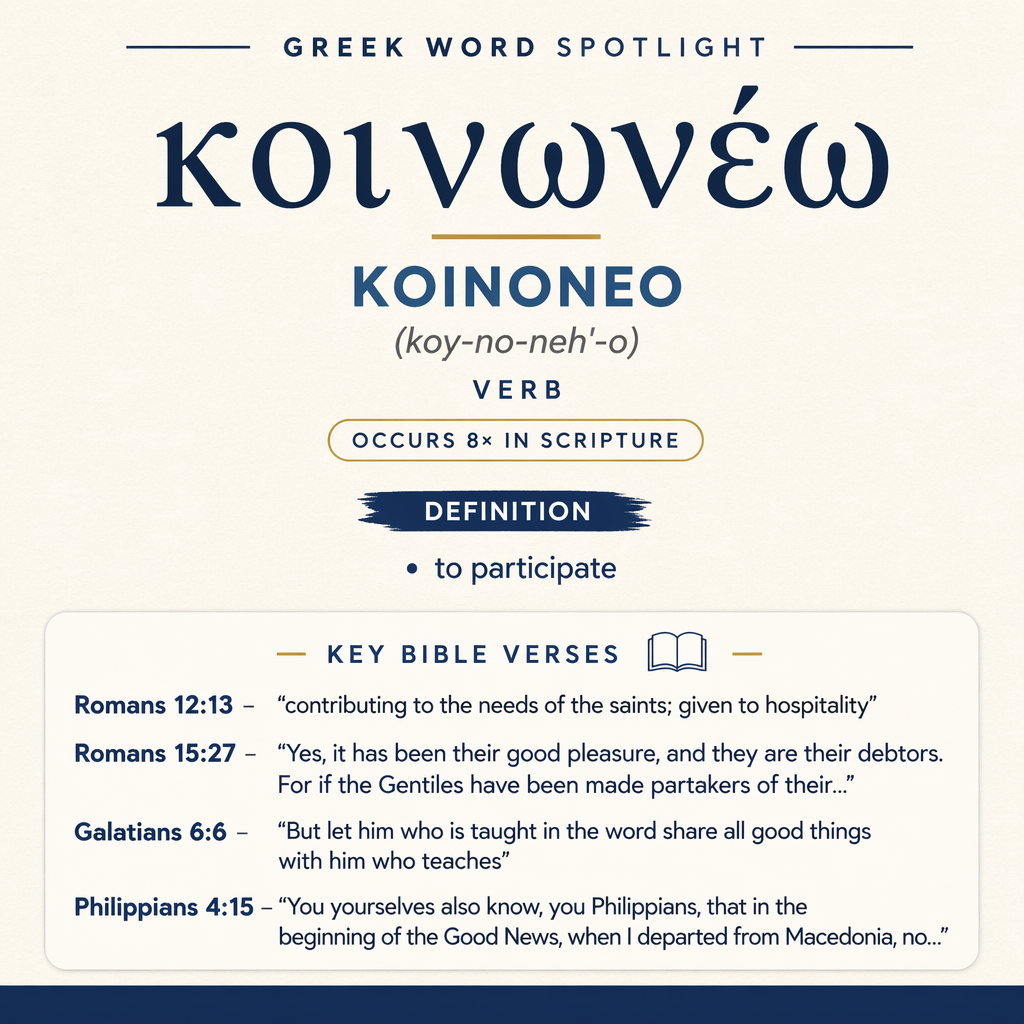
κοινωνέω means “to participate” and occurs 8 times in Scripture, including Romans, Galatians, Philippians, 1 Timothy, Hebrews, 1 Peter, and 2 John.
Core Meaning
κοινωνέω means “to participate.” It is used for sharing or partaking in something, for good or for evil.
Learn More →Sharing & Support
It appears in practical sharing: contributing to saints’ needs (Romans 12:13) and sharing good things with a teacher (Galatians 6:6). It also appears in support for gospel work (Philippians 4:15).
Learn More →Participation’s Weight
κοινωνέω can warn against joining in sin (1 Timothy 5:22; 2 John 1:11). It also describes sharing in flesh and blood (Hebrews 2:14) and in Christ’s sufferings (1 Peter 4:13).
Learn More →κοινωνέω expresses the act of participating. In the New Testament it appears in contexts that range from meeting practical needs, to sharing in instruction and giving, to being involved in realities as weighty as suffering, sin, and the common condition of “flesh and blood.”
Occurrences
Romans 12:13: “contributing to the needs of the saints; given to hospitality.”
Here κοινωνέω is tied to concrete action toward “the needs of the saints.” Participation is framed as active involvement in meeting needs, and it sits naturally beside “hospitality,” suggesting a hands-on, outward-facing posture. The word’s force is communal: participation is not private sentiment but engagement that addresses real lack within the community.
Romans 15:27: “Yes, it has been their good pleasure, and they are their debtors. For if the Gentiles have been made partakers of their spiritual things, they owe it to them also to serve them in fleshly things.”
In this sentence, participation establishes an obligation. The Gentiles’ participation in “spiritual things” creates a moral logic in which service in “fleshly things” is fitting and owed. κοινωνέω thus functions as a bridge between two spheres named in the verse: what is received in one domain grounds giving in another. Participation is relational; it binds parties together so that benefits shared are answered by service rendered.
Galatians 6:6: “But let him who is taught in the word share all good things with him who teaches.”
Participation here is structured within the teaching relationship. The one “taught in the word” is called to share “all good things” with “him who teaches,” placing κοινωνέω in the realm of ongoing support and mutual investment. The verse frames sharing as a proper outflow of being instructed: participation is the learner’s tangible involvement in sustaining the teacher’s well-being.
Philippians 4:15: “You yourselves also know, you Philippians, that in the beginning of the Good News, when I departed from Macedonia, no assembly shared with me in the matter of giving and receiving but you only.”
Here κοινωνέω is explicitly connected to “the matter of giving and receiving.” Participation is not vague goodwill; it is partnership expressed through exchange. The exclusivity—“but you only”—highlights that such participation can be distinctive and recognizable among communities (“no assembly shared with me”). In the scene, the word marks the Philippians as uniquely involved with Paul’s material situation in connection with the spread of “the Good News.”
1 Timothy 5:22: “Lay hands hastily on no one. Don’t be a participant in other people’s sins. Keep yourself pure.”
In this pastoral warning, κοινωνέω is used negatively: participation can occur in “other people’s sins.” The instruction assumes that involvement is possible without being the primary actor, and it treats such participation as contaminating—hence the follow-up command, “Keep yourself pure.” The surrounding caution about laying on hands suggests that certain actions can entangle a person in what another does; the verb names that entanglement as participation.
Hebrews 2:14: “Since then the children have shared in flesh and blood, he also himself in the same way partook of the same, that through death he might bring to nothing him who had the power of death, that is, the devil,”
Here κοινωνέω describes a shared human condition: “the children have shared in flesh and blood.” Participation is presented as a common possession and experience—something held in common by “the children.” The verse then places alongside it another verb (“partook”) to describe how “he also himself in the same way” entered that same condition. Within the sentence, κοινωνέω anchors the reality that “flesh and blood” is a sphere already shared, setting up the logic of entering into it “through death” for a specific purpose stated in the verse.
1 Peter 4:13: “But because you are partakers of Christ’s sufferings, rejoice, that at the revelation of his glory you also may rejoice with exceeding joy.”
In this exhortation, participation is in “Christ’s sufferings.” The word gives shape to the readers’ present experience: they are not merely observers of suffering but participants in it. That participation then becomes the ground for a command—“rejoice”—and it connects present hardship to a future moment, “the revelation of his glory.” κοινωνέω thus functions as a link between current participation in sufferings and a later participation in joy, both described as realities in which believers are involved.
2 John 1:11: “for he who welcomes him participates in his evil deeds.”
Here participation is again negative, and it arises through an apparently supportive action: “welcomes him.” The verse asserts that welcoming is not neutral; it can make one a participant in “evil deeds.” κοινωνέω therefore marks the moral weight of association and support. Participation is portrayed as transferable through relationship and endorsement, not only through direct commission of the deeds named.

Sense and Usage
Across these passages, κοινωνέω consistently marks involvement that makes one genuinely connected to what is shared. In some contexts that involvement is openly material: “contributing to the needs of the saints” (Romans 12:13) and sharing in “giving and receiving” (Philippians 4:15). The verb suits situations where resources circulate within relationships, and it highlights that such circulation is participation, not mere charity at a distance. Romans 15:27 presses this further by casting participation as a basis for obligation: having participated in “spiritual things,” the Gentiles “owe it… to serve… in fleshly things.” Participation creates a debt-like bond, a fittingness that calls for response.
In Galatians 6:6 the same idea is applied to the teacher-student relationship within the life of the word: the one taught is to “share all good things with him who teaches.” Participation here is directed and concrete, aimed at the teacher’s good, and it portrays the learner as an active partner rather than a passive recipient. Philippians 4:15 similarly underlines partnership by placing participation in an economic frame (“giving and receiving”), yet the context named is “the beginning of the Good News,” implying that their material involvement is intertwined with the broader work being referenced in the verse. In these uses, κοινωνέω points to shared responsibility expressed through practical support.
The verb also reaches beyond material exchange to participation in conditions and experiences. Hebrews 2:14 places κοινωνέω at the level of shared human existence: “flesh and blood.” Participation is what characterizes “the children” collectively; it is a common lot. This use shows that the verb can describe a shared state, not only shared resources. 1 Peter 4:13 then uses participation to describe a shared experience—“Christ’s sufferings”—and attaches to it an emotional and eschatological trajectory within the verse: present participation in sufferings is paired with rejoicing now and “rejoice with exceeding joy” at “the revelation of his glory.” The word thus serves to locate believers’ sufferings within a larger participatory pattern: what they undergo is framed as involvement in something that belongs to Christ, with a promised correspondence in joy.
Alongside these positive and strengthening uses, κοινωνέω is sharply warning in 1 Timothy 5:22 and 2 John 1:11. In both, participation describes complicity: “Don’t be a participant in other people’s sins,” and “he who welcomes him participates in his evil deeds.” These lines show that participation is not automatically commendable; it can be morally dangerous. They also show that participation can be indirect: one can participate in the sins or evil deeds of others by actions that connect one to them—whether by unwise involvement in a process that implicates one’s purity (1 Timothy 5:22) or by extending welcome that aligns one with wrongdoing (2 John 1:11). In these warnings, κοινωνέω emphasizes that involvement has consequences; association can become participation.
Taken together, the occurrences present a coherent picture: κοινωνέω marks a real sharing that binds persons to needs, resources, instruction, embodied existence, suffering, and even culpability. The verb’s flexibility across these scenes does not dilute its sense; rather, it shows that participation can be practical, relational, experiential, and ethical, depending on what the text places as the object of sharing.
Imagery in Context
The passages give κοινωνέω a set of vivid relational pictures. It can look like open hands meeting “the needs of the saints” (Romans 12:13), communities entering a pattern of “giving and receiving” (Philippians 4:15), or a reciprocal service that answers participation in “spiritual things” with service in “fleshly things” (Romans 15:27). It can also name deeper solidarity: the shared reality of “flesh and blood” (Hebrews 2:14) and the shared path of “Christ’s sufferings” that leads toward joy at “the revelation of his glory” (1 Peter 4:13). Finally, it can function as a boundary marker, warning that certain connections—such as welcoming a wrongdoer—are not mere contact but participation in “evil deeds” (2 John 1:11).
Sources: Lexical data from Strong’s Exhaustive Concordance and the Translators Brief Lexicon of Extended Strongs for Greek (STEPBible, CC BY). Occurrence data from the Translators Amalgamated Greek New Testament (STEPBible, CC BY). Scripture quotations from the World English Bible (public domain).





