
Exploring the Meaning of Koinonia in Greek
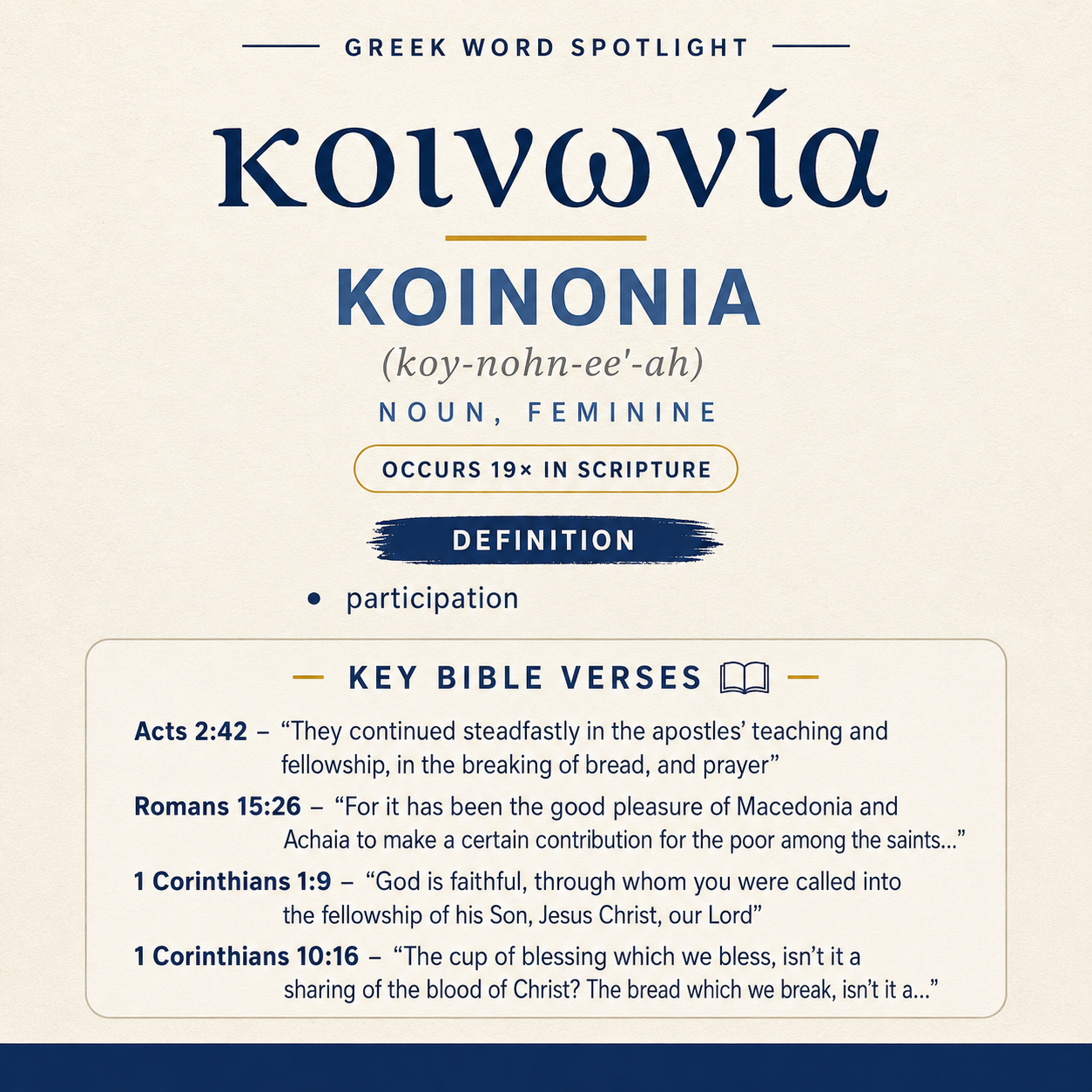
κοινωνία means “participation” and occurs 19 times in Scripture, including Acts 2:42 and 1 Corinthians 1:9.
Core Meaning
κοινωνία is defined as “participation.” It is a Greek word used in Scripture.
Learn More →Key Occurrences
It appears in Acts 2:42 as “fellowship” alongside teaching, breaking of bread, and prayer. It also appears in 1 Corinthians 10:16 as “sharing” in the blood and body of Christ.
Learn More →Contextual Range
Romans 15:26 uses it for a “contribution” for the poor among the saints. 2 Corinthians 6:14 uses it in a question about “fellowship” between righteousness and iniquity.
Learn More →κοινωνία centers on the idea of participation, describing shared involvement that binds people to teaching, worship, service, and allegiance. Across its New Testament uses, it can describe participation within the gathered church, participation in Christ, and participation expressed through practical generosity.
Occurrences
Acts 2:42 — “They continued steadfastly in the apostles’ teaching and fellowship, in the breaking of bread, and prayer.”
Here κοινωνία stands alongside “the apostles’ teaching,” “the breaking of bread,” and “prayer” as a defining practice of the earliest community. Participation is presented as something sustained (“continued steadfastly”), not occasional: the believers persist in shared involvement that marks their common life.
Romans 15:26 — “For it has been the good pleasure of Macedonia and Achaia to make a certain contribution for the poor among the saints who are at Jerusalem.”
In this setting, participation takes the form of a “contribution” directed to “the poor among the saints.” The action is framed as voluntary (“good pleasure”) and inter-church: believers in one region participate in the needs of believers in another through material assistance.
1 Corinthians 1:9 — “God is faithful, through whom you were called into the fellowship of his Son, Jesus Christ, our Lord.”
Participation is grounded in divine calling: it is something believers are “called into.” The sphere of participation is explicitly personal and Christ-centered—“the fellowship of his Son”—so the shared involvement is not merely social but defined by relation to Jesus Christ.
1 Corinthians 10:16 — “The cup of blessing which we bless, isn’t it a sharing of the blood of Christ? The bread which we break, isn’t it a sharing of the body of Christ?”
κοινωνία is expressed as “sharing” connected with the cup and bread. The rhetorical questions link participation to concrete acts—blessing a cup and breaking bread—while locating that participation in relation to “the blood of Christ” and “the body of Christ.” In this scene, participation is enacted in a communal rite and interpreted in explicitly Christ-referential terms.
2 Corinthians 6:14 — “Don’t be unequally yoked with unbelievers, for what fellowship do righteousness and iniquity have? Or what fellowship does light have with darkness?”
Participation is used to test compatibility: Paul poses two contrasts (“righteousness and iniquity,” “light and darkness”) and asks what participation they can have with each other. The force of κοινωνία here is evaluative—certain pairings are portrayed as lacking any shared involvement, supporting the warning against being “unequally yoked.”
2 Corinthians 8:4 — “begging us with much entreaty to receive this grace and the fellowship in the service to the saints.”
Participation is tied to “service to the saints,” and remarkably the givers “beg” to be included in it. κοινωνία is not only the act of helping but also the shared involvement in that act; it is counted as a privilege (“this grace”) that they urge Paul to accept on their behalf.
2 Corinthians 9:13 — “seeing that through the proof given by this service, they glorify God for the obedience of your confession to the Good News of Christ and for the generosity of your contribution to them and to all,”
The word appears in the language of “generosity” and “contribution,” again embedding participation in tangible giving. The contribution is interpreted as evidence (“proof given by this service”) that prompts Godward response (“they glorify God”) and is linked to confession and obedience to the Good News, showing participation can function as a visible expression of shared commitment.
2 Corinthians 13:13 — “All the saints greet you.”
In this concluding greeting, κοινωνία operates within the network of relationships implied by “all the saints.” Even with few details, the greeting performs participation: communities are not isolated, and communication itself becomes a small act of shared involvement between believers.
Galatians 2:9 — “and when they perceived the grace that was given to me, James and Cephas and John, those who were reputed to be pillars, gave to Barnabas and me the right hand of fellowship, that we should go to the Gentiles, and they to the circumcision.”
Participation is formalized through “the right hand of fellowship,” a gesture that recognizes shared involvement and coordinates mission. The context emphasizes mutual recognition (“perceived the grace”) and a settled division of labor (“we should go… and they…”), so κοινωνία here marks partnership that both unites and organizes work.
Philippians 1:5 — “for your partnership in furtherance of the Good News from the first day until now;”
Participation is presented as sustained partnership “from the first day until now,” and it has direction: “in furtherance of the Good News.” The emphasis falls on ongoing, purpose-shaped shared involvement, not a momentary association.
Philippians 2:1 — “If therefore there is any exhortation in Christ, if any consolation of love, if any fellowship of the Spirit, if any tender mercies and compassion,”
Participation is located “of the Spirit” and placed among motives that can shape communal life: “exhortation in Christ,” “consolation of love,” and “tender mercies and compassion.” κοινωνία in this conditional chain functions as a relational reality presumed to exert ethical and emotional force within the community.
Philippians 3:10 — “that I may know him, and the power of his resurrection, and the fellowship of his sufferings, becoming conformed to his death,”
Participation is intensely personal and costly: it is “the fellowship of his sufferings.” The sequence ties knowing Christ to participation both in resurrection power and in sufferings, and it culminates in “becoming conformed to his death,” presenting participation as a deep sharing in Christ’s experience rather than mere association.

Sense and Usage
Across these passages, κοινωνία consistently marks participation as a binding reality that creates shared life and shared purpose. In Acts 2:42 it is paired with teaching, table practice, and prayer, situating participation among the core rhythms that constitute a community’s identity. In the Corinthian correspondence, the term moves between worship and ethics: the cup and bread (1 Corinthians 10:16) portray participation as something enacted in a communal rite and interpreted as sharing in relation to Christ, while 2 Corinthians 6:14 uses the same concept to deny the possibility of meaningful shared involvement between opposites such as “righteousness and iniquity” and “light and darkness.” Participation can therefore be affirmed and cultivated in the right sphere, yet rejected as incoherent in incompatible pairings.
The collection material (Romans 15:26; 2 Corinthians 8:4; 2 Corinthians 9:13) shows another recurring shape: participation expressed through generosity. Participation is not reduced to sentiment; it can take the form of “contribution,” “service,” and concrete help for “the poor among the saints.” In these texts, giving is both practical and communal: it binds distant believers together and becomes a recognizable “proof” that evokes gratitude and praise. At the same time, the surprising posture of those who are “begging… to receive… the fellowship in the service to the saints” (2 Corinthians 8:4) highlights participation as something people desire to enter into, as a share in an honorable work.
Several occurrences place participation in explicitly Christ-centered or Spirit-related frames. Believers are “called into the fellowship of his Son” (1 Corinthians 1:9), making participation part of vocation, not merely voluntary club membership. Philippians 2:1 speaks of “fellowship of the Spirit,” naming participation as a reality rooted in the Spirit’s shared work among believers. Philippians 3:10 intensifies this by portraying participation as extending into suffering, where shared involvement is not only with other believers but also with Christ’s own path, “becoming conformed to his death.” Together these texts show κοινωνία as participation that can be communal, missional, sacramental, ethical, and experiential—yet always oriented toward a shared sphere that defines who belongs together and how that belonging is lived.
Implied Imagery
The most tangible images attached to κοινωνία in these passages are communal practices and gestures: believers continuing in shared life (Acts 2:42), a cup blessed and bread broken in a shared act (1 Corinthians 10:16), hands joined in recognition of partnership (Galatians 2:9), and material gifts carried to the needy (Romans 15:26). Even where the word is used rhetorically (2 Corinthians 6:14), participation is pictured through contrasts that evoke a world in which certain things simply do not mix—light with darkness, righteousness with iniquity—so the term carries both the warmth of shared life and the sharpness of boundary.
Sources: Lexical data from Strong’s Exhaustive Concordance and the Translators Brief Lexicon of Extended Strongs for Greek (STEPBible, CC BY). Occurrence data from the Translators Amalgamated Greek New Testament (STEPBible, CC BY). Scripture quotations from the World English Bible (public domain).




