Exploring the Meaning of Entugchano in Greek
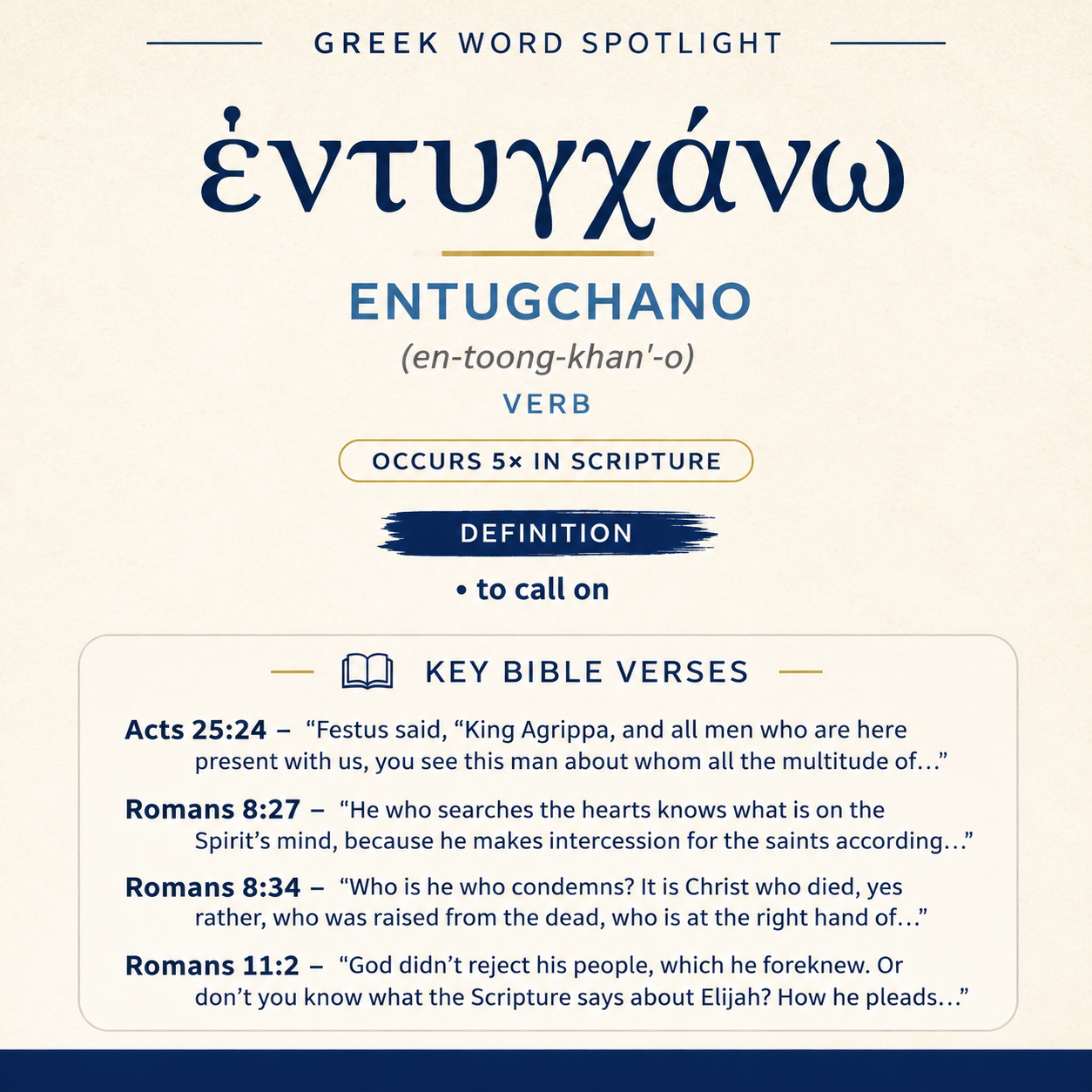
ἐντυγχάνω means “to call on” and occurs five times in Scripture: Acts 25:24; Romans 8:27, 8:34; Romans 11:2; Hebrews 7:25.
Scripture Occurrences
This word appears 5 times in Scripture. It occurs in Acts 25:24; Romans 8:27, 8:34; Romans 11:2; and Hebrews 7:25.
Learn More →Context Highlights
In Romans 8:27 and Romans 8:34, it is used in contexts of intercession. It also appears in Romans 11:2 and Hebrews 7:25.
Learn More →ἐντυγχάνω expresses the act of calling on someone, whether in formal petition before rulers or in prayerful appeal to God. It appears in narratives of legal petitioning and in passages that speak of intercession on behalf of others.
Root and Related Words
Entugchano (ἐντυγχάνω) is related to en (ἐν), “in/on/among” (Strong’s G1722), and tynchano (τυγχάνω), “to obtain/happen” (Strong’s G5177).

Occurrences
Festus said, “King Agrippa, and all men who are here present with us, you see this man about whom all the multitude of the Jews petitioned me, both at Jerusalem and here, crying that he ought not to live any longer.” (Acts 25:24)
Here the calling on is public and political. Festus frames the case in terms of repeated appeals directed to him: “all the multitude of the Jews petitioned me,” and the content of their cry is severe—“that he ought not to live any longer.” In this courtroom-like setting, ἐντυγχάνω belongs to the pressure of a crowd’s request upon an authority, showing the word’s suitability for direct address aimed at eliciting an official decision.
He who searches the hearts knows what is on the Spirit’s mind, because he makes intercession for the saints according to God. (Romans 8:27)
In Romans the calling on is carried into the inner life of prayer. The verse sets the action under divine scrutiny—“He who searches the hearts”—and ties it to alignment with God—“according to God.” The Spirit’s intercession is presented as purposeful and intelligible to the One who knows “what is on the Spirit’s mind,” so ἐντυγχάνω functions as a term for appeal that is both personal (for “the saints”) and ordered (not random, but “according to God”).
Who is he who condemns? It is Christ who died, yes rather, who was raised from the dead, who is at the right hand of God, who also makes intercession for us. (Romans 8:34)
This instance places the calling on within a chain of affirmations about Christ: death, resurrection, exaltation, and then continued intercession. The rhetorical question “Who is he who condemns?” is answered not by naming an accuser but by pointing to Christ’s status “at the right hand of God,” from which he “also makes intercession for us.” The word thus contributes to the picture of an advocate-like appeal on behalf of others, connected to Christ’s present position and activity.
God didn’t reject his people, which he foreknew. Or don’t you know what the Scripture says about Elijah? How he pleads with God against Israel: (Romans 11:2)
Here ἐντυγχάνω appears as “pleads,” and the direction of the appeal is explicitly “with God.” The verse introduces a Scriptural scene involving Elijah, and it adds a significant relational angle: the plea is “against Israel.” In other words, calling on God can be used not only to seek mercy or help for someone, but also to press a case that stands in opposition to others. The verb fits a solemn appeal in which the speaker addresses God directly with a definite posture toward the people in view.
Therefore he is also able to save to the uttermost those who draw near to God through him, seeing that he lives forever to make intercession for them. (Hebrews 7:25)
In Hebrews the calling on is bound to ongoing life and continuing effect. The verse makes a tight connection between Christ’s ability—“able to save to the uttermost”—and his perpetual activity—“he lives forever to make intercession for them.” The beneficiaries are defined as “those who draw near to God through him,” and the intercession is portrayed as a living, enduring work on their behalf. ἐντυγχάνω here highlights sustained appeal, not momentary petition.
Sense and Usage
Across these passages, ἐντυγχάνω (“to call on”) repeatedly involves an approach to an authority with a request or plea, but the setting determines the shape of that approach. In Acts 25:24, the authority is a Roman official, and the calling on takes the form of mass petitioning and insistence—an external, audible appeal (“crying”) aimed at a legal outcome. The verb fits the social dynamics of pressure and prosecution: many voices converging on one decision-maker.
In Romans 8:27 and 8:34, the authority addressed is God, and the calling on is described as intercession “for” others. The word’s function is relational and representative: one party addresses God on behalf of another (“for the saints,” “for us”). These verses also bind intercession to knowledge and position. In 8:27 it is framed by divine heart-searching and the Spirit’s mind; in 8:34 it is framed by Christ’s death, resurrection, and present place “at the right hand of God.” Without changing the basic idea of calling on, the passages show that the act can be portrayed as ordered, purposeful address that stands within God’s own knowing and within Christ’s continuing role.
Romans 11:2 adds a sharper edge by showing that calling on God may take an adversarial direction: Elijah “pleads with God against Israel.” The verb is thus capable of carrying not only supportive appeal but also accusatory or oppositional pleading, depending on what the plea seeks. The common element is direct address that aims at action or judgment, whether the speaker is a crowd before a governor or a prophet before God.
Hebrews 7:25 emphasizes duration and efficacy. The intercession is linked to continual life (“he lives forever”), and that ongoing calling on is linked with a comprehensive saving result (“save to the uttermost”) for a defined group (“those who draw near to God through him”). Here ἐντυγχάνω contributes to the logic of permanence: because the intercessor continues, the help implied is not sporadic but enduring.
Imagery
The passages give ἐντυγχάνω a consistent posture of approach: someone comes before a greater authority to press a matter. Acts evokes the public sound of petitioning—people “crying” their demand—while Romans and Hebrews place the same kind of directed address in the sphere of prayer, where the appeal is described as intercession and is tied to God’s knowledge and to Christ’s continuing life and place “at the right hand of God.” Romans 11:2 shows that such calling on can even be framed as a plea “against” others, underscoring how weighty and case-like the word’s action can be when the one addressed is God.
Sources: Lexical data from Strong’s Exhaustive Concordance and the Translators Brief Lexicon of Extended Strongs for Greek (STEPBible, CC BY). Occurrence data from the Translators Amalgamated Greek New Testament (STEPBible, CC BY). Scripture quotations from the World English Bible (public domain).